
No AI at the Eisners? Comics’ Trust Crisis Just Went Nuclear
·Al Mega
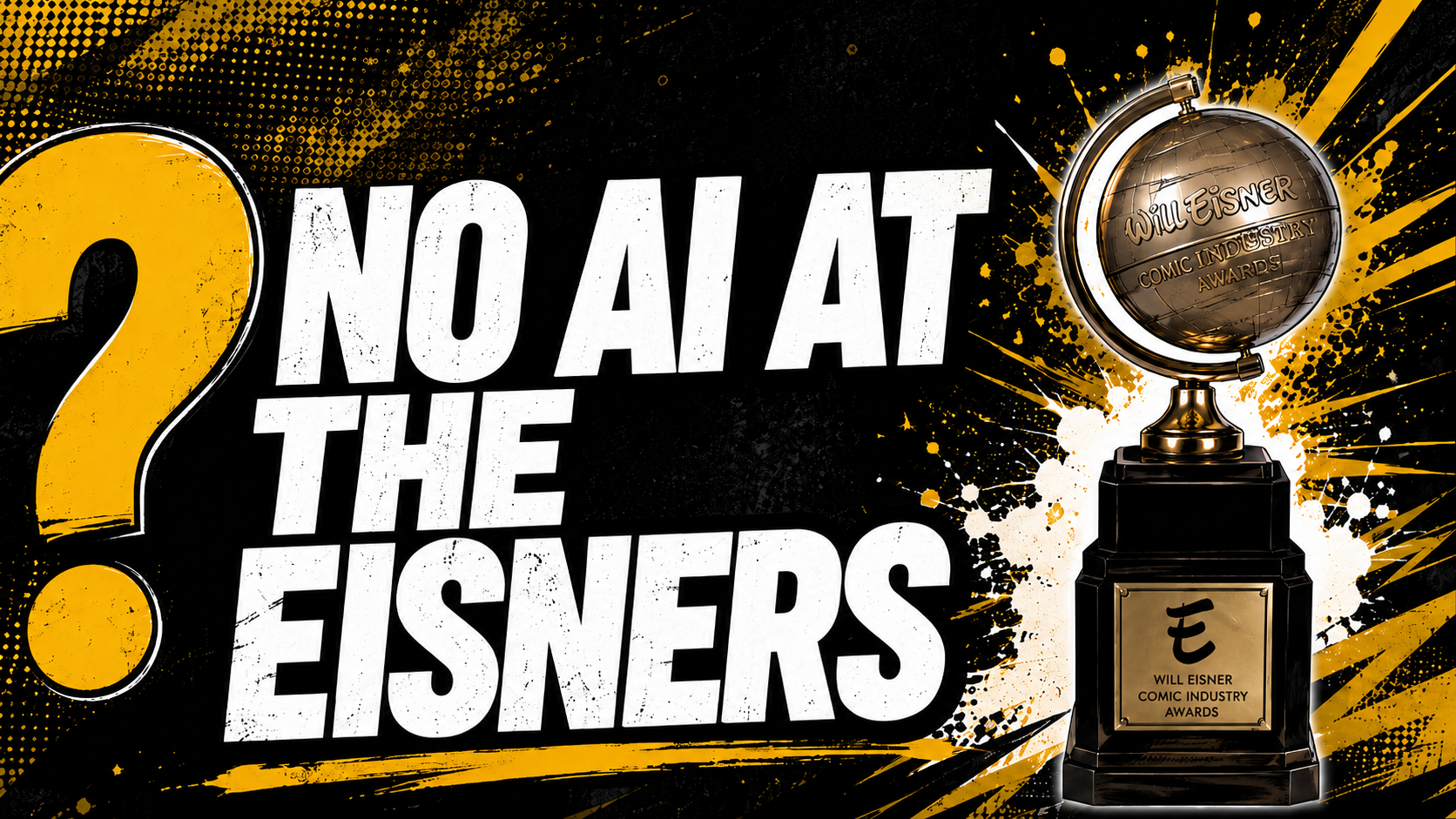
Comics Is Not Afraid of the Future It Is Afraid of Being Lied To
There are moments in comics when the noise becomes more than noise. It becomes a signal. It becomes the sound of an industry realizing that something it thought it could manage quietly has walked straight into the middle of the room, kicked over the table, and asked everybody to pick a side.
That is where we are with artificial intelligence. Not tomorrow. Not someday. Not in some hypothetical future where robots are drawing splash pages in a neon basement while publishers clap from a boardroom. We are there now. AI-generated comics are already being discussed, tested, shared, criticized, defended, and rejected across the comics community. One recent discussion described AI comic tools as the next stage after AI art, with users already noticing the awkward lettering and strange results that often come from these systems.
But the issue is not simply that AI exists. Comics has survived every kind of technological shift you can imagine. Digital coloring did not kill comics. Digital lettering did not kill comics. Webcomics did not kill comics. Crowdfunding did not kill comics. Tablets, social media, print-on-demand, and online shops all changed the game, but the soul of the medium kept beating because there was still a human being behind the work, making choices, taking risks, bleeding personality onto the page.
The real question now is not whether technology belongs in comics. That is too easy, too basic, too “old man yelling at cloud,” and we are not doing that here. The real question is this: when AI touches a comic, who gets told? Who gets credited? Who gets paid? Who gets erased? And who gets to decide whether the work belongs beside human-made art at the industry’s most respected tables? That is why the conversation around AI and comics feels so emotional. It is not just about tools. It is about trust.
Comics is a human industry held together by passion, deadlines, fragile budgets, convention tables, late-night emails, tiny print runs, ambitious Kickstarters, and creators who often work harder than the money suggests they should. Fans do not just buy comics because they like characters. They buy comics because they believe someone made something. Someone cared. Someone suffered over the panel. Someone fought for the line. Someone shaped the story. Someone made a choice.
That human connection is the whole deal. So when AI-generated or AI-assisted work enters the room without clear disclosure, it does not feel like innovation. It feels like somebody trying to sneak a fake ID into the creator party. And let’s keep it a buck: the comics community is already tense. Writers are worried. Artists are worried. Colorists are worried. Letterers are worried. Indie publishers are worried. Fans are worried. Some people see AI as a tool that could help small creators move faster. Others see it as a machine built on scraped work, recycled style, and the quiet devaluation of human craft. That divide is getting wider, louder, and nastier.
The Authors Guild has advised that AI use should be disclosed in places such as the front matter of a book or at the bottom of an article, because transparency is becoming a basic standard in creative work. That should not be controversial. If AI was used, say it. If it helped generate finished art, say it. If it helped with writing, layouts, concepts, restoration, backgrounds, or promotional material, say it. Let the audience decide whether they are comfortable with it.
The problem is that too many people want the benefit of AI without the burden of honesty. That is where the betrayal lives. Because comics is not just content. Comics is culture. It is Jack Kirby’s cosmic thunder. It is Will Eisner’s storytelling language. It is manga influence, underground rebellion, superhero mythology, indie confessionals, punk rock zines, horror anthologies, webtoon empires, and crowdfunding miracles. It is kids finding themselves in panels. It is adults surviving hard weeks through stories. It is creators turning trauma, imagination, politics, humor, rage, love, and weirdness into something we can hold in our hands.
You cannot reduce that to “output.” That word alone feels dirty in this conversation. Output is what machines produce. Comics are what people make. And yes, some will argue that AI is just another tool. There is a fair version of that argument. Universities and comics scholars are already exploring the relationship between comics, technology, and AI, asking what this new wave means for the medium rather than pretending it does not exist. That conversation matters. Not every use of AI is equal. Using AI to organize notes is not the same as using it to replace a penciler. Using accessibility software is not the same as generating a cover from a database trained on living artists. Using a tool to assist a disabled creator is not the same as a company cutting labor costs while calling it progress. Nuance matters. But so does power. And the people with the least power in comics are usually the first ones asked to “adapt.”
That is why this moment has teeth. When executives, publishers, platforms, or award systems talk about AI, creators hear the subtext. They hear cheaper. They hear faster. They hear fewer people. They hear “we love artists” right before the budget gets cut. They hear “this will save time” from people who were never spending twelve hours rendering a city street in the first place.And f ans hear it too.
Fans are not stupid. They can feel when something is off. They can tell when a piece of art has that strange glossy dead-eyed AI look. They can tell when hands are wrong, expressions are empty, lettering feels mangled, or the image looks like it was assembled from memories of other people’s work. Online debates about AI’s effect on the comic book industry show just how touchy and widespread the concern has become. The danger for comics is not only that AI might produce bad work. Bad work has always existed. The danger is that undisclosed AI makes readers suspicious of everything. That is poison.
Once audiences begin looking at every cover, every panel, every indie campaign, every award nominee, and every publisher announcement with suspicion, the trust between creator and reader starts to rot. That trust is sacred. It is why someone backs a Kickstarter from a creator they have never met. It is why someone drives to a convention and pays for a signature. It is why someone buys issue one from an unknown team. It is why someone believes in a name printed on a cover. Nobody wants to stand in line to meet a prompt. Nobody wants to shake hands with a dataset. Nobody wants to discover that the art they loved was made through a process nobody bothered to disclose. That is not anti-technology. That is pro-respect.
There is also a hypocrisy that needs to be called out, loudly and without the industry tap-dancing around it. AI is often sold as democratization. The pitch is seductive: now anyone can create. Now anyone can make a comic. Now the gatekeepers cannot stop you. Sounds beautiful, right? Real shiny. Real futuristic. Real “everybody gets a cape.”
But if the machine is trained on the work of artists who did not consent, then the democratization pitch starts looking like a heist with better branding. Critics of AI art have argued that utopian claims about AI often ignore the harm done to working artists whose labor and style become fuel for the system. That is the uncomfortable part.
Comics should absolutely open doors. More voices. More creators. More tools. More access. More weird, beautiful, impossible stories from people who never had traditional industry backing. Comic Crusaders is built on championing that energy. Indie creators, crowdfunding warriors, small press dreamers, the folks grinding from the kitchen table to the convention floor — that is the heartbeat right there. But opening doors cannot mean stealing the wood from somebody else’s house. If AI becomes a way for new creators to bypass exploitation, there is a conversation to have. If AI becomes a way for companies to exploit creators faster, cheaper, and with less accountability, then nah, we have a problem.
A big one!
The solution is not panic. Panic makes people sloppy. The solution is standards. Awards need standards. Publishers need standards. Conventions need standards. Crowdfunding platforms need standards. Review sites need standards. Fans deserve standards. Creators deserve standards. And those standards need to be plain enough that nobody needs a law degree, a tech background, or a secret decoder ring from the back of an old comic to understand them.
If AI was used in finished art, disclose it. If AI was used in writing, disclose it. If AI was used in lettering, coloring, backgrounds, design, covers, restoration, or promotional art, disclose it. If a publisher has an AI policy, publish it. If an award body accepts AI-assisted work, define the limits. If an award body rejects AI-generated work, say that clearly. If a creator uses AI ethically, explain how. If a company uses AI to replace paid creators, do not hide behind pretty language. Say the quiet part out loud. That is how trust gets rebuilt. Not through silence. Not through vague press statements. Not through “we take concerns seriously” corporate fog. Real trust comes from clarity, and comics needs clarity right now like Spider-Man needs rent money.
This is the crossroads. One path leads to transparency, where AI use is disclosed, creators are respected, fans are trusted with the truth, and the industry figures out where these tools belong without torching the people who built the house. The other path leads to suspicion, resentment, hidden shortcuts, angry fans, exhausted creators, and a marketplace where every piece of art is treated like a possible crime scene. Comics deserves better than that. The readers deserve better. The creators damn sure deserve better.
And here is the thing: the industry can handle the conversation. Comics fans argue about continuity timelines, costume changes, casting rumors, canon, retcons, pull lists, movie universes, and whether Batman needs more therapy than Gotham needs cops. We can handle a hard conversation about AI. What we cannot handle is being played. That is the line. Do not play the fans. Do not play the creators. Do not play the medium. Because comics is not afraid of the future. Comics helped invent the future. This medium taught generations how to imagine beyond the limits of the real world. Flying cities, cosmic gods, mutant nations, talking animals, haunted towns, dystopian futures, impossible science, multiverse madness — comics has been future-facing since before half these tech bros discovered the word “innovation.”
The issue is not fear. The issue is respect. Respect the craft. Respect the labor. Respect the audience. Respect the history. Respect the page. And if AI is part of the future, then make it honest. Make it visible. Make it accountable. Do not sneak it in the side door and act surprised when the building starts yelling. Because the comic book industry is watching now. The fans are watching. The creators are watching. And Comic Crusaders is watching too.
The future of comics should be bold, wild, messy, inclusive, innovative, and alive. But if that future is going to mean anything, it cannot be built on hidden shortcuts and erased hands.
Comics was built by humans.
Let’s make sure it stays worthy of them.
The Crusade Never Ends.
Image Disclosure: This visual may include AI-generated or AI-assisted elements created for editorial, promotional, or illustrative use.
Leave a Reply
You must be logged in to post a comment.