

Galactic #2 Review: DSTLRY’s Ultraviolent Sci-Fi Romance Escalates
·Al Mega
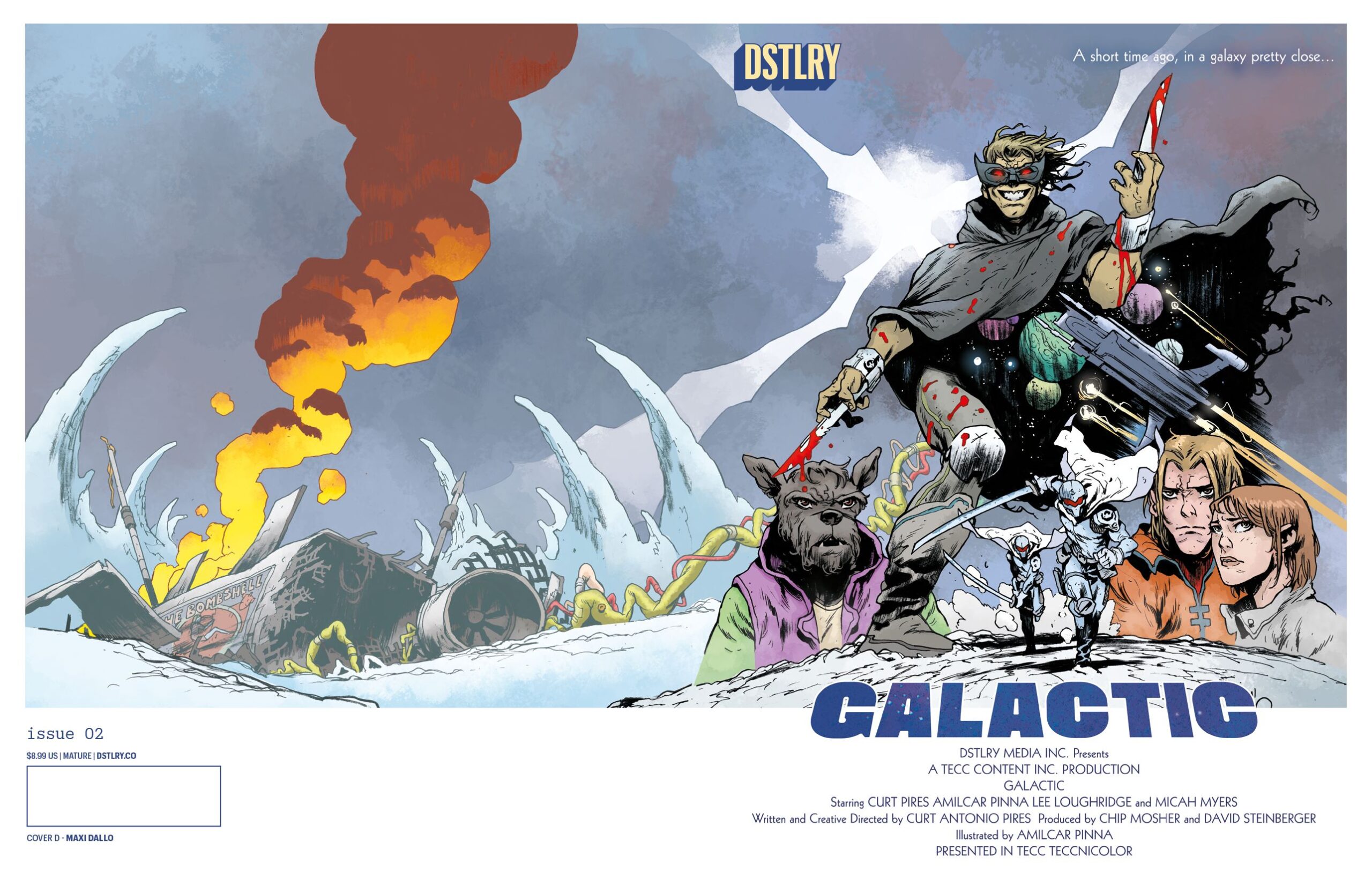
WEPAAAA! Galactic #2 comes flying out the hyperspace tunnel like it stole somebody’s ship, kissed somebody’s princess, forgot to pay the tab, and somehow still had time to make the getaway look stylish. Curt Pires and Amilcar Pinna are not playing cute with this second chapter. Issue #1 kicked the door open with attitude, danger, lust, and cosmic swagger, but issue #2 walks in wearing the jacket, holding the blaster, and saying, “Yeah, we’re going bigger.” And guess what? It does.
This is the kind of comic that knows exactly what it is: messy, violent, horny, romantic, political, weird, funny, tragic, and absolutely allergic to boredom. Galactic #2 is not just a continuation; it is an escalation. The chase gets nastier. The stakes get personal. The romance gets warmer even while everything around the characters gets colder, bloodier, and more unstable. It’s space opera with bruised knuckles and a racing pulse. True Romance meets The Incal is a wild pitch, but this book earns that comparison with a grin and a smoking blaster.
Curt Pires writes this issue like a man juggling dynamite, roses, and unpaid bounty notices. The dialogue snaps. The characters don’t speak like stiff sci-fi archetypes; they talk like people who have been running too long, lying too often, and falling for the wrong person at the worst possible time. Jecht continues to be that roguish bounty hunter type who clearly has survival instincts, charm, and terrible judgment all fighting for control of the same steering wheel. Seriah, meanwhile, is not just some royal package to be delivered. She has pain, fire, history, and a self-destructive edge that makes her compelling beyond the “princess on the run” setup. There’s a sadness behind her that sneaks up on you between the shootouts, like the emotional bill collector knocking while lasers are flying outside.
And Wolf? Come on now. A talking dog flying a ship should be ridiculous. Instead, Wolf is one of the best ingredients in the whole cosmic gumbo. He gives the book personality. He gives it humor. He gives it heart. He’s the kind of character who can make you laugh in the middle of a disaster and then make you worry when everything goes sideways. That’s not easy. That’s craft. That’s flavor. That’s “somebody protect the space dog” energy, and I am here for it.
The opening sequence wastes zero time reminding readers that this universe is built on deals, betrayals, debt, and bad decisions. What starts with a transaction and some sly banter turns into an ambush, and from there the issue hits the gas. Pires understands momentum. He lets the setup breathe just long enough for the reader to understand the con, then he detonates the room. The action isn’t just there for spectacle either. Every violent burst pushes character, exposes desperation, or reveals how unstable this whole galaxy really is. Nobody feels safe. Nobody feels clean. Everybody has a secret tucked somewhere under the jacket.
Amilcar Pinna’s art is the engine that makes this beast roar. There is a looseness to the linework that gives Galactic #2 a strange, organic energy. This doesn’t look like sterile, polished sci-fi where every wall is shiny and every alien looks like it was approved by a committee. Pinna’s universe feels lived-in, sweaty, cracked, gorgeous, and dangerous. The ships have personality. The rooms have atmosphere. The bodies carry impact. When violence happens, it’s not sanitized. It’s ugly, sudden, and sharp. When the story shifts into quieter moments, Pinna’s faces do heavy lifting. A glance, a wound, a pause by firelight; the emotion is right there, sitting in the panel like a ghost with receipts.
The crashdown sequence is pure comic book cinema. The chase through space has that big-screen, hold-your-breath rhythm, then the book slams our leads into a frozen nightmare and suddenly changes temperature without losing energy. That icy planet stretch is where the issue really starts cooking, ironically enough. The white landscape, the wreckage, the danger in the distance, the characters forced to keep moving while their emotional baggage gets heavier that’s the good stuff. That’s where Galactic #2 proves it isn’t just wild for the sake of being wild. Under all the gunfire and cosmic weirdness, there is an actual beating heart.
Lee Loughridge’s colors are sensational here. The book moves between pale frozen blues, warm firelit oranges, bruised purples, deep space blacks, and neon-touched nightlife tones with beautiful control. The colors don’t just decorate the story; they steer your emotional temperature. The icy survival scenes feel lonely and exposed. The flashbacks and political sequences feel warm but poisoned, like fancy rooms where somebody definitely got betrayed before dessert. The intimate scenes glow with pinks and purples that feel sensual without flattening the characters into simple desire. Loughridge gives the book mood, and that mood is “romance on the edge of catastrophe.” Chef’s kiss with a blaster burn.
Micah Myers’ lettering also deserves real praise because this issue has a lot of tonal traffic. You’ve got chase banter, threats, narration, political exposition, pain, flirtation, and chaos all sharing the same highway. The lettering keeps everything readable and rhythmic without stepping on the artwork. In a book this kinetic, bad lettering could turn the pages into a pileup. Myers keeps the flow smooth, even when the story is throwing elbows.
One of the strongest moves in Galactic #2 is how it expands the political world without turning into homework. We get House Gondek, House Silva, imperial power games, old betrayals, family wounds, and a whole galaxy’s worth of grudges. That could easily become a lore dump in lesser hands, but Pires threads it through character and consequence. The politics matter because they affect these people personally. This isn’t just “planet versus planet.” This is father versus son, house versus house, old loyalty versus new survival. That gives the universe weight.
Then Cyn Venta enters the picture, and let me tell you, the energy changes like somebody switched the playlist from romantic synthwave to murder jazz. Cyn is nasty business. Cold. Sadistic. The kind of bounty hunter who doesn’t just want the job done; they want the job to hurt on the way down. That entrance injects a whole new level of menace into the series. Galactic already had danger, but Cyn brings a more deliberate cruelty. This is the villain who makes the room feel smaller the moment they walk in. No wasted motion. No mercy coupons. Just pure “oh, this person is a problem” energy.
The romance between Jecht and Seriah is handled with heat but also vulnerability. What makes it work is that the book understands attraction under pressure isn’t clean. These are damaged people surrounded by war, debt, history, and death. Their connection feels impulsive, yes, but not empty. It’s two people reaching for warmth while the universe keeps trying to freeze, shoot, or sell them out. That’s why the title’s “interstellar romance” label actually lands. It’s not soft-focus fantasy. It’s survival intimacy. It’s messy. It’s probably a bad idea. Which means, naturally, it’s interesting as hell.
If there’s one thing readers should know going in, it’s that Galactic #2 moves fast and throws names, houses, grudges, and emotional shrapnel at you with no apology. This is not a book you skim while eating cereal and checking your phone. You need to sit with it, let the pages breathe, and maybe keep issue #1 nearby if your memory is as reliable as a bootleg hyperdrive from a Brooklyn flea market. That’s not a knock; it’s just the price of admission for a comic with this much attitude and world-building packed into the tank.
DSTLRY continues to be a perfect home for this kind of book because Galactic #2 benefits from space. The prestige-style presentation lets the action open wide, lets the quiet moments simmer, and lets the art team flex without feeling cramped. This comic wants to feel big, and it does. It has swagger. It has teeth. It has romance. It has a talking dog pilot. What more do you need, a cafecito and a seatbelt?
Galactic #2 is a killer second issue because it doesn’t just repeat what worked in the debut. It deepens the emotional mess, sharpens the danger, expands the mythology, and ends with a cliffhanger that feels like the universe itself just smirked and said, “You ain’t seen nothing yet.” Pires, Pinna, Loughridge, Myers, and the whole DSTLRY crew are building a sci-fi romance with grime under its fingernails and stars in its eyes. It’s violent, stylish, strange, sexy, and alive. Big WEPA recommendation right here. Get on board now before this ship leaves orbit and you’re standing at the spaceport looking goofy with a cold cafecito.
CRUSADERS SCORE:
4.5 / 5

Writer: Curt Pires
Artist: Amilcar Pinna
Colorist: Lee Loughridge
Letterer: Micah Myers
Editor: Chris Stevens
Cover A: Amilcar Pinna
Publisher: DSTLRY


Leave a Reply
You must be logged in to post a comment.