
Wonder Woman: Secret Files & Origins #1 Review – A 1998 Amazon Archive Still Swinging the Lasso
·Al Mega
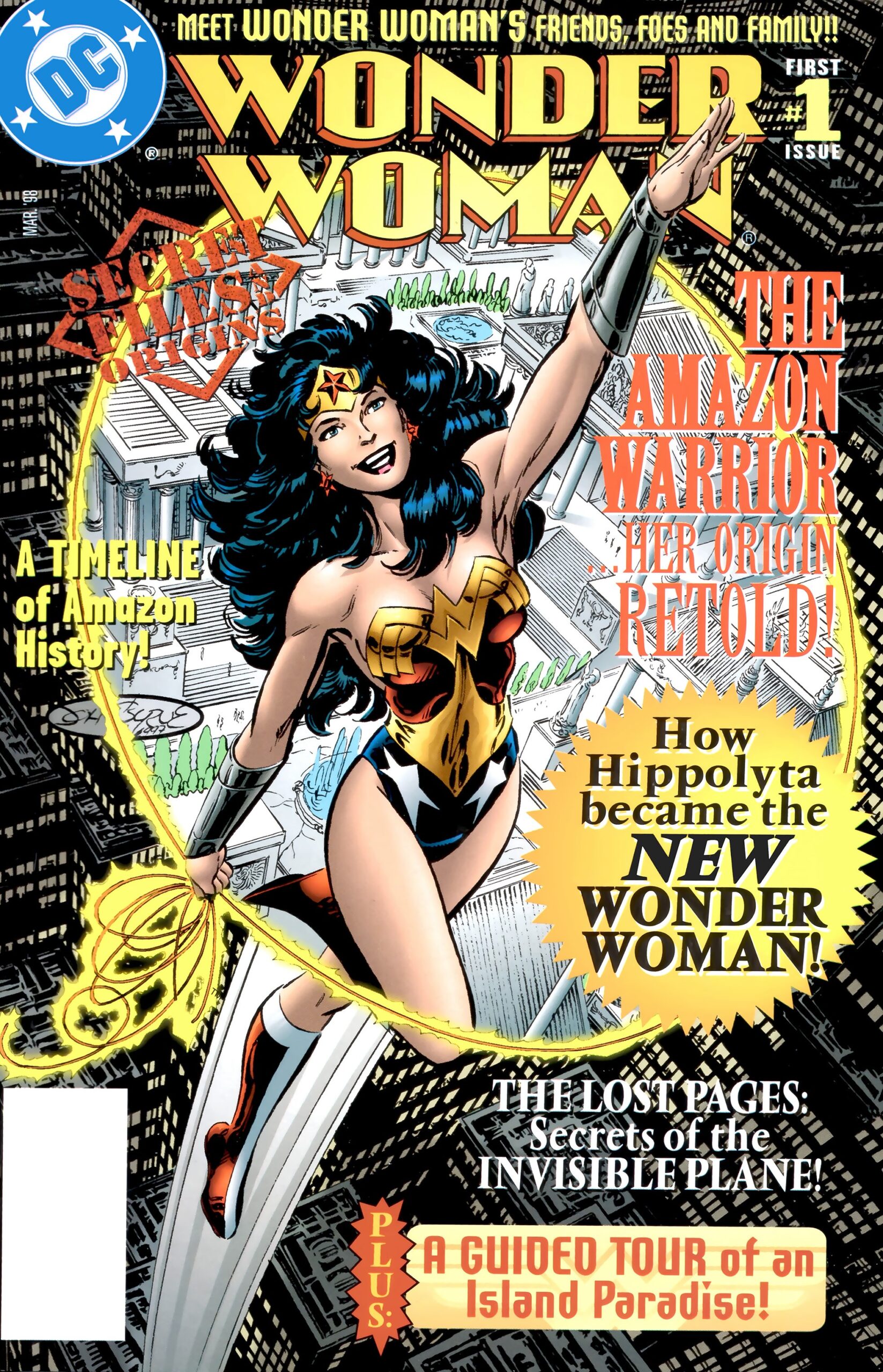
Wonder Woman: Secret Files & Origins #1 is one of those late-’90s DC books that walks into the room carrying a shield, a scroll, a family tree, a museum brochure, and a mythological sword sharp enough to cut through confusion. This is not a regular “sit down, read one clean adventure, move on with your day” comic. Nah, this is a full Amazonian dossier. It is part origin refresher, part character encyclopedia, part Themyscira travel guide, part continuity repair kit, and part love letter to Wonder Woman’s mythos during a very specific era of DC storytelling. In other words, this book came to educate, entertain, and make sure nobody left the island without knowing who Diana is, why Hippolyta matters, why Donna Troy is always tied to cosmic complications, and why Cassandra Sandsmark still had plenty to learn before fully stepping into superhero greatness. WEPA, this thing is packed like a Brooklyn bodega shelf before a snowstorm.
The main story works because it does something smart: it does not simply rehash Diana’s origin like a dusty lecture from Mount Olympus Community College. Instead, it frames the origin through a lesson in vulnerability, using Cassandra Sandsmark’s youthful confidence as the emotional doorway. Cassie is training on Themyscira, showing power, courage, attitude, and that classic teenage “I got this” energy that every mentor immediately recognizes as “Oh no, she absolutely does not got this.” Artemis pushes her, Diana corrects her, and the whole story becomes less about who can punch hardest and more about understanding that strength without awareness is just a disaster wearing bracelets.
That is the heart of this issue. Diana’s origin is not presented as some flawless superhero recipe where clay plus gods equals perfection. The story reminds us that Wonder Woman’s greatness was forged through limitation, mistakes, humility, responsibility, and pain. She was gifted by the gods, yes, but the issue makes a sharp distinction between power and invincibility. Diana can lift, fly, fight, lead, inspire, and stand toe-to-toe with nightmares, but she is not untouchable. That is powerful storytelling because it pulls Wonder Woman away from the lazy idea of “she is just perfect” and puts her back where she belongs: in the arena of choice, consequence, compassion, and discipline.

The training sequence with Cassie is a great narrative device because it mirrors Diana’s own history. Cassie thinks the lessons are unfair, too dangerous, or too intense, but Diana has lived the truth behind them. The flashbacks show a younger Diana learning the brutal difference between courage and recklessness. She learns that force has its place, but wisdom decides whether force becomes salvation or catastrophe. That theme lands beautifully. It gives the story a timeless quality, even if the actual structure screams 1998 in bold letters with a side of shoulder pads.
The art in the main story carries that old-school DC muscle. Dick Giordano’s pencils, strengthened by Sal Buscema’s inks, deliver clear storytelling, expressive faces, and action that feels staged with purpose. There is a classical quality here that fits Wonder Woman well. The figures feel heroic, the island feels mythic, and the action beats have that pre-digital physicality where every panel looks hand-built with intention. Patricia Mulvihill’s colors help keep the mythology warm and readable, especially when the story moves between bright training moments, golden temple spaces, and darker memory sequences. It is not trying to be slick in the modern cinematic sense. It is trying to be readable, bold, and sincere. Mission accomplished.
Now, let’s keep it real like an Amazon holding the Lasso of Truth at a family barbecue. This book is 28 years old, and you feel that in the pacing. Some of the narration is heavy. Some of the exposition walks onto the page, sets up a tent, cooks dinner, and stays the weekend. Modern readers who are used to decompressed storytelling, splashier emotional minimalism, and cleaner issue-by-issue arcs may find parts of this book dense. Secret Files issues were built differently. They were meant to be lore engines. They wanted to serve readers who needed context, collectors who loved profiles, and continuity warriors who enjoyed knowing where every mythic puzzle piece belonged. That makes the issue valuable, but not always smooth. The main story has heart, but it occasionally pauses to make sure the reader has the historical homework before moving forward. Not a dealbreaker, but definitely a “read with coffee” situation.
Where this issue really shines is in the extra material. “Origin Epilogue” gives Hippolyta’s story emotional weight, especially through the lens of motherhood, fear, sacrifice, and guilt. It captures the aching contradiction of a mother who wants to protect her child but also knows that destiny does not politely wait outside the palace gates. Lee Moder and Lary Stucker give that feature a lively, energetic quality that balances superhero action with personal pain. It deepens the issue and reminds readers that Wonder Woman’s story has always been bigger than one costume. It is about legacy, duty, and the cost of stepping into a symbol.

“Guided Tour: Themyscira” is the kind of feature that makes comic book world-building nerds start grinning like they found a longbox full of keys. Jason Hernandez-Rosenblatt, Phil Jimenez, John Stokes, and Patricia Mulvihill give the island architectural presence. Themyscira is not just “pretty paradise island where Amazons do cool poses.” It feels like a civilization, with temples, halls, councils, sacred spaces, justice chambers, and history carved into every column. Phil Jimenez on Themyscira-related material just feels right. His eye for detail and reverence for Wonder Woman lore gives the feature richness. You can feel the marble, the ceremony, the history, the loneliness, and the grandeur.
The artifacts and weapons feature is also a fun slice of mythic inventory. It is basically Amazonian show-and-tell, but with dangerous relics and divine consequences. Pablo Raimondi’s work gives the material a clean reference-book appeal, and for fans who love the tools, symbols, and sacred objects behind Wonder Woman’s world, this is a tasty little section. The John Byrne “Lost Pages” Invisible Plane feature adds a playful archival flavor too. It is quirky, very era-specific, and exactly the kind of thing Secret Files books were designed to include. Not every extra hits with the same dramatic force, but together they create a satisfying mythological grab bag.
The profile pages are probably where the book becomes most useful as an archive. Diana, Hippolyta, Artemis, Donna Troy, Cassie, Ares, Circe, Cheetah, Herakles, the Amazons, the gods — this is a roster roll call with artistic variety. Some profile pages are more visually striking than others, but the overall package gives the issue texture. Joe Kubert on Ares? That alone feels like finding a legendary weapon behind glass. Jill Thompson on Julia and Vanessa Kapatelis brings warmth. Phil Jimenez on Donna and the Amazons feels like a natural fit. Steve Lightle’s Circe has that sorcerous elegance. Dave Cockrum’s Cheetah closes the issue with feral personality. It is a creative buffet, and yes, some plates are hotter than others, but the spread is worth showing up for.

What holds Wonder Woman: Secret Files & Origins #1 back from a higher score is not lack of quality. It is format. This is a file issue, and file issues come with built-in strengths and built-in clunkiness. The book can feel less like one unified emotional journey and more like several excellent encyclopedia entries tied together with Amazonian ribbon. That was the assignment, and it fulfills that assignment well, but readers looking for a sleek, standalone Wonder Woman adventure may feel the stop-and-start rhythm. Still, as a Wonder Woman lore piece, as a 1998 DC artifact, and as a celebration of the character’s mythic architecture, this comic has real value.
At its best, this issue understands something essential: Wonder Woman is not great because she is powerful. She is great because she chooses compassion when vengeance would be easier, strategy when brute force would be louder, and responsibility when ego wants applause. The issue uses Cassie’s lesson to remind us that heroes do not become legends by ignoring vulnerability. They become legends by respecting it, learning from it, and protecting others because they know pain is real. That is Wonder Woman. That is the gold beneath the tiara.
Wonder Woman: Secret Files & Origins #1 may be a little dense, a little old-school, and very much a product of its time, but it is also sincere, informative, lovingly assembled, and rich with Amazonian soul. For longtime fans, it is a rewarding dive into Themyscira’s lore. For newer readers, it is not the smoothest first step, but it is a fascinating map of where Diana, Hippolyta, Donna, Cassie, and the larger mythos stood in that era. DC Comics gave fans a file cabinet full of mythology here, and somehow the thing still has a heartbeat. The lasso still glows. The shield still rings. The Amazon spirit still stands tall.
CRUSADERS SCORE:
4/5
A strong, lore-heavy Amazon archive with heart, history, and heroic purpose, even if its old-school density may slow down newer readers.
Title: Wonder Woman: Secret Files & Origins #1
Publisher: DC Comics
Year: 1998
Main Story: “Secret Origin” / “Vulnerability”
Script: Joanna Sandsmark
Pencils: Dick Giordano
Inks: Sal Buscema
Letters: Albert T. DeGuzman
Colors: Patricia Mulvihill
“Origin Epilogue” / “A Mother’s Mission”
Script: Ruth Morrison
Pencils: Lee Moder
Inks: Lary Stucker
Letters: Albert DeGuzman
Colors: Tom McCraw
“Guided Tour: Themyscira”
Writer: Jason Hernandez-Rosenblatt
Penciller: Phil Jimenez
Inker: John Stokes
Letters: John Costanza
Colors: Patricia Mulvihill
“Special Feature: Artifacts & Weapons”
Writer: Ruth Morrison
Pencils/Inks: Pablo Raimondi
Letterer: Albert DeGuzman
Colorist: Tom McCraw
“Lost Pages: Secret Details About Wonder Woman’s Invisible Plane!”
Writer/Pencils/Inks/Letters: John Byrne
Colors: Patricia Mulvihill
Interview Feature: Julia Kapatelis & Helena Sandsmark
Writer/Pencils/Inks: John Byrne
Timeline: Wonder Woman
Writer: Joanna Sandsmark
Profile Pages Written By: Alex Amado
Profile Page Colors: Tom McCraw
Profile Page Artists: John Byrne, Phil Jimenez, John Stokes, Eric Battle, John Lowe, Keron Grant, Ray Kryssing, Ethan Van Sciver, Ron Wagner, Joe Rubinstein, Lee Moder, Lary Stucker, Jill Thompson, Joe Kubert, Steve Lightle, Randy DuBurke, Dave Cockrum
Cover Art: John Byrne
Cover Colors: Patrick Martin
Editorial / Production Support: K.C. Carlson, Frank Berrios, Mike Carlin, Jenette Kahn, Paul Levitz, Georg Brewer, Patrick Caldon, Dorothy Crouch, Terri Cunningham, Joel Ehrlich, Lillian Aliberti Carson, Bob Rozakis

Leave a Reply
You must be logged in to post a comment.