
HÉCTOR LAVOE’S ¡QUE SENTIMIENTO! RETURNS TO VINYL AFTER 45 YEARS
·Al Mega
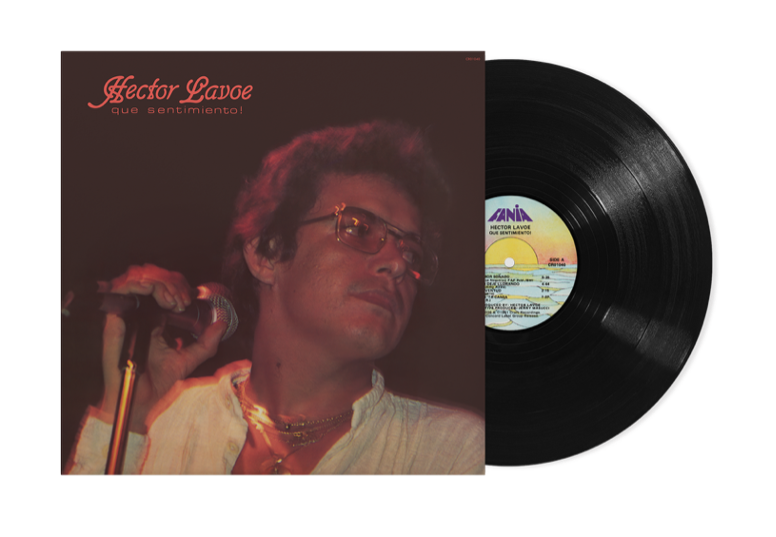
El Cantante’s only self-produced album receives an all-analog anniversary reissue, a limited Rojo Amor pressing, and its first Hi-Res digital release
Some voices never fade, and Héctor Lavoe’s sure as hell is not going anywhere. Craft Latino is celebrating the 45th anniversary of ¡Que Sentimiento!, the legendary Puerto Rican singer’s sixth solo studio album and the only project he produced himself, with a long-awaited vinyl reissue arriving October 2, 2026.
Originally released by Fania Records in 1981, ¡Que Sentimiento! features eight memorable salsa cuts, including “El Son,” “No Hay Quien Te Aguante,” “Soy Vagabundo,” and “Juventud.” The album’s rich musical foundation was shaped by celebrated arrangers and musicians Luís Cruz, Louie Ramírez, and José Febles, who helped Lavoe build a fuller, more ambitious sound without losing the sharp personality and streetwise storytelling that made him El Cantante.
Unavailable on vinyl for decades, the album returns as a 180-gram black vinyl pressing featuring all-analog AAA lacquers cut directly from the original master tapes. The remastered recording will also be released digitally, including in Hi-Res audio for the first time, giving longtime fans and a new generation of listeners another way to experience one of Lavoe’s most personal creative statements.
Collectors looking for something extra sabroso can grab the Rojo Amor color-vinyl edition. The 140-gram pressing is limited to only 300 copies and will be sold exclusively through the Fania and Craft Recordings stores. A separate Rojo Amor vinyl and Fania Logo T-shirt bundle will also be available, but with numbers that low, anybody interested should move rápido before the collectors scoop up every last copy.
Fans can explore Héctor Lavoe’s official Fania page, pre-order the standard 180-gram edition, or secure the exclusive Rojo Amor bundle now.
Born Héctor Juan Pérez Martínez in Ponce, Puerto Rico, in 1946, Lavoe grew into one of the most recognizable and influential voices in salsa history. His effortless phrasing, razor-sharp improvisations, humor, charisma, and emotional honesty allowed him to move between celebration and heartbreak without ever sounding like he was forcing the moment.
Lavoe relocated to New York City at 17 with dreams of establishing himself in music. He began performing with groups led by Roberto García, Kako, and Fania Records co-founder Johnny Pacheco, planting himself right in the middle of a Latin music movement that was about to shake the whole city.
Through Pacheco, Lavoe met a 16-year-old Willie Colón. The pairing became one of the most important creative partnerships in Latin music, combining Colón’s aggressive trombone-led arrangements with Lavoe’s unmistakable voice, sharp wit, and ability to make every lyric feel like it came straight from the neighborhood.
Beginning in 1967, Lavoe appeared as the featured vocalist on ten studio albums with the Willie Colón Orchestra. Their run included El Malo in 1967, Cosa Nuestra in 1970, Asalto Navideño in 1971, and Lo Mato in 1973, records that helped define the raw, sophisticated, and proudly Afro-Caribbean sound coming out of New York during salsa’s explosive rise.
Lavoe launched his solo career with La Voz in 1975, followed by De Ti Depende in 1976 and Comedia in 1978. Willie Colón remained an important producer and collaborator during this period, but Lavoe had not yet taken complete control of one of his own albums. That changed with ¡Que Sentimiento!
Released in 1981, ¡Que Sentimiento! marked the first and only time Lavoe served as the producer of one of his studio albums. After years of working with some of salsa’s strongest musical directors, he finally stepped behind the controls and shaped the sound around his own creative instincts.
Lavoe recruited his childhood friend, trumpeter and arranger José Febles, along with legendary arranger and producer Louie Ramírez, to serve as co-musical directors. Together, they pursued a broader and more polished sound built around sweeping strings, layered percussion, bold brass arrangements, and melodies that gave Lavoe’s voice plenty of room to breathe.
The style reflected a larger shift taking place in salsa during the late 1970s and early 1980s. Willie Colón had explored similar orchestral territory on his 1979 album Solo, and that bigger approach began spreading throughout the scene. Lavoe embraced the evolution without abandoning the humor, danger, pain, and neighborhood truth that had always lived inside his performances.
That balance is heard throughout “No Hay Quien Te Aguante” and the joyful “Yo ’Ta Cansá,” both of which use sweeping string arrangements to create a fuller musical backdrop. Instead of burying Lavoe beneath the production, the orchestration gives his voice another lane to drive in, letting him shift between playful improvisation and emotional storytelling with that effortless timing only he possessed.
Written by Marcelino Guerra and Julio Blanco, “Yo ’Ta Cansá” showcases Lavoe’s vocal agility while giving guest flautist Nestor Torres and longtime pianist Gilberto “El Pulpo” Colón space to shine. Instrumental solos are used sparingly throughout the album, making their appearances on the track hit with even more flavor.
Lavoe’s legendary storytelling takes center stage on “Soy Vagabundo,” written by Enildo “Chino” Padrón and arranged by Luís Cruz. Lavoe delivers the song with the lived-in personality that made listeners feel as though he was speaking directly to them from the other side of the table, sharing a drink, cracking a joke, and telling the truth whether anybody was ready for it or not.
His interpretation of “Lo Dejé Llorando,” the classic bomba associated with Cortijo y Su Combo, carries the same personality. Lavoe honors the song’s Puerto Rican roots while adding his own timing, humor, and vocal swagger. He was never interested in simply copying what another singer had already done. He stepped into a song, moved the furniture around, and made the place feel like his.
The anthemic “El Son,” written by Rafa Benítez, captures Lavoe in full command of his gifts. His phrasing rides the rhythm with an ease that generations of salsa singers have studied, but few have ever matched. Lavoe knew exactly when to push, when to pull back, and when to slip a little extra attitude between the beats.
On the emotionally charged bolero “Juventud,” written by Marcelino Guerra, Lavoe sings from the perspective of an elderly man mourning the youth he can never recover. The narrator also warns a younger man that time is undefeated and that the strength and beauty he enjoys today will eventually become memory.
Lavoe does not oversell the sadness or turn the performance into melodrama. He lets the lyrics breathe, carrying the weight with a voice that already understood regret, loss, pride, and survival. The result is one of the album’s most human moments and another reminder that his greatness went far beyond dance-floor fire.
Although ¡Que Sentimiento! remained Lavoe’s only self-produced recording, the album stands as evidence of how much confidence and creative authority he had developed as a solo artist. He was no longer simply the gifted singer standing in front of somebody else’s orchestra. He had become an artist capable of directing the entire musical world around his voice.
Lavoe continued recording throughout the 1980s, reuniting with Willie Colón for the Vigilante soundtrack before releasing Reventó in 1985 and Strikes Back in 1987. The latter became his final studio album released during his lifetime and earned a GRAMMY nomination.
His career carried incredible triumphs alongside well-documented pain and personal struggle. Through all of it, Lavoe maintained a connection with listeners that few performers ever achieve. He could be hilarious, wounded, cocky, reflective, or completely broken, sometimes within the same performance, and people believed every second because the emotion never felt manufactured.
Lavoe’s legacy stretches far beyond his solo catalog and celebrated partnership with Willie Colón. He was also a regular featured vocalist with the Fania All-Stars, appearing across more than a dozen studio and live albums with the legendary collective.
Those performances helped take salsa from New York’s clubs and barrios to stages around the world. The music carried the rhythms of Puerto Rico, Cuba, the Dominican Republic, and the wider Caribbean, but its attitude was unmistakably New York. It was polished enough for the concert hall, dangerous enough for the street corner, and built to make people move.
Lavoe died in 1993 at the age of 46, but his cultural presence has only grown. His contributions have been honored throughout Puerto Rico and New York with murals, statues, street dedications, public celebrations, and tributes from generations of singers who followed in his footsteps.
His life also inspired an off-Broadway production, tribute albums, documentaries, and feature films. Among the best known is the 2006 biographical drama El Cantante, starring Marc Anthony as Lavoe and Jennifer Lopez as Nilda “Puchi” Román. In 2000, Lavoe was inducted into the International Latin Music Hall of Fame, further recognizing his influence on Latin music and culture.
For longtime fans, the anniversary edition of ¡Que Sentimiento! offers a chance to reconnect with one of Lavoe’s boldest and most personal albums. For younger listeners discovering him through streaming, family record collections, samples, films, or stories passed down through generations, the reissue provides another doorway into the music of a true Boricua icon.
This is Puerto Rican and New York music history coming back into circulation with the sound, respect, and presentation it deserves. Put the needle down, raise the volume, and let El Cantante handle the rest.
¡QUE SENTIMIENTO! VINYL TRACKLIST
Side A
- “Amor Soñando”
- “Lo Dejé Llorando”
- “Juventud”
- “Yo ’Ta Cansá”
Side B
- “Soy Vagabundo”
- “El Son”
- “Seguiré Mi Viaje”
- “No Hay Quien Te Aguante”
The digital edition features the same eight-song tracklist as the vinyl release.
ABOUT FANIA
Fania Records is one of the most influential labels in Latin music history. The company carried salsa from the clubs and neighborhoods of New York City to listeners around the world, becoming a major musical and cultural institution in the process.
Fania’s master recording catalog serves as an essential home for salsa, Latin soul, boogaloo, Afro-Cuban jazz, and Latin big-band music. Its roster includes icons such as Héctor Lavoe, Celia Cruz, Willie Colón, Rubén Blades, Johnny Pacheco, Ray Barretto, La Lupe, and the Fania All-Stars.
The formation of the Fania All-Stars brought many of the label’s greatest performers together as an international supergroup and helped establish what became known worldwide as the Fania Sound. The catalog also includes Pete Rodriguez’s boogaloo classic “I Like It Like That,” which was later sampled in Cardi B’s chart-topping hit “I Like It.”
Three Fania releases have been added to the National Recording Registry: Celia & Johnny by Celia Cruz and Johnny Pacheco, Azúcar Pa’ Ti by Eddie Palmieri, and Live at Yankee Stadium by the Fania All-Stars. More information is available at Fania.com.
ABOUT CRAFT LATINO
Craft Latino is home to one of the world’s largest and most respected collections of Latin music master recordings and compositions. Its catalog includes releases from Héctor Lavoe, Willie Colón, Celia Cruz, Ray Barretto, La Lupe, Rubén Blades, the Fania All-Stars, Antonio Aguilar, Joan Sebastian, Pepe Aguilar, and Daddy Yankee.
The labels and catalogs issued through Craft include Fania, Musart, TH, Panart, West Side Latino, Kubaney, and many others. Craft Latino develops carefully curated releases with a strong focus on audio quality, historical preservation, thoughtful packaging, and keeping classic recordings available for future generations.
Craft Latino is the Latin repertoire division of Craft Recordings, the catalog label team for Concord. Visit CraftRecordings.com for additional information.


Leave a Reply
You must be logged in to post a comment.