
REVIEW: He Who Fights with Monsters, Book 2: Adventurer Levels Up the Chaos
·Al Mega
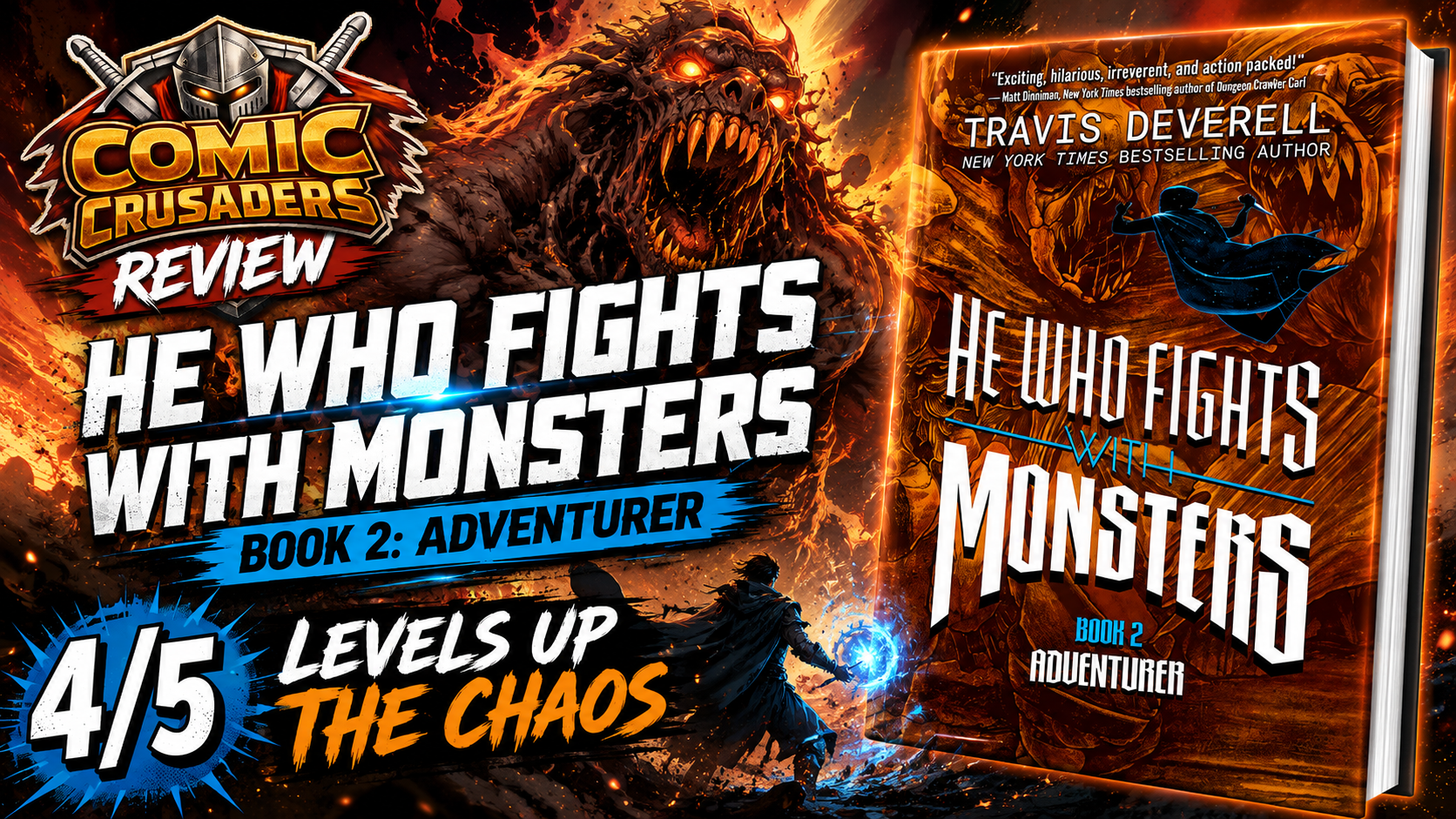
 Wepa! He Who Fights with Monsters, Book 2: Adventurer wastes very little time reminding you why Jason Asano works as a lead. Dude is still sarcastic, stubborn, weirdly philosophical, occasionally reckless, and completely incapable of entering a serious conversation without finding some sideways joke hiding inside it. That personality is the engine of this book, but Book 2 succeeds because Travis Deverell does not let Jason carry 600-plus pages by himself. The world around him gets bigger, the supporting cast gets stronger, and the problems stop feeling like random quests and start feeling connected to something much nastier.
The early stretch picks up with Jason settling deeper into life as an adventurer while still carrying the emotional damage of what came before. Sophie and Belinda remain tied into his orbit, Emir Bahadir’s presence opens new doors, and the novel keeps pushing Jason toward a reality he cannot joke his way around forever: power in this world comes with politics, obligations, enemies, and consequences. Deverell is very good at letting the comedy sit next to that weight without completely deflating it. Jason can be making somebody uncomfortable over tea one minute and processing grief, trauma, or a threat to his identity the next.
The biggest improvement over the setup-heavy nature of an early LitRPG story is the team dynamic. Humphrey, Clive, Sophie, Belinda, and Neil all bring different temperaments and combat roles, and the book becomes noticeably more fun once Jason is no longer operating like a one-man chaos department. Their personalities bounce off each other naturally, especially when Jason’s habit of saying exactly the wrong thing collides with characters who are increasingly willing to call him on his nonsense. The banter is funny, but the group also starts feeling like an actual adventuring unit instead of a collection of names waiting for their next stat increase.
The adventure-team competition gives the middle of the novel some of its strongest momentum. Deverell uses those sequences to show how far Jason has come without pretending he is suddenly the biggest monster in the room. Strategy matters. Team composition matters. Aura control, healing, positioning, familiars, status effects, and battlefield awareness all matter. Jason’s abilities can be horrifyingly effective, but the book repeatedly reminds us that raw power and clever tricks only go so far when everybody around you is talented too. Those fights are satisfying because victories feel assembled rather than handed out.
LitRPG readers are obviously here for progression, and Adventurer delivers plenty of it. Ranks, abilities, awakening stones, familiars, essences, rewards, and magical upgrades continue to shape the story. The difference is that the best progression scenes are not interesting because a number went up. They matter because the upgrades reveal something about how these characters see themselves and what kind of adventurers they want to become. Sophie adapting to a life she never expected, Clive growing more confident outside the purely academic world, Humphrey carrying the pressure of expectation, and Jason wrestling with changes that go deeper than stats all give the system some emotional weight.
The worldbuilding also takes a big step forward. Star seeds, astral entities, religious power, hidden agendas, old families, the Adventure Society, magical institutions, and the politics surrounding Greenstone begin fitting together into a much wider picture. Deverell is planting a lot of pieces on the board, and by the time the story starts pushing toward places like the City of Fallen Echoes, the series feels less like one guy dropped into a fantasy RPG and more like a genuinely large fantasy world with forces moving whether Jason is involved or not.
One of the stronger themes running underneath all that magic is identity. Jason’s soul, aura, choices, scars, and evolving sense of who he wants to be become increasingly important. The book asks what happens when power changes you, when trauma marks you, and when the version of yourself you thought was permanent turns out to be temporary. Some of the best quieter scenes come when the novel stops counting abilities and lets Jason confront the person he is becoming. Those moments give the louder action more meaning.
Now for the part where I keep it a buck: this book is huge, and you feel that size. Deverell loves conversations, system readouts, explanations, side interactions, jokes, and worldbuilding detours. Most of them are entertaining, but not all of them are necessary. There are stretches where the momentum softens because the story has already made its point and keeps talking anyway. Readers who enjoy living inside this world will probably consider that extra time part of the appeal. Readers looking for a lean fantasy sprint may occasionally want somebody to hit the fast-forward button.
The stat blocks can also become repetitive once you already understand Jason’s toolkit. They are useful as progression markers, but a few of them arrive at moments where the narrative is already moving and the pause feels more mechanical than exciting. This is a common LitRPG balancing act, and Adventurer handles it better when the systems are embedded directly into action or character choices rather than presented as inventory.
Still, the personality carries it. Jason remains one of those protagonists who can be hilarious, irritating, clever, compassionate, self-destructive, and strangely sincere within the same chapter. More importantly, Book 2 starts surrounding him with people strong enough to prevent the series from becoming a nonstop Jason Asano victory lap. The team challenges him, the world challenges him, and the larger threat developing behind the adventure keeps reminding us that being clever is not the same thing as being ready.
He Who Fights with Monsters, Book 2: Adventurer is bigger, stranger, funnier, and more confident than a simple second-step progression story. It deepens the cast, expands the world, sharpens the combat, and starts exposing the machinery behind the threats Jason has been stumbling into. It could absolutely lose some pages without losing its soul, but when the character work, tactical action, and cosmic weirdness all hit at the same time, this thing cooks.
CRUSADERS SCORE:
4/5

Writer: Travis Deverell writing as Shirtaloon
Cover Art: Adam Cahoon
Publisher: AETHON: Vault
On Sale:
September 9, 2026
Leave a Reply
You must be logged in to post a comment.