
Crowdfunding Saved Indie Comics, But Let’s Stop Pretending It’s Easy Money
·Al Mega
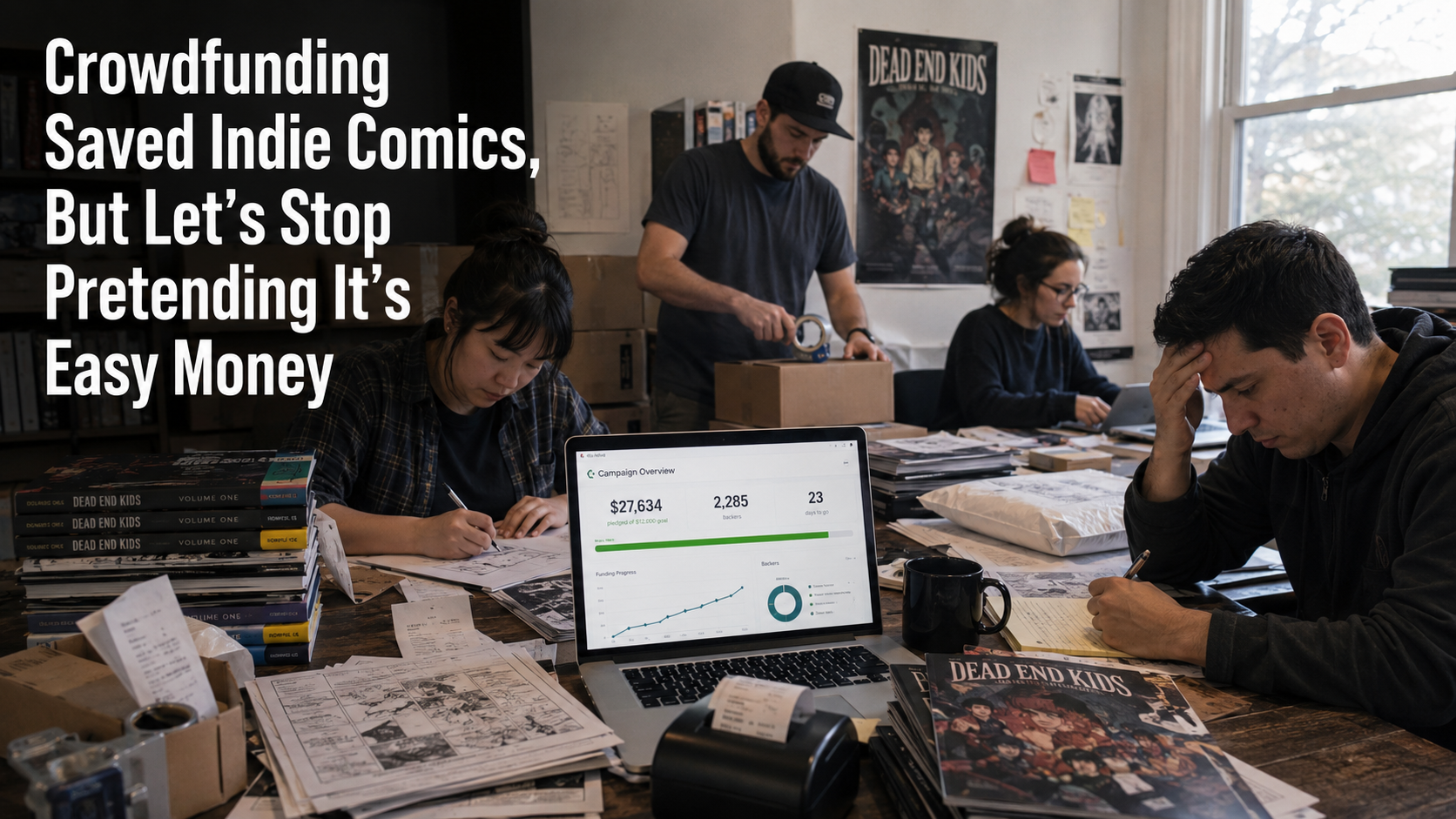
Let’s stop pretending. Let’s stop tiptoeing around it like we’re scared to say it out loud. Crowdfunding changed indie comics forever. Permanently. Irreversibly. There is no debate, no asterisk, no “well, actually.” Kickstarter. BackerKit. Zoop. Crowdfundr. Creator-owned storefronts popping up like neighborhood corner stores in a city that used to only have one grocery chain. These platforms didn’t just open a door they kicked the whole wall down.
For decades, indie creators had to perform an exhausting dance for gatekeepers. You needed a publisher to bless your book like it was holy water. You needed a distributor to acknowledge you existed. You needed some guy in an office who never read your script to decide whether your story “fit” inside his neat little marketing buckets. And if it didn’t fit? Tough. Try again. Or don’t.
Now? You go straight to the people. You skip the middleman, the gatekeeper, the suit, the “we’ll get back to you,” the polite rejection letters that smell like cologne and condescension. You build your audience. You tell your story. You make your art.
That is beautiful.
That is revolutionary.
That is also brutal.
Kickstarter’s own public data shows the Comics category has launched over 32,000 projects and pulled in more than $322 million. The success rate sits around 68.59% higher than most other categories on the platform. Read that again. Comics creators show up harder than almost anyone else. Backers show up too. This community is real. This community is hungry. This community is loyal in a way that the mainstream industry has never fully understood and probably never will. But let’s not get cute. Let’s not romanticize this thing into something it isn’t.
Crowdfunding is not “post a link and collect money.” That fantasy belongs in the same trash bin as expired coupon books, broken promises, and every “easy six figures” guru pitch that ever clogged your timeline. Anybody selling you that dream is selling you smoke. A good campaign is a full-time job wearing the costume of a creative dream.
You need the book. You need the pitch. You need the trailer that grabs people in the first three seconds because attention spans are a battlefield now. You need the reward tiers that actually make sense and don’t bury you in fulfillment hell. You need the page design that feels alive instead of looking like a half-finished Wikipedia entry. You need the shipping plan and I mean a real one, not a vibe. You need the fulfillment budget. You need to understand taxes. You need updates that keep your backers feeling like family instead of strangers waiting on a package that may or may not arrive. You need stretch goals that excite without crushing your spine. You need social media pushes. You need a mailing list. You need press outreach. You need to know how to talk to journalists and podcasters and YouTubers and the random person in your DMs who might be your biggest evangelist.
And on top of all of that? You need the emotional stamina to ask people for their hard-earned money every single day without feeling like a human billboard slowly losing your soul. That last part? That’s what breaks people.
Creators love making comics. Most of us hate selling them. There’s a special kind of vulnerability in saying, “Hey, look at this thing I made. Please believe in it. Please trust me with your money. Please don’t ghost me.” It’s a different muscle than the one you use to write or draw, and a lot of creators have never had to train it. Crowdfunding doesn’t care. Crowdfunding doesn’t ask if you’re comfortable. Crowdfunding doesn’t tuck you in at night.
The platform rewards momentum, trust, clarity, and direct audience connection. It punishes vague promises, weak pages, bad math, and that “I’ll figure out shipping later” energy that has buried more campaigns than counterfeiters and chargebacks combined. This isn’t a game of luck. It isn’t a lottery. It’s a discipline disguised as a dream.
And the rules? They keep changing. Kickstarter has been rolling out new discoverability features, including expanded subcategories for tabletop roleplaying games, STL files, audiobooks, and other niches living under Games and Publishing. That means the platforms are still trying still iterating, still tinkering to help backers find projects they’ll love. But creators cannot lean on discovery alone. The algorithm is not your manager. The platform is not your publicist. If you build your whole strategy around “people will just find me,” you are setting yourself up to drown.
Then there’s the uglier side. The side nobody mentions in the highlight reels. Mature content rules. Payment processor pressure. Platform policy changes that drop without warning and shift the ground under thousands of creators overnight. BackerKit’s mature content policy, for example, allows mature material but makes it crystal clear that projects remain subject to review and to the rules of payment partners. That matters. That matters a lot. Because so much of indie comics lives in horror, in romance, in adult satire, in underground comix, in spaces that don’t fit neatly into the squeaky-clean corporate boxes that payment processors prefer. If your work has bite, if your work has edge, if your work breathes in places the mainstream considers too dark or too dangerous or too honest you have to plan for that. You have to be smart. You have to read the fine print. Freedom is not the same as a free pass.
Crowdfunding is freedom. But it is not freedom from responsibility. It is not freedom from fulfillment. It is not freedom from customer service. It is not freedom from platform rules, payment processor whims, or the simple human contract you sign the moment somebody trusts you with their credit card.
The creators who win long-term and I mean really win, not just hit a funded goal once and disappear are the ones who treat backers like community instead of ATMs. They communicate when things go sideways. They price honestly even when honesty is uncomfortable. They deliver. They build trust before launch day, not during it, and definitely not after. They understand something most newcomers miss until it’s too late:
Every campaign is not just selling a book. Every campaign is building a reputation. A reputation that will either open doors for the next one or slam them shut forever. The market remembers. The community remembers. Backers talk to each other. Word travels faster than any algorithm.
Crowdfunding saved indie comics because it gave the power back to creators. That’s the gift. That’s the miracle. That’s the thing previous generations would’ve wept to have access to. But power without discipline is just a loud noise. Power without follow-through is just a broken promise wearing a costume. Power without respect for the people who handed it to you is the fastest way to lose it.
So the question isn’t whether crowdfunding works. It works. The numbers prove it. The success stories prove it. The whole new generation of creators building careers outside the old system proves it. The question is whether you can handle the power once it lands in your hands. Because the platform won’t save you. The algorithm won’t save you. The trend won’t save you. Only the work will. Only the truth will. Only the relationship you build with the people who believed in you before anyone else did.
Indie comics didn’t just survive the old gatekeepers. We outlived them. We out-hustled them. We built something they never could have built because they were too busy guarding doors instead of opening them. Now it’s on us to prove we deserve what we fought for. Stay sharp out there. Stay honest. Stay hungry.
The future of this industry is still being written and for the first time in a long time, the pen is in our hands!
WEPAAAAAAAAAAAA…..
Image Disclosure: This visual may include AI-generated or AI-assisted elements created for editorial, promotional, or illustrative use.
Leave a Reply
You must be logged in to post a comment.