
Manga and Kids Graphic Novels Are Schooling American Comics Right Now
·Al Mega
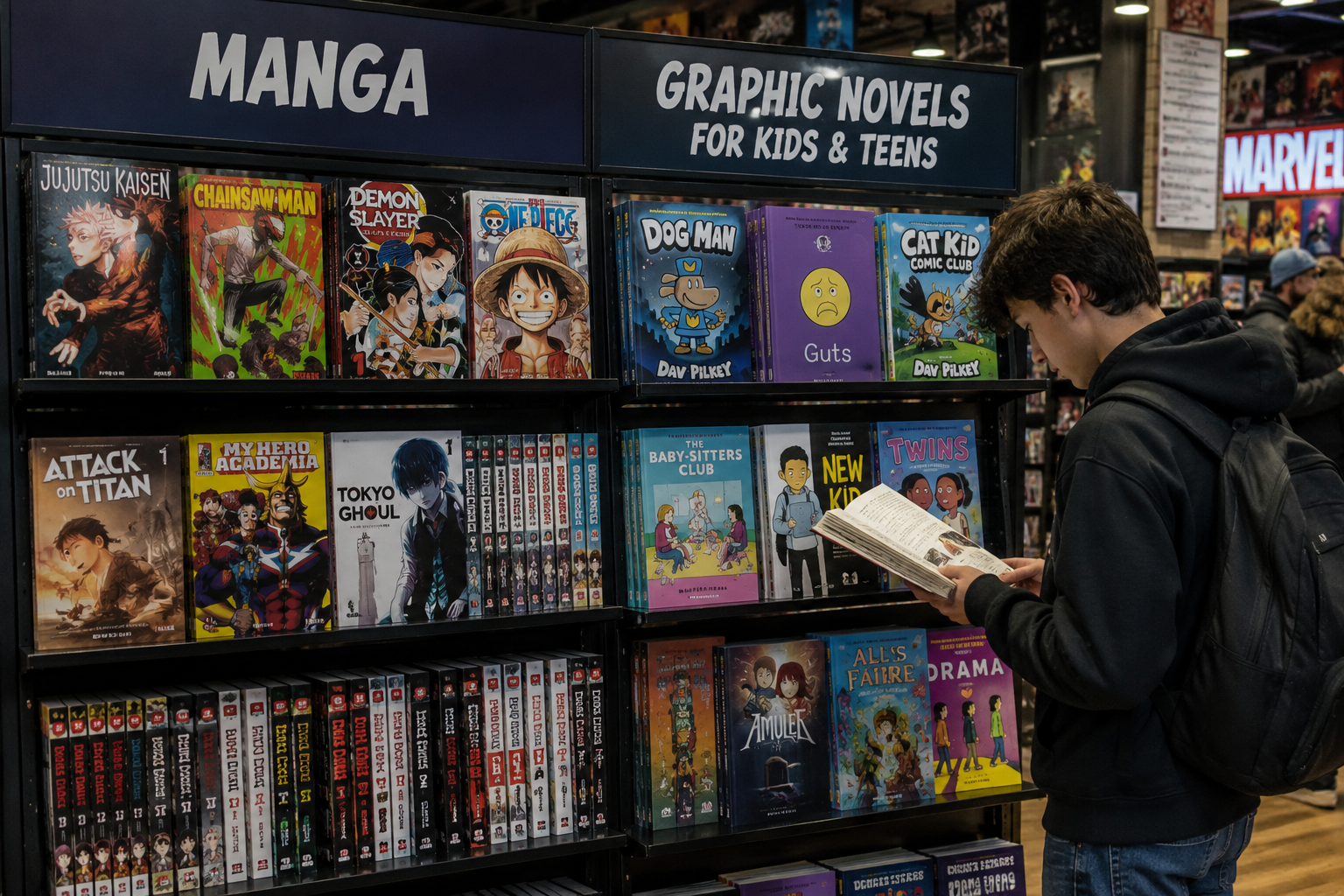
Manga keeps eating at the table because manga understands something painfully simple: readers need a clear way in. That is the lesson. No mystery. No secret handshake. No twelve-tab reading order. No “actually, you need to start with the 1986 run, then jump to the annual, then skip the reboot, then read the tie-in that explains why the main book makes sense.” Nah. Manga pulls up like a clean menu at a good neighborhood spot and says, “Volume 1 starts here. You hungry?” American comics should be taking notes.
For years, parts of the traditional comic book industry treated manga like an invading army. Like manga walked into the house, kicked its feet up on the couch, and stole everybody’s snacks. But manga did not steal the audience. Manga served the audience better. That is the uncomfortable truth. It gave readers structure, momentum, consistency, and a shelf experience that does not require a doctorate in continuity just to buy a book.
ICv2’s Circana BookScan coverage for 2025 showed how dominant manga remained across adult graphic novel sales, with major titles and franchises continuing to lead the conversation. Circana collects weekly point-of-sale data on print books from over 16,000 locations, which means these numbers are not vibes. They are receipts. And the receipts keep coming. Comics Beat reported that graphic novel sales rose 28.5% in Q1 2026, even while total print book unit sales dropped 3.1% compared to the previous year. Translation? The broader book market took a hit, but graphic novels still punched upward. That is not a dying format. That is a format with muscle.
So let’s stop with the tired funeral music. Young readers are not avoiding comics. Book readers are not avoiding comics. Parents are not avoiding comics. Libraries are not avoiding comics. Bookstores are not avoiding comics. The audience is there. The problem is that too much of American comics still acts like every new reader should already know where the entrance is. That is bad business. Worse, it is bad hospitality. A reader walks into a bookstore and sees a manga shelf. They see Volume 1, Volume 2, Volume 3. The series branding is clear. The story path is clean. The connection to anime helps. Social media helps. Fan communities help. The whole system points the reader forward. “Start here. Keep going.” That is not complicated. That is smart.
Now compare that to the experience of many new readers trying to get into monthly American superhero comics. They ask where to start, and suddenly someone launches into a monologue about legacy numbering, event fallout, relaunches, alternate universes, canon status, creative team changes, and why Issue #1 is somehow not really the beginning. My people, that is not onboarding. That is a pop quiz with staples. This is where manga is not just competition. Manga is a teacher.
It teaches that readers reward clarity. It teaches that long-form storytelling works when people understand the order. It teaches that emotional investment builds over time when readers feel confident about the journey. It teaches that a shelf can be a roadmap instead of a maze. American comics do not need to become manga. That argument is lazy. Nobody is saying every book needs to be black-and-white, digest-sized, or modeled after Japanese publishing. The lesson is not “copy manga.” The lesson is “respect the reader’s doorway.” That doorway matters.
The same goes for kids graphic novels. Honestly, kids graphic novels may be the biggest wake-up call of all because they are doing what comics always claimed they wanted to do: build lifelong readers. Kids graphic novels meet young readers where they are. They use humor, emotion, clear storytelling, strong visual pacing, and accessible formats. They do not make the child feel like they arrived late to a party that started before they were born. That is powerful.
A kid can pick up a graphic novel and immediately understand the premise. A parent can buy it without feeling lost. A librarian can recommend it. A teacher can use it. A bookstore can display it. The whole chain works because the product respects the reader, the buyer, and the environment where discovery happens. That is why American comics should be watching this lane with respect, not side-eye.
Because here is the real talk: kids graphic novels are not “lesser comics.” They are not training wheels for “real books.” They are not just for reluctant readers. Comics are reading. Comics are visual language. Comics teach pacing, expression, sequence, emotional inference, panel logic, and narrative rhythm. Any adult still acting like graphic novels are some sneaky little cheat code needs to catch up before the bus leaves without them. And yes, the bus is moving.
Publishers Weekly reported that comics were making a comeback in a changing market, including a reported 27% increase in comic store sales from January through August 2025 compared with the same period the year before. That matters because it shows the story is not simply “bookstores good, comic shops bad” or “manga good, American comics cooked.” The real story is bigger. The market is shifting, and the players who understand different reader lanes are the ones who win. Comic shops still matter. Let’s be clear. The local comic shop is sacred ground when it is run with heart. A great shop can change someone’s life. It can introduce a kid to Spider-Man, a teen to manga, an adult to indie horror, a collector to a rare back issue, and a creator to their first real community. The shop is not the problem.
The problem is when the industry treats one kind of shop customer as the only kind of reader worth building around. Respect the Wednesday warrior. Always. That reader kept the direct market breathing through chaos, crashes, shutdowns, distribution drama, and every “comics are dead” headline that gets recycled like bad leftovers. The pull-list reader is loyal, knowledgeable, and essential. But the future cannot be built only around the person who already knows everything. That is like opening a restaurant and only serving people who already memorized the menu from 1987.
New readers need welcome signs, not warning signs. They need clean starts. They need available collections. They need reasonable prices. They need shelves that make sense. They need publishers to stop turning every fresh launch into an event spillover. They need comic shops to display entry points like they actually want new people to walk in and buy something. They need marketing that speaks human, not continuity goblin. And they need the industry to stop acting shocked when they choose manga or kids graphic novels instead. Because those books are not making them feel stupid. That is the heart of it.
Too many American comics still carry this weird energy where confusion gets mistaken for depth. But complicated is not always deep. Sometimes complicated is just messy. A rich universe is beautiful when it invites readers to explore. It becomes a problem when the entrance looks like a locked door with a footnote taped to it. Manga has massive stories. One Piece is not exactly a pamphlet. Berserk is not light homework. Jujutsu Kaisen, Chainsaw Man, Demon Slayer, Blue Lock, Dandadan, Solo Leveling, and the rest are not small cultural blips. These are big, passionate, emotionally charged fandom machines. But the path is clear enough for new readers to begin. That is the difference.
The American comics industry has legendary characters, world-class creators, incredible artists, brilliant writers, elite colorists, sharp letterers, passionate editors, and decades of cultural power. It has everything it needs except enough humility to admit the shelf experience is often broken. Fix the shelf. Fix the start. Fix the format strategy. Keep collections in print. Make Volume 1 easy to find. Build reading lanes by genre, not just publisher universe. Push horror as horror. Romance as romance. YA as YA. Fantasy as fantasy. Superheroes as superheroes. Stop acting like every comic must enter the same funnel. Readers do not shop that way anymore.
The future comic reader is not one person. It is the manga kid. The library kid. The anime fan. The bookstore parent. The Wednesday collector. The webtoon reader. The crowdfunding backer. The indie convention shopper. The horror fan. The teacher. The gamer. The kid who just wants something funny. The adult who wants a serious graphic memoir. The teenager looking for a story that finally sees them. That is the audience. Manga and kids graphic novels understand that better than many traditional American comics because they do not demand the reader bend first. They bend toward the reader. That is not weakness. That is strategy.
So here is the controversial part, served hot: American comics does not have a talent problem. It has an access problem. The talent is there. The stories are there. The passion is there. The fans are there. The problem is that too many parts of the machine still operate like the audience should work harder to participate. That is backwards. The industry should work harder to invite them in. Because the next generation is not rejecting comics. They are rejecting confusion. They are rejecting gatekeeping. They are rejecting being told that the comics they love do not count. They are rejecting formats that make discovery harder than it needs to be. They are choosing the comics that respect them first.
That is why manga is winning. That is why kids graphic novels keep rising. That is why the smartest American publishers, shops, creators, and media platforms should stop treating these categories like side quests and start treating them like the blueprint. Not the enemy. The blueprint. The message is simple. Feed readers. Guide readers. Respect readers.
Give them a clean doorway, then let the story do what great comics have always done: grab them by the heart and refuse to let go!
WEPA. The Crusade Never Ends.

Leave a Reply
You must be logged in to post a comment.