
Marvel Artists Archive: Jim lee w/ S. Moore & J. Barber | Comic Crusaders Podcast #735
·Al Mega
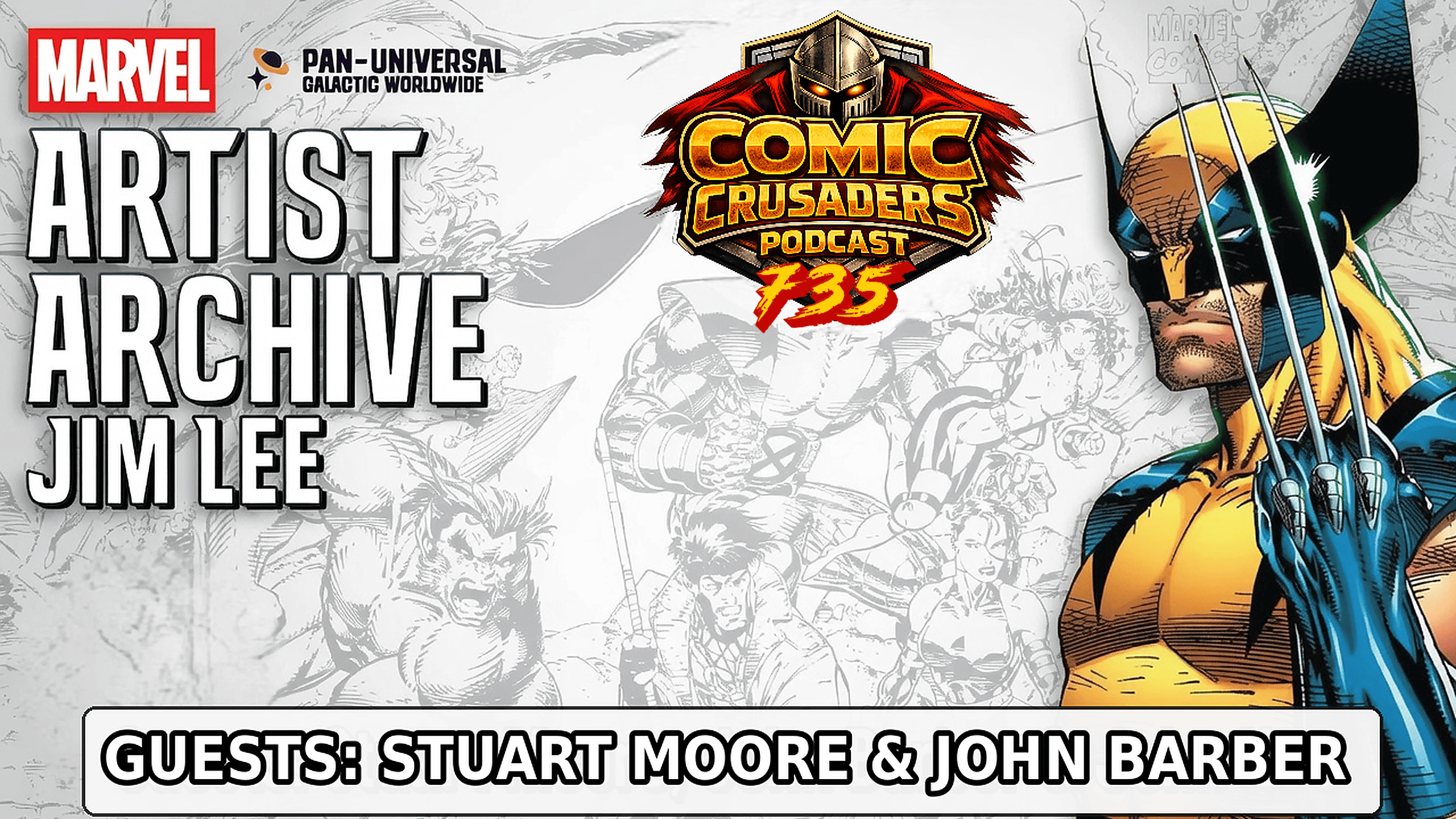
Stuart Moore and John Barber Take Comic Crusaders Inside Marvel Artist Archive: Jim Lee
The writer and PUG-W Editor in Chief join Al Mega to explore the research, rare artwork, editorial decisions, and extraordinary Marvel journey behind one of comics’ most influential artists.
There are comic-book artists who become popular, artists who become influential, and artists whose work permanently changes the way an entire generation imagines superheroes. Jim Lee belongs firmly in that final category. On Comic Crusaders Podcast #733, host Al Mega welcomes writer, editor, and historian Stuart Moore, along with Pan-Universal Galactic Worldwide Editor in Chief John Barber, for an extensive discussion about the creation of Marvel Artist Archive: Jim Lee.
The deluxe hardcover is being produced by PUG-W in partnership with Marvel Comics and presents approximately 300 oversized pages chronicling Lee’s Marvel career. The collection travels from his developmental work on Alpha Flight and Punisher War Journal through the industry-shaking success of Uncanny X-Men, his celebrated Marvel trading-card illustrations, rare artwork, covers, process material, and his later work on Heroes Reborn: Fantastic Four. This is not simply a collection of Jim Lee’s most recognizable images.
The project is designed to show progression the choices, experimentation, discipline, and rapid artistic development that transformed a promising young illustrator into one of the biggest names American comics had ever produced.
Stuart Moore provides the book’s historical narrative, original research, background information, and newly conducted interviews. His contribution places the finished artwork into context, allowing readers to understand not only what Jim Lee created, but when he created it, what stage of his career he had reached, and how quickly his visual storytelling was evolving.
During the interview, Moore joins Al in examining the qualities already visible in Lee’s earliest Marvel assignments. The anatomy, character acting, page composition, attention to texture, cinematic framing, and remarkable level of detail were still developing, but the ambition was already sitting there on the page like Wolverine waiting for somebody to make the wrong move.
The conversation also digs into a question that comic historians and longtime readers love debating: Was there one particular issue, cover, or sequence where Jim Lee stopped being viewed as an exciting new artist and became an undeniable superstar? That transformation did not happen by accident. Behind the dynamic poses and famous crosshatching was an artist working under deadline pressure, studying the craft, refining his visual instincts, and learning how to control the reader’s eye across every panel.
John Barber brings the editorial perspective to the conversation, discussing the enormous challenge of transforming decades of artwork into a cohesive reading experience. A book of this scale cannot simply throw beautiful images onto pages and hope the audience supplies the structure. It must balance chronology, artistic development, historical commentary, finished artwork, rough material, covers, trading-card illustrations, rarities, and enough breathing room for each piece to command attention.
That challenge becomes even greater when the intended audience includes lifelong Jim Lee collectors, working artists, comic historians, casual Marvel readers, and younger fans who may know Lee’s reputation without having experienced his early Marvel material firsthand. Barber discusses the importance of presenting the archive as a visual narrative one that allows readers to watch an artist becoming more confident, ambitious, and technically formidable from assignment to assignment. In other words, the book is not simply showing greatness. It is showing greatness being built.
Some of the most revealing pieces in any artist archive are not necessarily the polished covers that everyone already recognizes. Rough layouts, unfinished pencils, production notes, alternate compositions, corrections, and developmental artwork can expose the decision-making process behind the final page. They show where an artist changed direction, solved a storytelling problem, strengthened a pose, adjusted a character’s expression, or found a more dramatic way to stage a sequence.
Marvel Artist Archive: Jim Lee complements its finished artwork with process pieces and historical commentary intended to offer readers a deeper understanding of Lee’s technique and development. The Comic Crusaders conversation explores the archival hunt behind the project, including the difficulty of locating, identifying, verifying, scanning, and reproducing material from across Lee’s Marvel career. Because apparently assembling 300 pages of Jim Lee artwork is slightly more complicated than yelling, “Put all the awesome stuff in one book!” Who knew?
Jim Lee’s Marvel trading-card work receives special attention because those illustrations served as an entry point into the Marvel Universe for countless young fans. Each card demanded a complete character statement within one image. The costume, attitude, power, personality, and mythology all had to register immediately.
For many collectors, those cards were not secondary merchandise. They were portable galleries, character encyclopedias, playground currency, and the source of several heated childhood negotiations that remain unresolved to this day. Their inclusion helps demonstrate how Lee’s influence expanded beyond monthly comics and into the wider visual identity of Marvel during the era.
Jim Lee’s work did not simply make established characters look cool—although, yes, they looked ridiculously cool. His artwork helped redefine the scale, energy, intensity, and commercial possibilities of superhero comics. His interpretations of Wolverine, Cyclops, Storm, Psylocke, Rogue, Magneto, and the larger X-Men universe became foundational images for readers, collectors, animators, game designers, and future comic-book artists. That influence is why Marvel Artist Archive: Jim Lee matters. It preserves the artwork, but it also documents the journey behind it.
The Kickstarter campaign includes the oversized hardcover alongside exclusive portfolio prints, miniature cover reproductions presented in a custom mini-shortbox, and additional campaign-specific collectibles. The project launched on Kickstarter on July 14, 2026. Stuart Moore and John Barber give Comic Crusaders listeners a look inside the research, storytelling, design, and editorial thought required to honor an artist whose Marvel work helped reshape modern comics. Collectors should clear some shelf space.
Actually, reinforce the shelf first. Three hundred pages of Jim Lee energy may violate local building codes.
🔥 Support the Kickstarter at🔥:
https://www.kickstarter.com/projects/pug-w/marvel-artist-archive-jim-lee
🎙️ Guests:
Stuart Moore – Writer, editor, historian, and author of Marvel Artist Archive: Jim Lee
John Barber – Editor in Chief of Pan-Universal Galactic Worldwide
The Crusade Never Ends!
Thank You for Watching / Listening!
We appreciate your support!
Host: Al Mega
Follow on Twitter | Instagram | Facebook:
@TheRealAlMega / @ComicCrusaders
Make sure to Like/Share/Subscribe if you haven’t yet:
Rumble/Twitch: ComicCrusaders
YouTube: / comiccrusadersworld
Visit the official Comic Crusaders Comic Book Shop:
comiccrusaders.shop
Visit the OFFICIAL Comic Crusaders Swag Shop at:
comiccrusaders.us
Main Site:
https://www.comiccrusaders.com/
Edited/Produced/Directed by Al Mega


Leave a Reply
You must be logged in to post a comment.