
Amazing Améziane Talks Spielberg From Titan Comics
·Al Mega
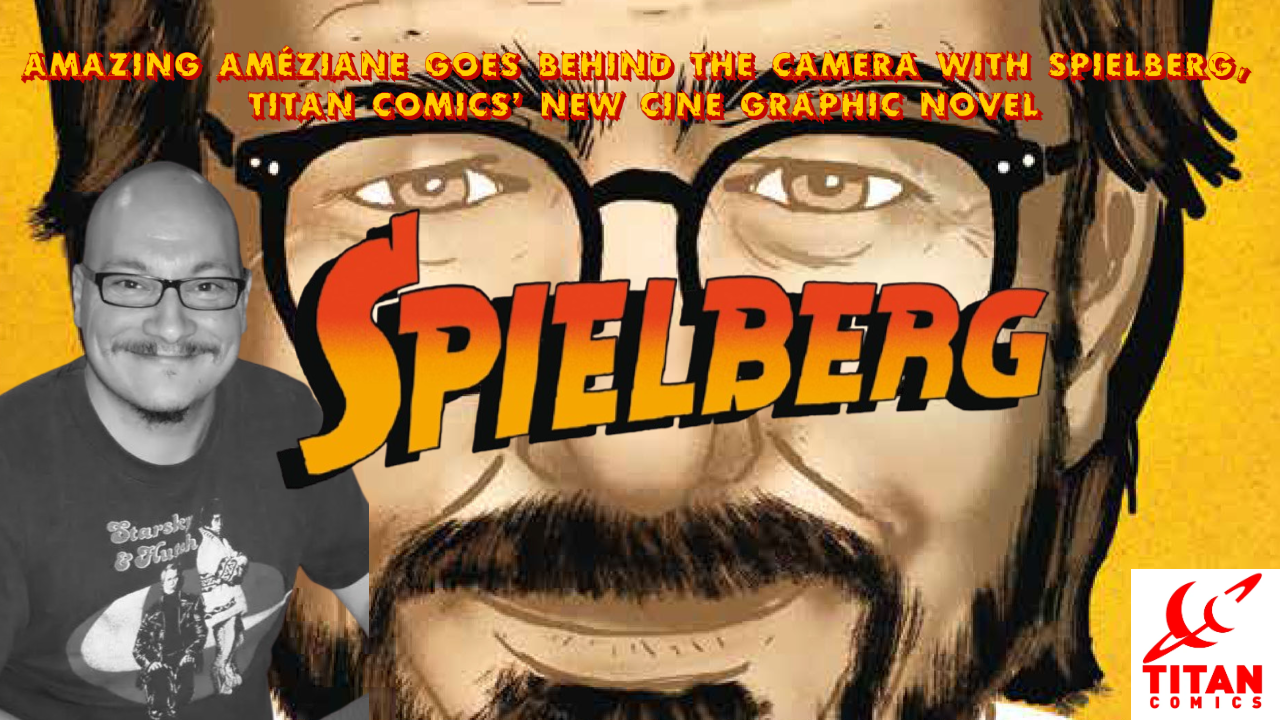
WEPA! Now this is the kind of interview that hits the movie-loving part of the soul, grabs the popcorn, kicks open the theater doors, and says, “Let’s talk CINEMA!”
Comic Crusaders had the pleasure of connecting with the one and only Amazing Améziane, the creator behind cine graphic novels like Quentin by Tarantino and Don Coppola, to discuss his upcoming Titan Comics release, Spielberg, on sale September 1, 2026.
This new graphic novel dives into the life, career, creativity, and cinematic fingerprints of Steven Spielberg, one of the most influential storytellers in film history. From the terror of Jaws, to the wonder of E.T., the adventure of Indiana Jones, the awe of Jurassic Park, and the emotional weight of films like Schindler’s List and Saving Private Ryan, Spielberg’s work has shaped generations of moviegoers.
But this book isn’t just about the famous scenes we all know. It’s about the person behind the camera, the creative choices, the emotional connections, the family history, the risks, the reinvention, and the magic that turns movies into memories.
So let’s roll camera, cue the John Williams energy in your head, and jump into this conversation with Amazing Améziane!
Comic Crusaders: Amazing, your work has carved out this fascinating lane where cinema history becomes graphic storytelling. What first pulled you toward turning the lives of legendary filmmakers into comic book narratives instead of traditional biographies?
Amazing Améziane: I drew the Soul Trilogy, the biographies of Muhammad Ali, Big Black: Stand at Attica, and Ms. Davis, all set around the year 1971. I loved working on the scripts by Sybille Titeux de la Croix and Jared Reinmuth, but it was very hard on the spirit. There was a lot of suffering, killings, and even torture in those stories about civil rights. So I needed a timeout. I needed a story with a lower body count.
I wanted to write and draw a book myself on Scorsese. I love him so much, and I assumed I wouldn’t need that much research because I know his work pretty well.
But the best part was the research. Being paid to rewatch all of Scorsese’s movies? One morning, I was on the couch in front of the TV with a pile of Marty’s DVDs. My son went to school at 8 a.m. When he came back at 5 p.m., he said I hadn’t moved at all and asked if I didn’t have a job. I told him, “This is my job,” and he laughed a lot.
I sold the book to my publisher as the Ciné Trilogy because three books are better than one, and I had a pretty extensive list of directors I wanted to work on. I’m still amazed that I successfully finished two Ciné Trilogies. Not bad!
Comic Crusaders: After exploring figures like Quentin Tarantino and Francis Ford Coppola, what made Steven Spielberg feel like the next essential chapter in this saga of cine graphic novels?
Amazing Améziane: I’m not saying it verbatim, but I wanted to do all the directors of New Hollywood: Scorsese, Coppola, De Palma, Spielberg… all but Lucas.
I wanted to have Lucas as a bonus in those stories. Like when you buy a Marvel Legends toy, you get all the Fantastic Four, and as a bonus, you get Galactus that you have to build. A leg there, a torso there… Lucas is my bonus.
De Palma, I don’t think there is an audience for a book on him. Same with Schrader and Milius. So that leaves Spielberg. And I knew exactly what to do with him when I saw The Fabelmans in the theater.
Comic Crusaders: Spielberg’s career is massive: blockbusters, childhood wonder, terror, history, adventure, emotion, legacy. When you started shaping this book, what was the first big creative challenge you had to solve?
Amazing Améziane: In the very middle of the book, there is a double-page spread with Sheriff Brody holding a rifle on the sinking Orca boat. The shark is looking at Brody, and the text says, “WE’RE GONNA NEED A BIGGER BOAT.”
And similarly, my problem was space.
Scorsese, for instance, produced 25 films, and my graphic novel about him was 384 pages long. It nearly killed me because I did all of it in nine months.
That’s why, for Spielberg, I had to make some choices. Your favorite movie might not be in it, especially if it’s Hook or Ready Player One. But I needed space for Jaws, Close Encounters of the Third Kind, Raiders of the Lost Ark, and Schindler’s List. At the end of the day, art is choice.
Comic Crusaders: Your previous cine books have a distinct rhythm, almost like the reader is stepping into the mind and mythology of the filmmaker. How did your visual language change when approaching Spielberg compared to Tarantino or Coppola?
Amazing Améziane: I listen to directors’ interviews to familiarize myself with their tone and speech patterns. In the Ciné Trilogy, I have the directors speaking in the first person.
Tarantino is almost in stand-up comedian mode in interviews. He’s over the top and funny. Coppola is the true artist in mind. He had so much suffering in his career and his life that it bleeds into his art.
Spielberg is calmer. He is the true boy wonder. His pure talent was evident from the set of Columbo and Jaws. He had very few troubles or flops. So, the way to tell the story is really to go deep into his way of thinking. Each of his movies could be a book by itself. That’s why, in this graphic novel, I pushed his personal experience.

Comic Crusaders: Spielberg is connected to so many emotional entry points for audiences: fear with Jaws, wonder with E.T., adventure with Indiana Jones, awe with Jurassic Park, and historical weight with films like Schindler’s List and Saving Private Ryan. How did you decide which parts of his creative identity deserved the most space on the page?
Amazing Améziane: I listened to Spielberg’s interviews and looked for signs of what was important to him.
That’s one of the reasons why I used six pages in my mock-up to tell the story of E.T. and the work with Kubrick.
On the other hand, I wanted to talk more about Munich. But Spielberg has done zero promotion for the film. He basically refused to talk about it. And I had so many questions! What is the real meaning of the sex scene at the end? The only sex scene of his entire career…
I had things I wanted to portray well in the graphic novel, and I hunted for the answers. My idea was that if I didn’t find them, I would reduce the pages about the film.
For other movies, even though I liked them, I didn’t find any interesting material for the kind of book I produce. That’s why some films aren’t in it.
My graphic novels are one-third biopic, one-third film book filled with facts, one-third art book, and one-third comics with narration. Yes, that makes it one-third too much. I’m bad at math, and that’s why my book is so big!
Comic Crusaders: When you create a book about a filmmaker whose work is already so visually iconic, how do you avoid simply “illustrating the famous moments” and instead create something that feels like your own artistic interpretation?
Amazing Améziane: I try to do it differently. Always.
I’m the soldier who zigzags while running on the battlefield. It’s tiresome, it seems stupid, but I’m alive at the end.
Do my books sometimes have too much text? Yes. Has anyone ever requested a refund because of it? No. The readers enjoy books that have a good rhythm. Do readers ever feel offended because I change styles often? Also no. They are happy to be surprised because they want that rush of adrenaline when they turn the pages.
Visually, I follow the WWBSD method: What Would Bill Sienkiewicz Do? My DNA is Elektra Assassin… Bill’s madness and Miller’s overuse of voice-over. With my modest capacities, of course.
Comic Crusaders: Spielberg’s stories often balance spectacle with deeply human emotion. As a graphic novelist, how do you translate that cinematic feeling into panels, pacing, composition, and page turns?
Amazing Améziane: I use the never-ending wonder of the human face. Especially Spielberg’s.
In the book, he is looking directly at us. He ages with us. He talks to us about finding meaning in life, his family, his faith, and his fear of working on Schindler’s List.
I try to play with the readers. Everybody has seen Jaws or Raiders, so if I play it right, you will hear the music in your head. I don’t want to spoil the movies, so I show very little. I show only what I need to illustrate. I make references directly to your subconscious.
Comic Crusaders: What did researching Spielberg teach you about the person behind the legend that surprised you or changed the way you viewed his body of work?
Amazing Améziane: The Fabelmans was the piece of the puzzle I needed to go inside his mind. It’s my Rosetta Stone in trying to understand the hieroglyphs of his life.
Why do his movies feature so many blonde mothers with short hair, often single mothers? Because of his mom.
Why did Close Encounters have so much gripping family drama when Richard Dreyfuss loses his marbles? Because they were inspired by his father’s downfall while his wife divorced him.
All of that was in the movie. I simply connected the dots. And colored them. For the readers.
Comic Crusaders: Your cine graphic novels don’t just celebrate fame; they seem to examine obsession, ambition, risk, failure, reinvention, and artistic hunger. What part of Spielberg’s journey felt most human to you?
Amazing Améziane: Artistic life is everything: obsession, ambition, risk, failure, reinvention, and creative hunger.
Sometimes you hit the jackpot, and you change your art form. Sometimes the fact that you finished your project and it was shown to audiences is your only reward.
But as I talk about all these cinematic geniuses, it is entertaining to analyze where they drown before flying again. My books are like Titanic. You all know the ending. It’s the journey that counts, and my stylish way of helping you get through it.
Comic Crusaders: For fans who know Spielberg mainly as the blockbuster king, what do you hope this book reveals about him as an artist, a craftsman, and a storyteller?
Amazing Améziane: Steven made half of his career with very serious films. Sure, they aren’t the most famous of his projects, but they are still his.
I made a joke about Amistad, calling it “I Miss That,” because nobody saw it. I discovered it while working on this book, actually. What a surprise! What an incredible film.
Same with Always. I encourage readers to take a look at these two lesser-known titles.
Comic Crusaders: When readers finish Spielberg, what do you want them to feel first: nostalgia, inspiration, deeper respect for cinema, or that sudden urge to go rewatch everything with fresh eyes?
Amazing Améziane: All of that.
I want readers to see the movies they love differently. I want them to enjoy rewatching them or, for our younger audience, or people whose jobs don’t let them rewatch Raiders of the Lost Ark for the gazillionth time, to discover them.
Steven influenced all his New Hollywood friends by coining the phrase, “One film for me, one film for them.” His secret weapon was that he was also “them,” the producers.
He successfully took responsibility for his productions. But he had a way of seeing what the audience wanted and delivering it with a quality that doesn’t exist anymore.
Comic Crusaders: If young Amazing Améziane could sit in a theater and watch one Spielberg scene before becoming the artist you are today, which scene would you choose, and what would you tell that younger version of yourself after the credits rolled?
Amazing Améziane: I would watch the intro sequence of Indiana Jones and the Temple of Doom.
It is like a wonderful mini movie inside the film. A dance number, suspense, fun, balloons flying around, poison, an emperor’s ashes, punching, a car chase with a child driving, and a formidable “Nice try, Lao Che,” while boarding a plane owned by Lao Che. Just pure perfection. No notes.
The lesson for my younger self would be that you need to have fun if you want to offer a good time to others. Which is exactly how I make those books. The secret is enjoying yourself while doing it. And that works for any job.
And there it is, Crusaders! Amazing Améziane isn’t just drawing cinema history; he’s remixing it through memory, research, rhythm, humor, obsession, and pure artistic nerve. Spielberg sounds like the kind of graphic novel that doesn’t just ask you to remember the movies, it asks you to look at the man behind them with fresh eyes.
This is for the film lovers, the comic readers, the art book collectors, the creators chasing their own impossible visions, and everybody who ever sat in a theater and felt that goosebump moment when story, image, music, and emotion all hit at once.
Spielberg from Titan Comics arrives September 1, 2026. Keep your eyes on this one, because when comics and cinema shake hands like this, magic tends to show up wearing a director’s cap.
Pre-order it from Amazon, Barnes & Noble, Books A Million, and Forbidden Planet for the UK & Europe.
Leave a Reply
You must be logged in to post a comment.