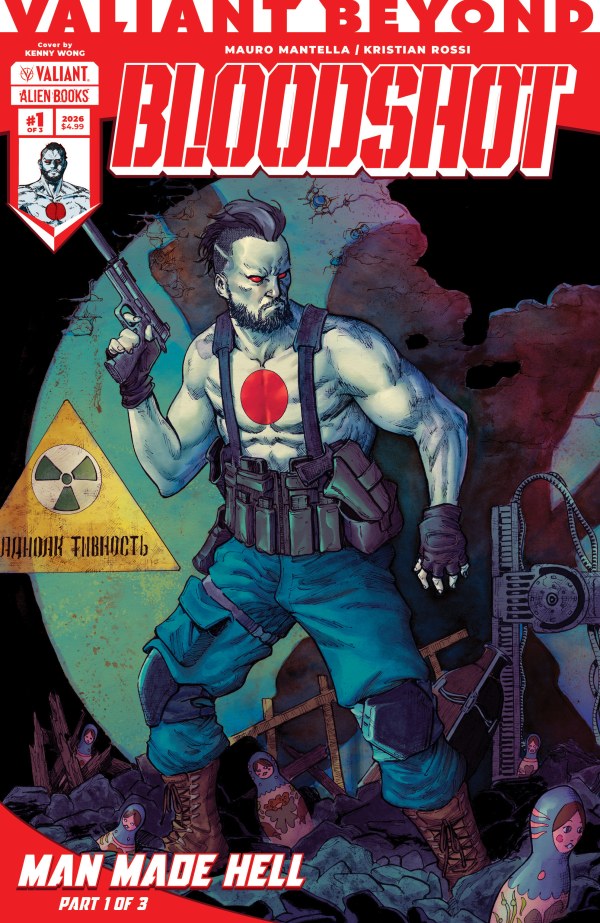
Review: Valiant Beyond: Bloodshot – Man Made Hell #1 Throws Bloodshot Into Chernobyl, Clones and Straight-Up Nightmare Fuel
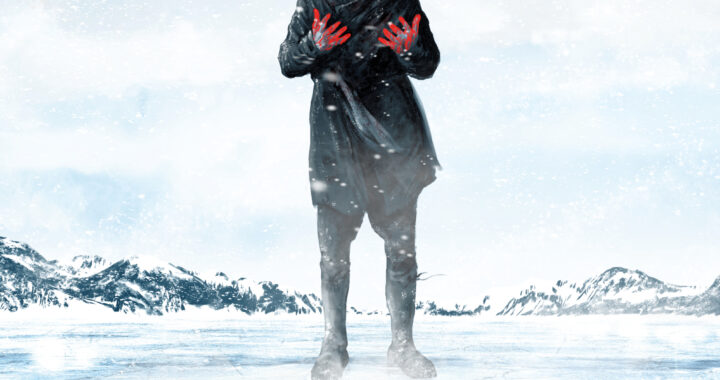
WEPA! Now this is how you toss Bloodshot back into the fire without even giving the man a warm-up lap. Valiant Beyond: Bloodshot – Man Made Hell #1, also rolling as Valiant Beyond: Bloodshot #4, kicks off a new three-part arc from Alien Books and comes out swinging like it owes somebody money. Mauro Mantella drops Roy Harrison into the Exclusion Zone around Chernobyl, Kristian Rossi brings the cold, grimy brutality to the page, Brushu Studio drenches the whole thing in sickly atmosphere, and the end result is a book that feels like military sci-fi, war horror, radioactive espionage, and old-school Valiant weirdness got locked in a bunker together with no snacks and bad intentions.
Bloodshot is not walking into this mission clean. That is the first thing that hits. Yeah, the elevator pitch is simple enough: Red Ops sends him toward Chernobyl to prevent another nuclear disaster. But the real meat here is that Roy is still rattled from the Japan incident, still chewing on what happened with Udo Namura, still wondering if what got awakened in him is memory, infection, vampirism, nanite malfunction, trauma, or all of the above wearing the same bloody trench coat. The issue does a smart thing by letting the mission briefing feel cold, procedural, and almost absurdly bureaucratic, while Roy’s internal narration is anything but. He is sarcastic. He is tired. He is suspicious. He is, basically, every guy at the job who knows the boss is saying “quick assignment” when the whole thing smells like overtime and lawsuits.
Mantella gives Bloodshot a sharp inner voice here. It has bite. It has fatigue. It has gallows humor. That matters because this arc could easily become “big tough guy walks through radioactive ruins and punches things,” which, let’s be real, we would still read because Bloodshot punching things is part of the natural order. But Man Made Hell wants more than that. It wants the mission to scrape against Roy’s identity. The Red Ops setup, the nanites, the memories, the haunted pocket-dimension weirdness, the language-neutral translation, the almond water survival gag, the whole “don’t stay too long or you’ll go insane” warning, it all builds a world where nothing is trustworthy. Not the handlers. Not the terrain. Not history. Not memory. Not even Roy’s own body. That is where this book finds its juice.
And Chernobyl? Ay bendito. The creative team does not use it as cheap set dressing. The ruins carry weight. The issue references the human cost, the liquidators, the displacement, the poisoned land, and the ghost of political failure without stopping the book dead in its tracks. There is a harsh little truth humming under the action: ordinary people always end up paying for powerful people’s disasters. Governments posture. Soldiers bleed. Civilians vanish into statistics. Then some poor cursed bastard like Bloodshot gets sent into the mess with a gun, a mission objective, and barely enough information to survive the first act. Tell me that ain’t the most comic-book and real-world thing at the same time.
Kristian Rossi’s art is a strong fit for this chapter because it does not over-polish Bloodshot. Roy looks heavy. Not just physically heavy, although yes, the man is built like a refrigerator with trauma. I mean emotionally heavy. His face carries exhaustion. His eyes carry threat. His body language tells you this dude has survived too many experiments, missions, lies, and “classified” explanations. The pages inside Red Ops have this cramped, artificial awkwardness that works perfectly, like the place itself is pretending to be normal and failing miserably. Once the story moves into Kyiv and then closer to the Exclusion Zone, the visuals open up into broken architecture, snow, concrete, smoke, and silhouettes that feel half military thriller and half ghost story.
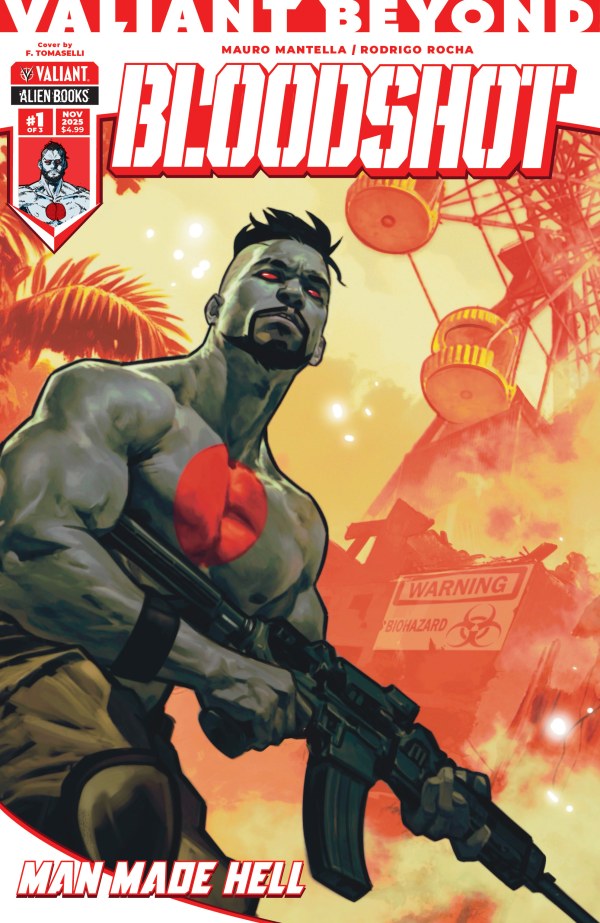
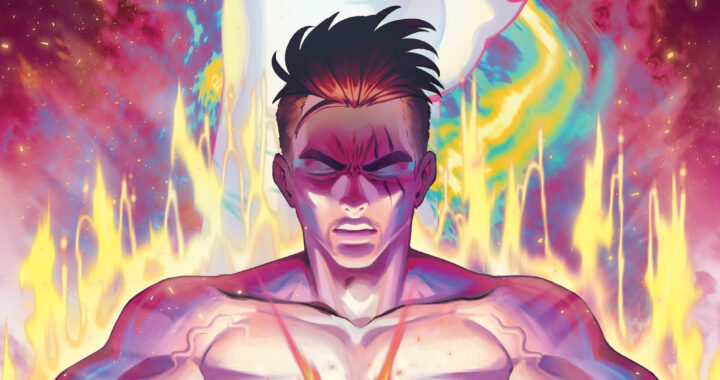
Brushu Studio’s color work deserves a big shout because this issue lives in temperature. The cold blues and dead grays make the environment feel hostile before anyone even pulls a trigger. Then the reds pop like alarms: Bloodshot’s eyes, chest mark, blood spray, gunfire, danger signs, emotional flares. That contrast gives the issue its heartbeat. It is not flashy just to be flashy. It guides the reader’s eye, keeps the action clear, and reminds you that Bloodshot himself is basically a walking emergency signal. Even when he is trying to be quiet, the page is telling you, “Nah, fam, this man is a problem.”
The introduction of Vuk is one of the best pieces of the issue. He comes in with a gun to Bloodshot’s face, which is rude, yes, but in their line of work that’s practically a hug. Their chemistry gives the book a much-needed human charge. Vuk’s tragic background ties him directly to Chernobyl in a way that makes the location personal instead of abstract, and his prophetic vision ability gives the action a sharp tactical edge. He is funny, broken, angry, and weirdly charming. The man is drinking vodka in the middle of mutant-supernatural-military madness like he has accepted that HR will not be responding to his complaint. Respect!
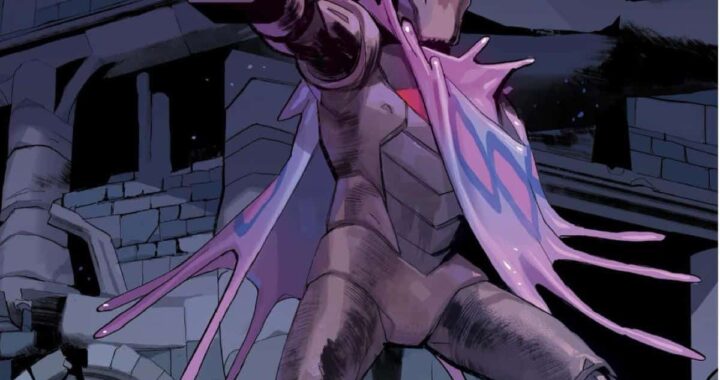
Then the book escalates. We get Blyad and the Matryoshka Project, and that is where Man Made Hell #1 fully leans into the freakshow. The clone concept is cool because it is not just “multiple enemies, shoot harder.” The clones share a strange physical and emotional bond, and the issue hints at a nasty instability underneath the power. There is something genuinely unsettling about a character whose duplicates are treated like extensions of self, disposable but not really separate. The action sequence has speed, chaos, and some nasty little visual beats, especially when the clone system starts going wrong. Bloodshot and Vuk are not just fighting a squad. They are fighting a collapsing idea of identity. That is very Bloodshot. That is the lane. Stay in that lane and floor it.
Camila Jorge’s lettering keeps the whole machine readable even when the book gets loud, layered, and frantic. That is not small work here. You have narration boxes, tactical dialogue, screams, gunfire, overlapping action, and weird sci-fi terminology all trying to crowd the same pages. The lettering keeps rhythm without getting cute for no reason. Clean work. Let the chaos breathe, but don’t let it become soup. That is the assignment, and it lands.
Now, keeping it 100, this is a dense first chapter. There are a lot of proper nouns, a lot of world-state information, and a lot of “here’s the situation, but actually here’s the worse situation hiding behind that situation.” New readers can jump in because the recap page helps, but they may still feel like they walked into a war room five minutes late and everybody is already pointing at maps. That is not a dealbreaker. It actually adds to the disorientation of Bloodshot’s mission. Still, some readers may want a second pass to catch all the moving pieces. This issue is not sipping coffee. It is chugging battery acid and sprinting toward Reactor 4.
What makes the book work is that the confusion feels purposeful. Bloodshot is confused too. He is being sent into a zone where physics, politics, radiation, military agendas, and paranormal nonsense are all beefing at the same table. The storytelling does not hand you a comfy chair. It gives you boots and says, “Move.” That urgency is the point.
By the time Boris Dragunov enters the conversation, the issue has already built enough dread that his name lands like a threat you believe before you even fully understand it. The stories about him are brutal, almost mythical, and the fact that Red Ops sends Bloodshot after him alone says everything you need to know about how disposable “top agent” really means in this universe. The cliffhanger promises the Black Forest, Reactor 4, and deeper radioactive nightmare business, and yeah, I’m in. Hook set. Reel me in.
Valiant Beyond: Bloodshot – Man Made Hell #1 is a strong, vicious, moody opening chapter that gives Bloodshot fans the violence they came for, but layers it with identity crisis, wartime horror, dark humor, and dangerous weird-science mythology. It is not a smooth little superhero snack. It is jagged. Bitter. Cold. Built like a mission file somebody spilled blood on. And that works. Mantella and Rossi put Roy Harrison in a place where the world is broken, the past is radioactive, and the future is three seconds away from exploding. That’s Bloodshot, baby. Dead-ass chaos with a red circle on its chest.
CRUSADERS SCORE:
4/5

Writer: Mauro Mantella
Artist: Kristian Rossi
Color: Brushu Studio
Flats: Ludwig Olimba
Letters: Camila Jorge
Editor: Clara Bartolozzi
Editor-in-Chief: Matías Timarchi
Main Cover: Kenny Wong with Lautaro Ftuli
Variant Cover: Francesco Tomaselli
Publisher: Alien Books / Valiant
Author Profile

- I'm Al Mega the CEO of Comic Crusaders, CEO of the Undercover Capes Podcast Network, CEO of Geekery Magazine & Owner of Splintered Press (coming soon). I'm a fan of comics, cartoons and old school video games. Make sure to check out our podcasts/vidcasts and more!
Latest entries
 Comic ReviewsJuly 30, 2026Predator vs. the Planet of the Apes #1 Review: Welcome to the Jungle, Damn Dirty Yautja!
 Comic Crusaders PodcastJuly 29, 2026Greg Weisman Returns to Unleash Gargoyles Vol. 2 #1 | Comic Crusaders Podcast #738
- Comic Crusaders PodcastJuly 29, 2026Amanda Deibert | Disney’s Talespin | Comic Crusaders Podcast #737
- MusicJuly 29, 2026GUNSHIP and Corin Hardy Bring Back MTV-Era Movie Magic With Haunting “Time After Time” Video for Whistle