
Professor of Art Found Treasure During Summer Break
·Al Mega
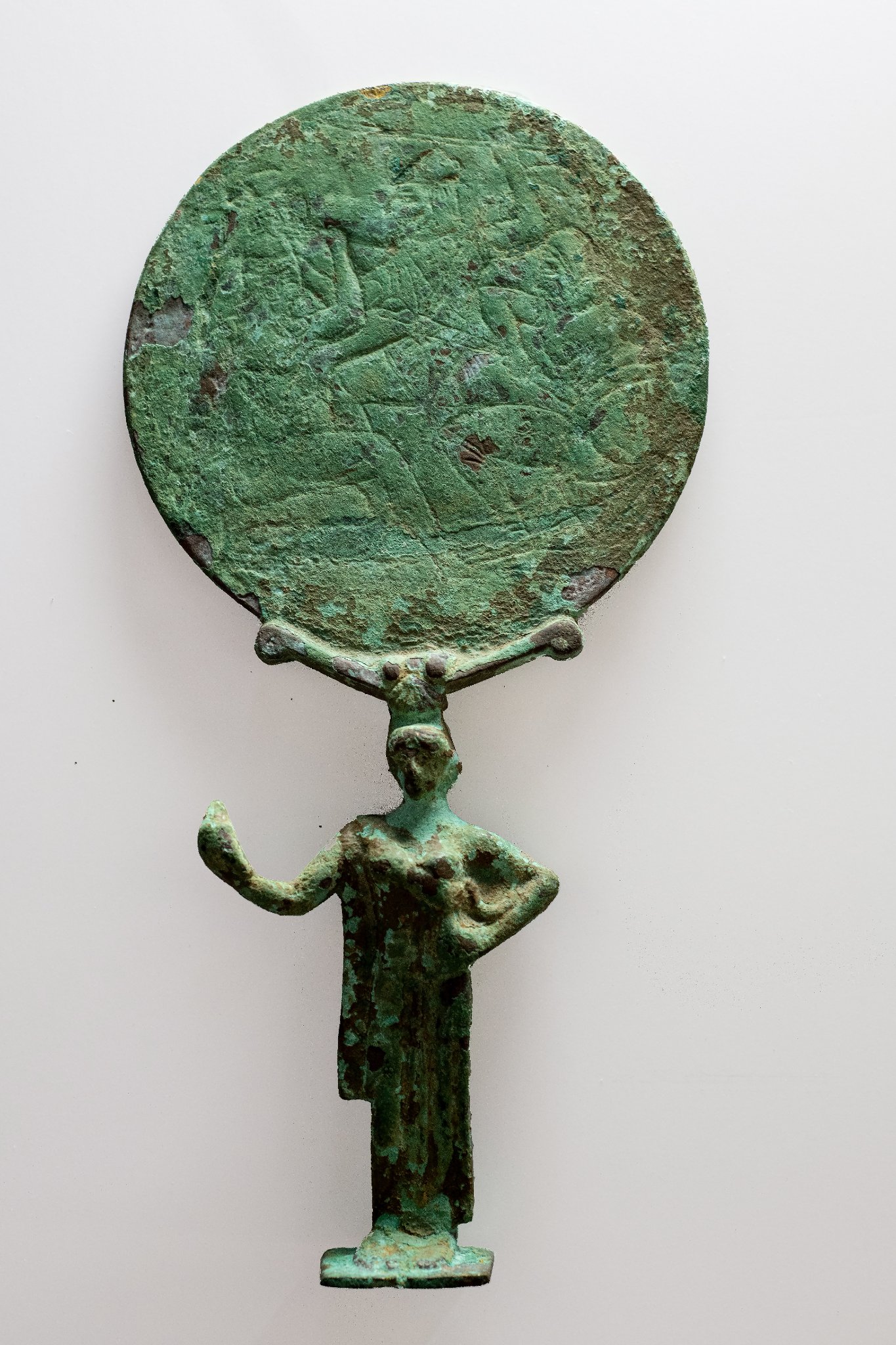
An Story About A Found Artifact by Brookdale Community College Professor Marie Naples Maber
Created before Jesus walked the Earth and found in New Jersey
While alone on vacation on a lazy day in Cape May, I set out for a long walk. As I was about to pass an antique shop in the harbor area, my curiosity made me stop in to browse around instead.
The glass cabinets had vintage figurines and ropes of jewels that caught the light. Tabletops were cluttered and crowned with dishes, silver, cups, and bowls, all beautifully designed. In the second room, on a back table, rested a large, heavily encrusted object that did not belong within this mix. Its surfaces were corroded and obscured with layers indicating more distant antiquity.
This object could have been made before Jesus walked the Earth but after Moses parted the Red Sea. Why was it here in the Cape May Harbor? The handle formed a standing draped female, her right hand holding a dove. The top part formed a perfect circle with deeply engraved lines, obscured by corrosion. With its layering of mottled green over bronze with flecks of gold in between, it felt authentic. What was its function? It was far too delicate to be a weapon. How could it be priced at $125 when it seemed to be so old?
The store clerk had few answers to my questions, stating that their vendors don’t supply information about the goods they’ve purchased from estate sales and consigned there. I reached out to a former classmate from Temple University, Dr. Senta German, who worked at the Ashmolean Museum of Art and Archaeology at the University of Oxford and now works at Montclair State University as an associate professor in Classics and Humanities department. She identified the object as a caryatid mirror, an Etruscan object from the 6th century BCE.
I’d seen similar objects on display on the mezzanine (Etruscan/Roman) level of The Metropolitan Museum of Art in New York City. Did this object belong there, too? Perhaps, it truly belonged in Italy where it seems to have originated. I had to buy it. Otherwise, I’d never forgive myself for leaving it in the harbor shop where it could end up on someone’s coffee table as a paperweight.
I called local photographers Liz and Bob McKay at McKay Imaging in Red Bank. I knew they would be able to place this object under a “raking light” that skims the object’s surface to reveal its delicate detailing and provide a photo to reveal more than our naked eyes can see.
Having a burning desire to share this find, I posted images on Facebook. Many of my former classmates and colleagues from Brookdale Community College, where I’ve taught Art History for the past 30 years, have ongoing discussions about objects of art. Once I’d posted this object, someone wrote that likely this piece was discovered by an American Soldier digging ditches during WWII and brought home as war booty. That explanation is good enough for me — especially since we’ll never know the facts of its journey here.
According to Nigel Spivey, in his 1997 book, “Etruscan Art,” from Thames and Hudson’s World of Art Series, “If a girl from an Etruscan family in Veii were being married to a youth from a similarly aristocratic family from Tarquinia or Rome, then a mirror may have become part of an inner-clan agreement, and its iconography would have been accordingly portentous.”
He goes on to describe mirrors inscribed for personal use as bearing the imagery of Aphrodite and the Judgment of Paris, Ganymede, Zeus and erotic designs that have their origins in Greek mythology. The warrior scene inscribed on this disc describes a historic conflict, its characters identifiable by their headgear, weapons and a shield.
Nigel Spivey also says, “Etruscan mirrors survive because they were placed in tombs.”
So yes, this mirror could have been dug up by an American Soldier during WWII and landed in his basement in New Jersey, ultimately resurfacing in an Estate Sale upon his death.
I have reached out to another former classmate who has contacts in major museums throughout Europe. I have offered this object (through her) to any archaeological museum in Italy that will take it, free of charge. It’s our civic duty to return such antiquities to their homelands in keeping with laws pertaining to the repatriation of cultural artifacts worldwide. I must not become too attached to this beautiful antique. Before long, she’ll be on her way home.
Marie Naples Maber is a professor of Art at Brookdale Community College, Lincroft, NJ. She also spent two summers on excavations on Pseira Island, north of Crete.



Leave a Reply
You must be logged in to post a comment.