
THE AMAZING SPIDER-MAN #1000 REVIEW: A THOUSAND ISSUES LATER, PETER PARKER STILL GETS BACK UP
·Al Mega
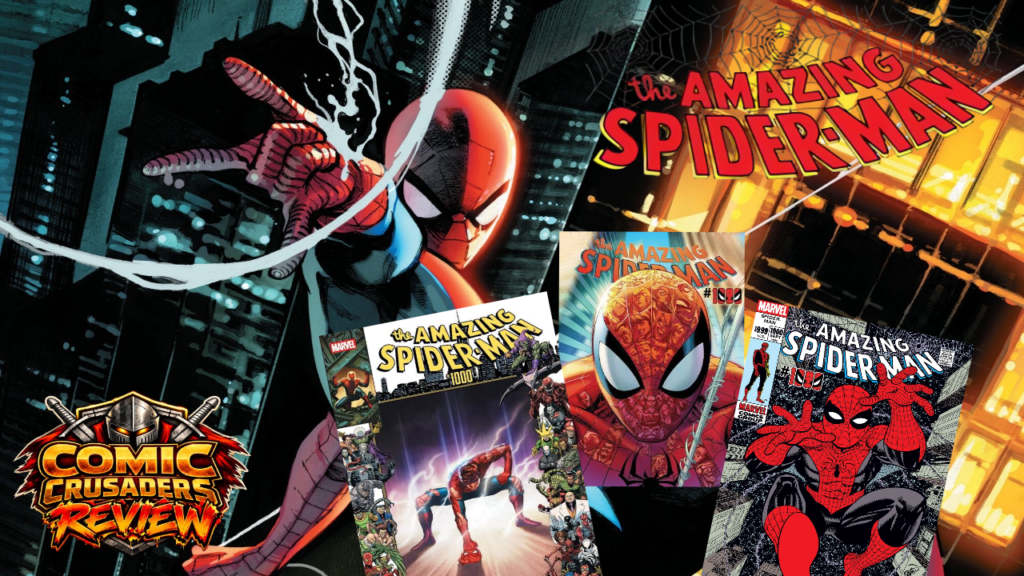
WEPAAAA! One thousand issues, fam. Really think about that for a second because that number is bananas. Peter Parker has been catching hell since 1963. Broke, dumped, evicted, cloned, buried, resurrected, embarrassed, fired, emotionally stomped out and financially abused by New York City more times than anybody should survive, yet this dude STILL puts the mask back on. That’s Spider-Man to me. It ain’t only the powers, the web-shooters or the jokes he cracks while somebody is trying to cave his chest in. It’s that stubborn New York mentality buried inside Peter Parker where life can knock you on your ass, take your wallet while you’re down there and somehow charge you a late fee too, and you’re still getting up like, “Aight, we doing this again? Bet.”
Joe Kelly and Pepe Larraz understand that immediately in the main story. Peter is already carrying enough weight with Aunt May suffering a stroke, everything surrounding Cormac Crane and the Parker family history, and another piece of his life getting rearranged without anybody bothering to ask him first. My guy can never just wake up, grab some coffee and have a regular damn Tuesday. Then Ravage comes crashing into the situation because apparently Peter’s misery had an opening on the calendar. Kelly is smart enough not to make Ravage another oversized punching bag created so Spider-Man can bounce off walls for twenty pages. He attacks the thing that has haunted Peter forever: the possibility that no matter how badly he wants to save somebody, there may eventually be something he simply cannot fix. Now the superhero action has some meat behind it because Peter isn’t only fighting Ravage. He’s fighting that fear too.
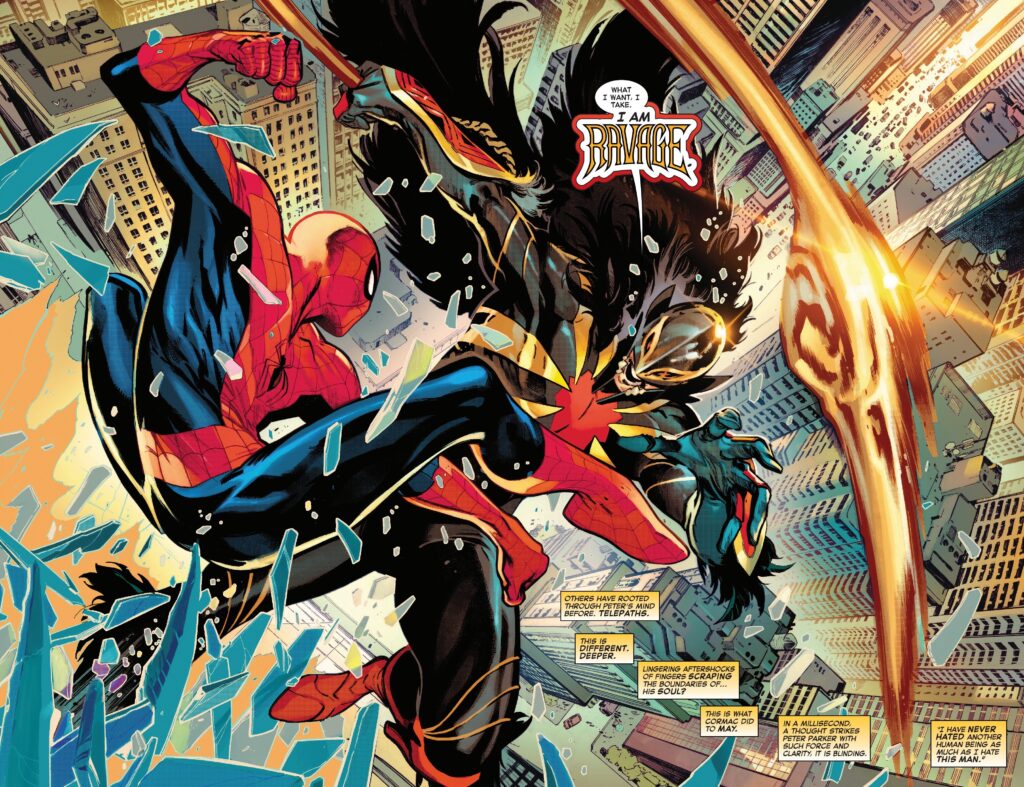
And Pepe Larraz? Yo, stop playing with me. This dude draws Spider-Man like movement itself threw on a red-and-blue suit. Peter twists through panels, launches across environments, folds himself into those impossible Spidey positions and ricochets through the action without the page turning into visual arroz con mierda. You always know where Peter is, where he came from and where the impact is going. That’s harder than some artists make it look. Once Ravage enters the picture, Larraz changes the physical relationship immediately. Peter suddenly looks smaller without looking helpless. He’s quicker and constantly moving, but Ravage occupies the page like a damn building woke up and decided it had beef with Spider-Man. Federico Blee’s colors push that contrast even harder, especially when the story moves from those colder hospital scenes into louder superhero territory, while VC’s Joe Caramagna handles dialogue, sound effects and emotional shifts without stepping all over Larraz’s storytelling. That core team is cooking, plain and simple.
Then this giant anniversary book opens the vault, and that’s where Amazing Spider-Man #1000 stops feeling like an oversized installment of the current run and starts becoming a Spider-Man family reunion. Marvel basically brought creators from different generations into the room and said, “Aight, tell us why this dude matters to you.” That’s exactly what an anniversary book like this should do. The voices don’t match. The artwork doesn’t match. Some stories are sentimental, some weird, some funny, and others feel like they escaped from completely different periods of Spider-Man history. Good. I don’t want 100-plus pages where everybody sounds the same and every artist is trying to imitate one house style. Let everybody cook their own arroz.
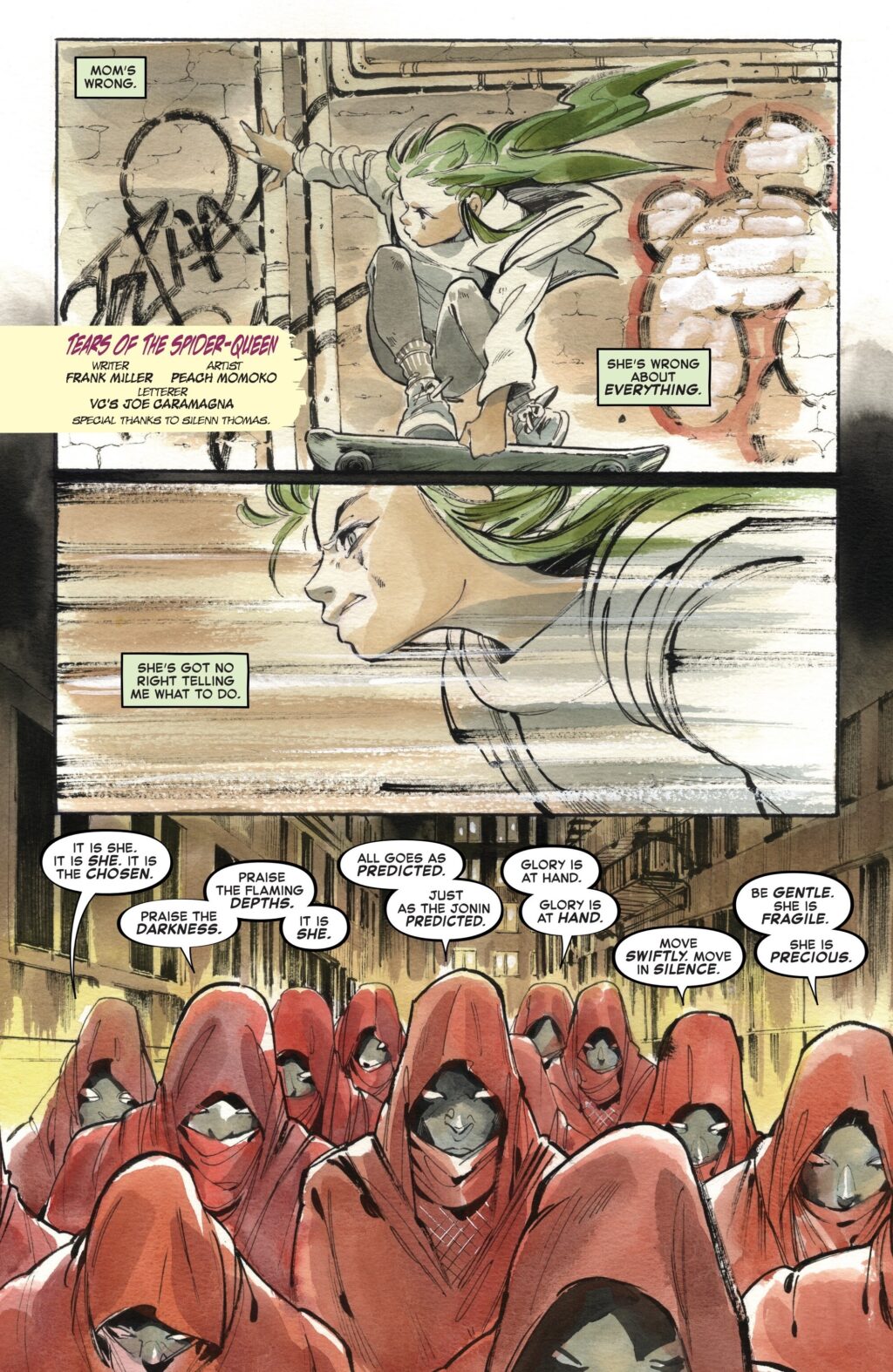
Frank Miller working with Peach Momoko on “Tears of the Spider-Queen” is probably the strangest example of that philosophy. I saw those two names together and immediately went, “Miller and Momoko? Who put THIS combo together?” On paper, that’s kinda cray-cray. Once you actually get into the story, though, Momoko’s dreamy watercolor textures rubbing against Miller’s harder storytelling instincts gives the piece its own identity. It doesn’t remotely resemble the Larraz material that came before it, and thank God for that. Issue #1000 should feel like you’re walking through different rooms of the same giant Spider-Man house rather than staring at the same wallpaper for a hundred pages.
Triple H, Rob Fee, Ed McGuinness, Mark Farmer and Matthew Wilson come swinging in with “The Big Night,” and yea, seeing Triple H sitting in the credits of Amazing Spider-Man #1000 made me look twice too. Wrestling and comics have always been cuzo’s, so I’m not mad at it, especially because the story goes somewhere much more personal than I expected. McGuinness brings that huge expressive energy he always carries, but underneath all that visual muscle is something quieter about Peter’s childhood and the people who helped shape him before Spider-Man existed. Uncle Ben obviously matters, but Peter Parker wasn’t manufactured by one tragedy and one famous sentence. He was shaped by Queens, May and Ben, school, friendships, rejection, embarrassment, neighbors and all those little experiences you don’t realize stayed with you until you’re older.
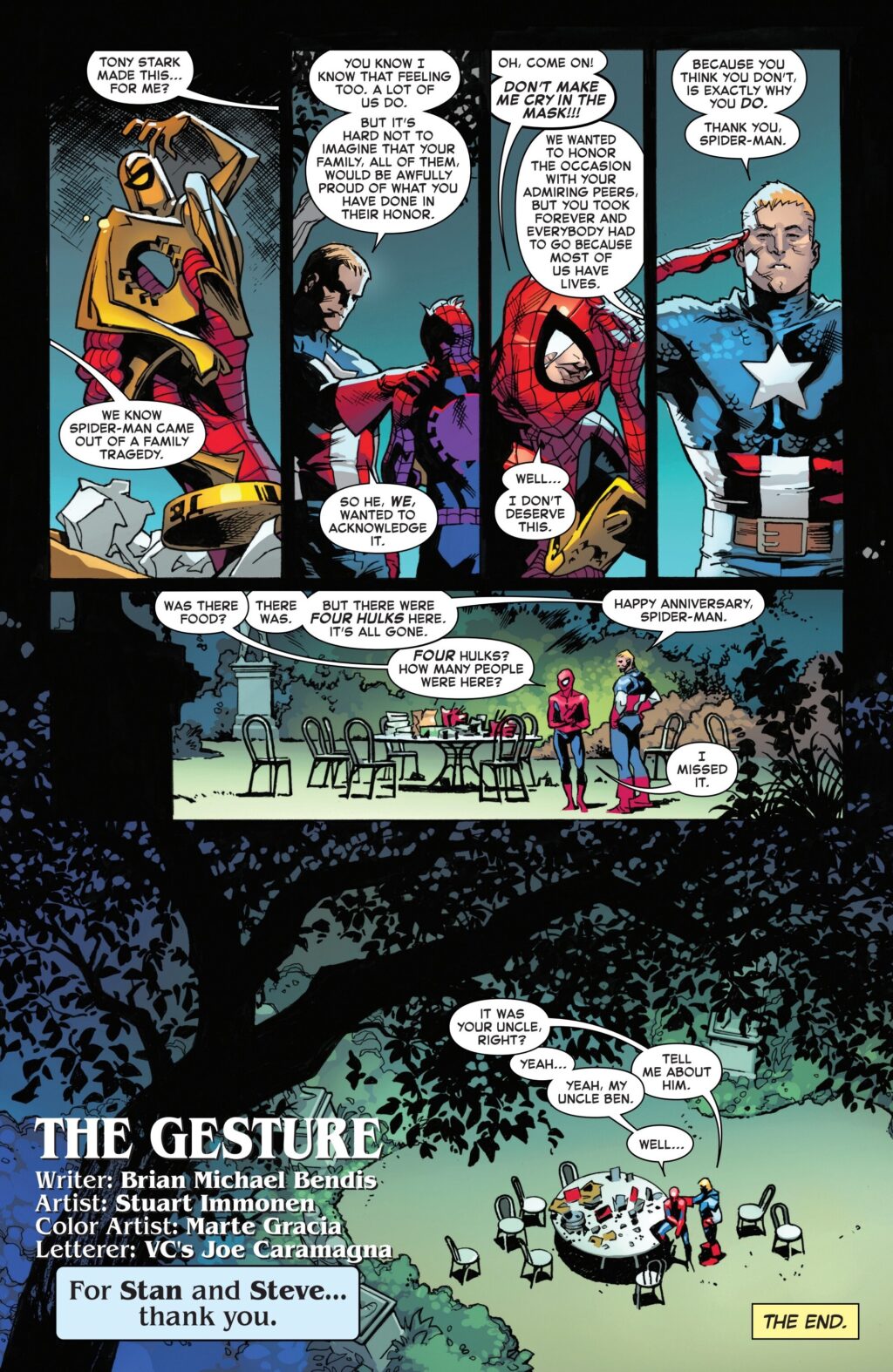
Brian Michael Bendis and Stuart Immonen returning together for “The Gesture” might be one of my favorite pieces in the whole package because they don’t need Manhattan exploding to make Peter interesting. Nobody has to crack open another multiverse. Galactus can stay home today. Peter’s fellow heroes simply recognize what he’s done, and Spider-Man has absolutely no idea how to handle being appreciated. Of course he doesn’t! This cabrón can save half of New York before lunch and still look confused when somebody gives him flowers. Immonen’s body language is ridiculously good here, while Bendis lets the humor live naturally inside the emotion instead of waving some giant sign telling you where the joke is. That little Captain America exchange gets right to the heart of Peter. Everybody else sees what Spider-Man has accomplished. Peter remembers the people he couldn’t save.
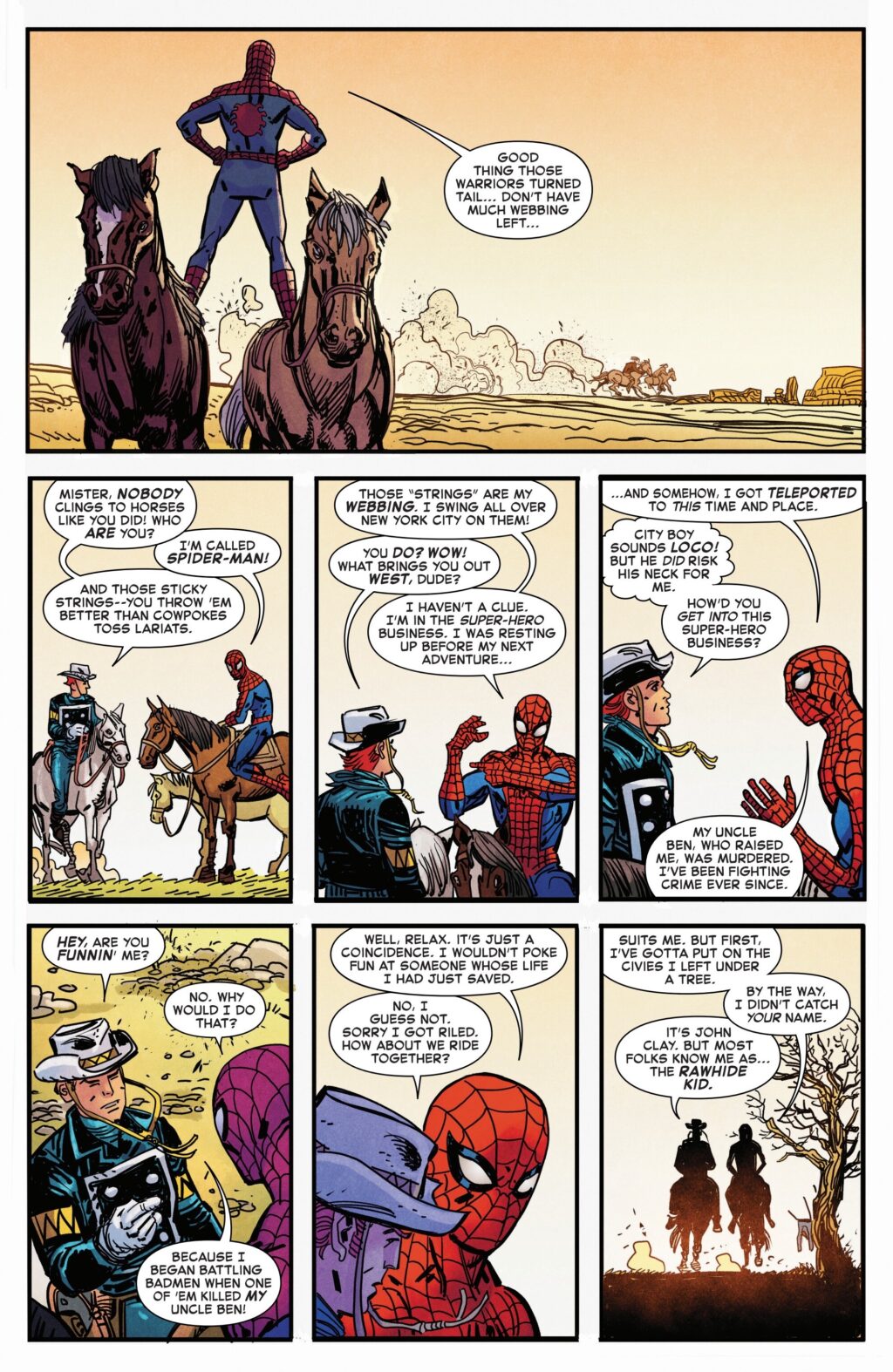
Larry Lieber’s “Of Webs and Six-Guns,” with Giuseppe Camuncoli and Klaus Janson, comes rolling in from another damn zip code and throws Spider-Man into a Western-flavored adventure. You know what? It’s issue #1000, coño. Why the hell not? That’s part of the fun of this entire package. Spider-Man can survive damn near any genre because the costume isn’t what holds the character together. Put Peter in Queens, throw him into space, drag him through horror, make him an Avenger or dump his ass into the Old West. As long as the person underneath that mask still reacts like Peter Parker, the character travels. That’s a testament to how strong the foundation really is.
The issue also understands that you can’t celebrate Amazing Spider-Man #1000 without acknowledging Stan Lee and Steve Ditko. Those names don’t need fireworks exploding behind them because the history already carries enough weight. Amazing Fantasy #15 gave readers this awkward teenage kid who worried about money, got embarrassed, made selfish decisions, got angry and sometimes acted like a pain in the ass. He wasn’t some perfect superhero floating above everybody else’s problems. Peter had problems before the spider bite, and getting powers basically gave him a whole new subscription package of bullshit. That’s why generations connected with him. Since then, hundreds of writers, pencilers, inkers, colorists, letterers and editors have grabbed that foundation and said, “Okay, my turn.” Some protected it, some stretched it, some reinvented it and, let’s keep it a buck, some decisions had Spider-Man fans ready to launch the comic across the room. Through all of it, Peter survived.
Now, does every story in this monster hit with the same force? Nah, fam. Come on. With more than 100 pages and this many creators, that was never happening. Some stories really landed for me, while others felt more like cool anniversary pieces that I enjoyed and kept moving. A couple finish right when they seem ready to dig into something deeper, and the transition from Kelly and Larraz’s Ravage storyline into the celebratory material definitely changes the rhythm. If you’re buying this because you’re invested in the current run, you may feel somebody hit the brakes just when that story gets hot. If you’re here strictly for the #1000 celebration, you might wonder why part of your giant anniversary issue is handling ongoing continuity. That’s the weird dance Marvel has to do here, and for the most part they keep both feet underneath them.
At $9.99, though, Marvel at least brought some food to the damn party. This doesn’t feel like they took a regular issue, stapled twelve pages of congratulations behind it and yelled, “Historic milestone!” There’s a ridiculous amount of talent packed into this thing. Joe Kelly, Noah Hawley, Frank Miller, Dan Slott, J.M. DeMatteis, Brian Michael Bendis, Triple H, Rob Fee and Larry Lieber are among the writers, while Pepe Larraz, Patrick Gleason, Peach Momoko, Marcos Martin, Humberto Ramos, Stuart Immonen, Ed McGuinness and Giuseppe Camuncoli represent this crazy visual trip through different generations of Spider-Man. Everybody isn’t cooking the same dish, but that’s exactly why the buffet works.
What stayed with me after closing the issue wasn’t Ravage or even that giant creator roster. It was Peter Parker and the absurd amount of punishment this fictional man has survived. Writers have changed his job, his apartment, his relationships and damn near every other part of his life. They’ve given him money and taken it away because apparently Marvel gets nervous whenever Peter can afford groceries. They’ve killed people he loves, brought some back, cloned him, replaced him, shot him across dimensions, put him on the Avengers, handed him businesses, destroyed those businesses and found about fifteen thousand different ways to make his life miserable. Yet through all that insanity, one thing keeps surviving every creative team and every era: somebody needs help, Peter moves toward them. That’s the sauce right there, papo. That’s Peter Parker.
The Amazing Spider-Man #1000 works because underneath all the anniversary fireworks, variant covers, nostalgia and historical significance, it remembers why we’re still here. Peter was never the strongest guy in the Marvel Universe, and he was never supposed to be. He’s the kid from Queens who knows what it feels like when nobody comes to save you, so when somebody else is in trouble, he goes. Even when he’s exhausted. Even when he’s hurt. Even when his own life is falling apart around him. Issue #1000 isn’t flawless, but it defo understands the character it’s celebrating, and after sixty-plus years of Spider-Man getting knocked down and dragging himself back up again, that still hits me the same way. One thousand issues later, fam, the mask still fits. WEPAAAA!
Crusaders Score:
4.5/5

Main Story Writer: Joe Kelly
Main Story Artist: Pepe Larraz
Main Story Color Artist: Federico Blee
Letterer: VC’s Joe Caramagna
Designer: Jay Bowen
Editor: Nick Lowe
Assistant Editor: Kaitlyn Lindtvedt
Associate Editor: Tom Groneman
Editor in Chief: C.B. Cebulski
Additional Writers: Noah Hawley, Frank Miller, Dan Slott, J.M. DeMatteis, Brian Michael Bendis, Triple H, Rob Fee, Larry Lieber
Additional Artists: Patrick Gleason, Peach Momoko, Marcos Martin, Humberto Ramos, Stuart Immonen, Ed McGuinness, Giuseppe Camuncoli, Klaus Janson and additional contributing creators
Main Cover Artists: John Romita Jr. & Paolo Rivera; Pepe Larraz & Marte Gracia
Publisher: Marvel Comics
Leave a Reply
You must be logged in to post a comment.