
DIVINITY CALLS SHOTGUN Review: Heaven Has a Vacancy and All Hell Just Broke Loose
·Al Mega
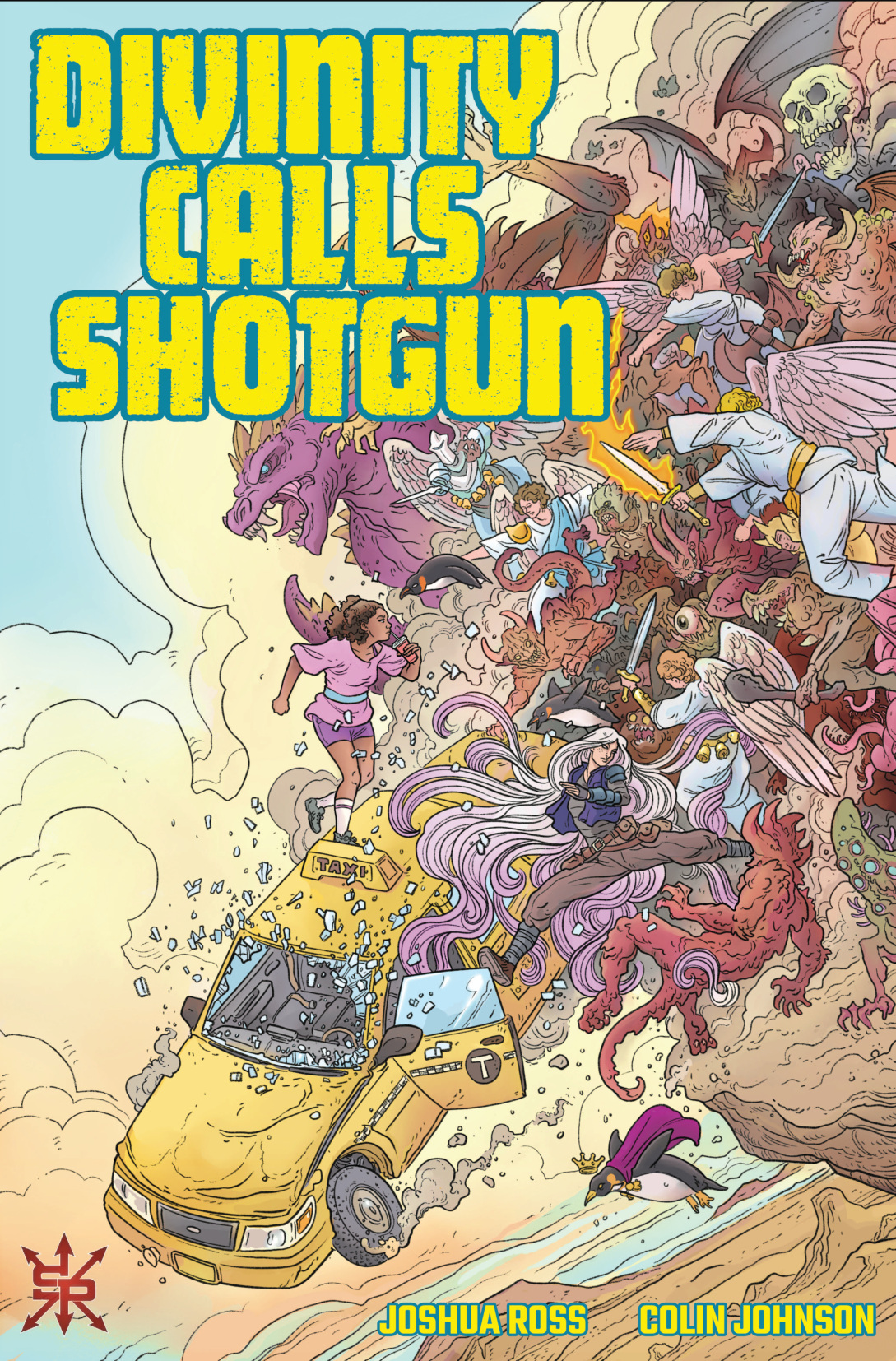
WEPA! Now THIS is more like it. Divinity Calls Shotgun is the kind of graphic novel that looks you dead in the face, tells you God is dead, introduces the possible replacement while he’s dealing with crusty-ass pink eye, then sends a gigantic monster rampaging through the city before you’ve had time to process what in the holy hell you just read. Joshua Ross is not easing anybody onto the highway here. He throws the cosmic emergency lights on, punches the gas, and trusts you to hang on.
The setup is beautifully ridiculous. God is dead, and apparently divine succession works a little differently than Sunday school led us to believe. Mitch, an absurdly nice, deeply religious thirty-three-year-old guy living an almost aggressively wholesome life, is next in line for the job. The problem is Mitch doesn’t know any of this. He’s waking up, making breakfast, meditating, watching televangelists, helping old ladies, feeding birds and generally existing like the human equivalent of a warm glass of milk while the supernatural world is turning into a five-car pileup behind him. Heaven is overloaded, demons are making moves, ancient powers are circling the vacancy, prayers are stacking up, and giant creatures are suddenly treating civilization like a demolition derby.
That’s where Ross gets the hook in deep. Mitch could have been unbearably corny in lesser hands, but the book knows exactly how funny this dude is. He’s so genuinely decent that it becomes part of the gag without making him the punchline. The early sequence establishing his personality is hilarious because Ross keeps adding another wholesome detail until you’re basically waiting for woodland creatures to start helping Mitch make the bed. Even when danger comes looking for him, Mitch remains oblivious enough to make everybody trying to kill him look increasingly incompetent. It’s a great running bit, but more importantly, it makes Mitch immediately likable. Then Ross starts opening the throttle.

Once the celestial players begin crashing into Mitch’s ordinary world, Divinity Calls Shotgun becomes this gloriously weird mixture of road-comedy energy, supernatural action, religious satire, creature-feature madness and buddy-story banter. Ross has clearly built a massive mythology behind the book, but the fun comes from watching these grand cosmic personalities behave like dysfunctional employees at the worst-managed company in creation. Heaven has hierarchy problems. Hell has hierarchy problems. Angels are frustrated. Demons are frustrated. Everybody has grievances. Apparently immortality does not protect you from bad management, fam. That might be the most believable supernatural concept in the whole damn book.
Jesse becomes one of the biggest reasons the story works. The guy looks like somebody who has been awake for six straight days, has several warrants in three dimensions, and would rather solve a theological dispute with twelve-gauge ammunition than attend another celestial meeting. His dry reactions play perfectly against the increasingly insane situations around him. Ross knows when to let Jesse talk, when to let him react, and when to simply put a shotgun in the man’s hands and get the hell out of the way. There’s a wonderfully nasty streak to the character, but there’s also enough weariness and personality underneath it to keep him from becoming generic supernatural tough-guy number 847.
The demon and divine characters are equally nuts. One minute you’re dealing with enormous cosmic consequences, the next you’re watching immortal beings squabble, insult each other, complain about their assignments or drop some wildly inappropriate observation right in the middle of Armageddon. The comedy can get crude, violent and gleefully stupid, and I mean stupid in the good way. Ross commits to the gag. He doesn’t wink at you afterward and ask if you understood it. He throws the joke, moves on, then comes back with a kaiju smashing through a building like somebody ordered Godzilla by way of Preacher.
Once Ross gets all the celestial craziness rolling in the same direction, Divinity Calls Shotgun really starts cooking. The opening has to do some heavy lifting because this dude basically built a whole supernatural power grid from scratch, so yeah, there are moments where the book pulls over to explain how the engine works before smashing the gas and sending the whole cosmic jalopy screaming down the highway. There are pages loaded with narration and mythology where I wanted the transmission shifted into the next gear a little quicker. But once Mitch, Jesse and the various heavenly and hellish factions become active parts of the same mess, the story gets much smoother. Conversations shorten, action gets bigger, jokes land faster and Ross starts using the world he built instead of stopping to describe it. And visually? Yo. Joshua Ross draws the living hell out of this thing.

His everyday character work has a slightly old-school comic-book cleanliness that helps the stranger material pop harder. Mitch’s house feels normal. Streets feel lived in. Characters aren’t posed like action figures waiting for splash pages. There’s an earthy quality to the linework that keeps everything grounded until Ross decides it’s time to unleash some enormous purple nightmare with teeth like broken tombstones. Then everything goes kaboom.
Ross clearly LOVES monsters, and brother, it shows. The kaiju sequences are packed with debris, busted architecture, explosions and chunky creature detail. The monster isn’t just standing there looking impressive. It occupies the page. It pushes against panel borders. Buildings suddenly feel tiny. Characters become specks. Those changes in scale give the action some real juice because you actually feel the difference between the human-level scenes and the cosmic madness surrounding them.
The book’s creature designs are also awesomely gross. Ross doesn’t settle for generic horned demons walking around looking like rejected heavy-metal mascots. There are things with too many teeth, too much flesh, weird anatomy, bizarre expressions and enough gnarly little details that you’re constantly scanning backgrounds. Some pages have that glorious Shaolin Cowboy mentality where your eyeballs start wandering around the artwork looking for whatever insane detail you missed on the first pass.
Colin Johnson’s colors are doing major work keeping all that visual lunacy readable. The mundane scenes stay controlled and approachable, which gives the supernatural stuff room to explode. Purples, sickly reds, fiery oranges, icy blues and celestial light push the different worlds apart without turning every page into Skittles soup. When the big action hits, Johnson lets the monsters and destruction scream while still preserving Ross’s linework. That’s important because once you have creatures, buildings, smoke, debris, blood and characters sharing the same page, one wrong color decision and everybody gets lost in the sauce.

The visual comedy deserves mad love too. Ross doesn’t rely entirely on dialogue to sell jokes. Facial expressions, panel timing and sudden cuts do plenty of heavy lifting. The penguin sequence is a perfect example of how bizarre the humor can get. You have regal penguins speaking their own language, demonic assassination nonsense, extreme violence and somebody essentially shrugging through the entire catastrophe. It shouldn’t be funny. It absolutely is. That’s the flavor of Divinity Calls Shotgun at its best. Ross sets up something ridiculous, plays it completely straight, then drives it directly through the guardrail.
The book also isn’t afraid to get bloody. When Ross decides somebody is getting splattered, you ain’t getting the PG version. Bodies burst, things get blown apart and monsters become chunky abstract art. Yet the violence fits the exaggerated universe. It doesn’t suddenly turn the book into grim torture porn because the comedic rhythm is still there underneath it. You can practically hear Ross saying, “Yeah, yeah, philosophy later. Watch this dude explode.”
There’s real imagination packed into these 200 pages. Every time you think you’ve figured out the lane, Ross changes lanes without signaling. Biblical mythology bumps into ancient gods. Cosmic authority meets bureaucracy. Monsters crash through cities. Heaven has staffing problems. Hell has office politics. Mitch is still Mitch. The whole thing feels like somebody took Dogma, Preacher, a monster movie and an Adult Swim fever dream, tossed them into the trunk of a beat-up Crown Vic and drove from Brooklyn to the gates of Heaven with the check-engine light flashing the entire way. Most importantly, Divinity Calls Shotgun is FUN.
It isn’t flawless. Some of the early exposition could lose a little weight, a few jokes run longer than they need to, and certain mythology dumps briefly put the brakes on an otherwise energetic ride. But those bumps never made me want to get out of the car. Ross keeps rewarding the reader with another great character moment, ridiculous visual, nasty creature, unexpected gag or big action sequence.
By the time Divinity Calls Shotgun reaches full cosmic-chaos mode, the book has become exactly the wild ride that cover promises. Joshua Ross brings a strong creator-owned personality to the page, Colin Johnson makes the supernatural madness pop without burying the storytelling, and Michael Negin helps steer a seriously packed concept through 200 pages without the wheels flying completely off. This sucker is strange. Loud. Funny. Bloody. Occasionally ridiculous. Frequently gorgeous. And I dug the hell out of it.
Divinity Calls Shotgun feels like the comic somebody makes when they’re tired of being told a story has to stay inside one genre. Ross grabs theology, kaiju, horror, fantasy, action and comedy, throws them all in the passenger seats and screams, “Everybody buckle up!” Nobody buckles up. That’s half the fun.
Crusaders Score:
4.5/5

Written & Illustrated by: Joshua Ross
Colors by: Colin Johnson
Edited by: Michael Negin
Based on a Short Story by: Jonathan Ross
Publisher: Source Point Press


Leave a Reply
You must be logged in to post a comment.