
Scorn Review: Michael Nunneley’s Norse Grimdark Tragedy
·Al Mega
Scorn walked into my reading pile with blood on its boots, Norse gods looking over its shoulder and the kind of bad decision following behind it that makes you wanna yell, “Bro… NO!” before the character even finishes the sentence. WEPA! Michael Nunneley calls this a Norse grimdark fantasy, and after riding with King Ingvar from the opening voyage through every increasingly brutal consequence that follows, yeah fam, that description fits tighter than chainmail before a raid. Quick clarification for my Crusaders, because we keep the receipts around here: Scorn is a prose novella rather than a sequential-art graphic novel, but I attacked this review exactly the way I would an original graphic novel, cover to cover, judging the complete journey instead of cherry-picking its coolest battles. What Nunneley delivers is a violent mythological tragedy powered by faith, leadership, lust, grief, supernatural horror and one gigantic question: when your own choices burn your whole world down, how much responsibility are you willing to carry?
King Ingvar is what makes this thing work. Nunneley could have easily dropped some generic Viking brute into the middle of a battlefield, handed him two axes and called it a day. Nah. Ingvar is a king, farmer, husband, father, warrior and deeply religious man whose relationship with the gods forms the backbone of his identity. When Freya sends him on a quest to rescue Odin’s raven Muninn, Ingvar treats the mission like the ultimate divine cosign. Imagine getting personally tapped by the gods for the biggest assignment of your life. Your chest is gonna puff out a little. His expedition to Sudrey becomes a slaughterhouse almost immediately, complete with an enemy ambush, flaming traps, berserkers, shapeshifting, gruesome wounds and armies colliding while supernatural forces hover over the carnage. Nunneley goes hard here. Axes bite. Bodies open. People get absolutely wrecked. Yet the battle itself is almost a setup for the real story, because Scorn gets far more interesting once Ingvar survives the thing that should have killed him.
Enter Fegra. Bruh. If somebody ever needed an instructional video called “People You Absolutely Should Not Make Romantic Promises To Unless You Mean Them,” Fegra would be hosting the seminar. She arrives as this ancient, mysterious volva carrying tremendous magical authority, resurrecting fallen warriors, healing wounds and operating so close to Freya and Odin that everybody around her immediately understands they are dealing with somebody extraordinary. When Ingvar is horribly wounded, Fegra helps save his life. Respect becomes fascination. Fascination becomes desire. Desire starts making executive decisions. There goes the neighborhood. Nunneley plays their relationship as more than cheap temptation, which is important because Ingvar genuinely develops feelings for her while still loving his wife Ulla. That contradiction is ugly, selfish and completely human. Fegra also isn’t some cardboard evil witch waiting backstage for her villain cue. She opens herself emotionally after having been hurt before, accepts Ingvar’s promise of his heart and believes the commitment carries real weight. Ingvar eventually realizes what his affair is doing to his family, warriors and responsibilities, but recognizing stupidity after signing the contract does not magically cancel the contract. When he chooses home over Fegra, the emotional bill arrives with supernatural interest.
From there, Scorn stops playing around. The fantasy quest mutates into straight horror as Ingvar learns exactly how expensive one broken oath can become. A death-spirit begins stalking his existence, possessing people around him and turning friends, warriors and family against one another. Nunneley makes these scenes vicious. Not comic-book splash-page vicious where everybody looks cool getting hit. I mean uncomfortable, wet, panicked horror where somebody wakes up and realizes the person they trusted five minutes ago is now trying to murder them. Characters we have spent time getting to know disappear fast, sometimes horribly, and each death strips another layer off Ingvar until the mighty king introduced near the beginning starts looking emotionally naked. The violence will absolutely be too graphic for readers looking for cozy mythology with a little swordplay. Wrong longship, primo. Scorn wants consequences to hurt, and Nunneley keeps tightening that screw until grief becomes almost another character following Ingvar across the landscape.
The Norse material has real muscle because Nunneley does not treat mythology like decorative wallpaper. His preface makes his mission clear: build a world where the Norse myths are not dusty stories but accepted reality woven into ordinary life, and he largely pulls that off. Odin, Freya, Loki, Muninn, the Norns, Valhalla, Folkvang, volvas, wights, berserkers, god-houses and ritual practices all exist naturally inside the worldview of the characters. Ingvar does not wonder whether Odin exists. He worries whether Odin is pissed at him. Big difference. That perspective gives the fantasy a strong internal logic and lets Nunneley explore something deeper than mythological name-dropping. Faith becomes terrifying when the gods you worship are demonstrably real yet still refuse to save you. The later collision between Ingvar’s Norse worldview and Aldred’s radically different concept of a single foreign god adds another fascinating wrinkle, especially because Ingvar’s desperation never automatically becomes conversion. He is willing to seek help outside his faith without conveniently rewriting who he has always been. That kind of character consistency matters.
Nunneley also understands that grimdark cannot survive on entrails alone. Under all that steel and supernatural nastiness is a tragedy about leadership. Ingvar repeatedly faces the difference between fate and accountability. He believes deeply in the Norns and knows destiny governs mortal lives, yet he never uses fate as a cheap excuse for his mistakes. His disastrous battlefield confidence, romantic betrayal, delayed return to Kust and consequences for the families that trusted him keep circling back to the same uncomfortable truth: being king means you own what happens under your command, especially when your judgment helped cause it. There are moments where the prose explains its mythology or character motivations more than necessary, and certain conversations can become instructional instead of natural, particularly when characters recap information for one another. A tighter editorial blade could shave some repetition and make the momentum even nastier. Still, the emotional intent remains clear, and once the curse starts collecting bodies, Nunneley keeps the narrative moving with increasing dread.
The final movement is where the title really lands. Ingvar loses pieces of himself faster than he can comprehend what is happening, and every possible escape becomes another test of what kind of man remains underneath the crown, weapons and reputation. That is the nasty beauty of Scorn. This isn’t really asking whether Ingvar can defeat the monster. It asks what dignity looks like after a man realizes he helped create the monster standing at his door. Fegra’s vengeance becomes increasingly monstrous, but Ingvar’s responsibility never disappears simply because her retaliation goes beyond anything reasonable. Nobody gets a clean moral exit. Even divine intervention comes with clauses, debts and consequences. By the time Nunneley reaches his bleak conclusion, everything promised in the opening has been turned inside out. The warrior who can walk into battle against impossible odds discovers that surviving grief, shame and his own choices may be infinitely harder than surviving an axe.
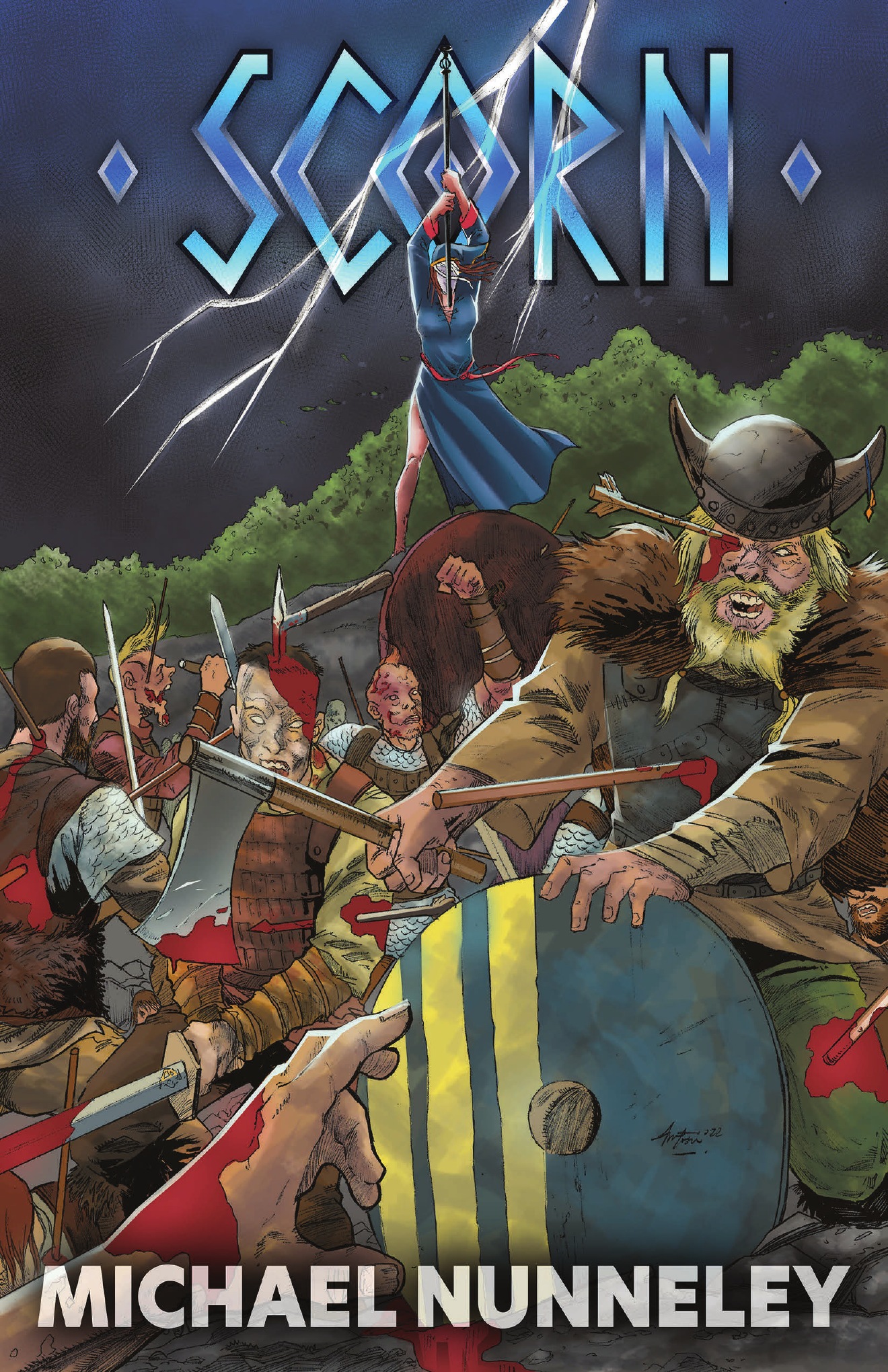
Tosin Awosika’s cover artwork sells that atmosphere before page one even starts, packing warriors, shields, blood, steel and looming supernatural menace beneath the sharp SCORN logo. Since this is prose rather than sequential art, that cover carries the book’s primary visual burden, and it does the job. Fans of The 13th Warrior, Vikings, tabletop fantasy, old-school sword-and-sorcery and horror that ain’t afraid to get its hands dirty should find plenty to chew on here. Michael Nunneley came to the mead hall carrying more than a Viking adventure. He brought a tragedy about masculine responsibility, shattered trust, religious devotion, obsession and the difference between admitting you screwed up and actually surviving what happens afterward. Savage. Messy. Mean when it needs to be. Surprisingly emotional when the armor comes off. Scorn ain’t asking whether hell hath fury like somebody scorned. It’s basically saying, “Fam, you really wanna test that theory?” Trust me. You don’t.
CRUSADERS SCORE
4/5
Written by: Michael Nunneley
Publisher: Revelation Publications
Imprint: Revelation Publications, an imprint of Omen Publications
Editor / Foreword: Steve Sellers
Cover Artwork: Tosin Awosika
Logo / Cover Design: Kayla Colvard at Forrest Office, Susanville, California
Copyright: © 2026 Michael Nunneley
Leave a Reply
You must be logged in to post a comment.