
You Must Take Part in Revolution Review: Resistance, Regret & Revolution
·Al Mega
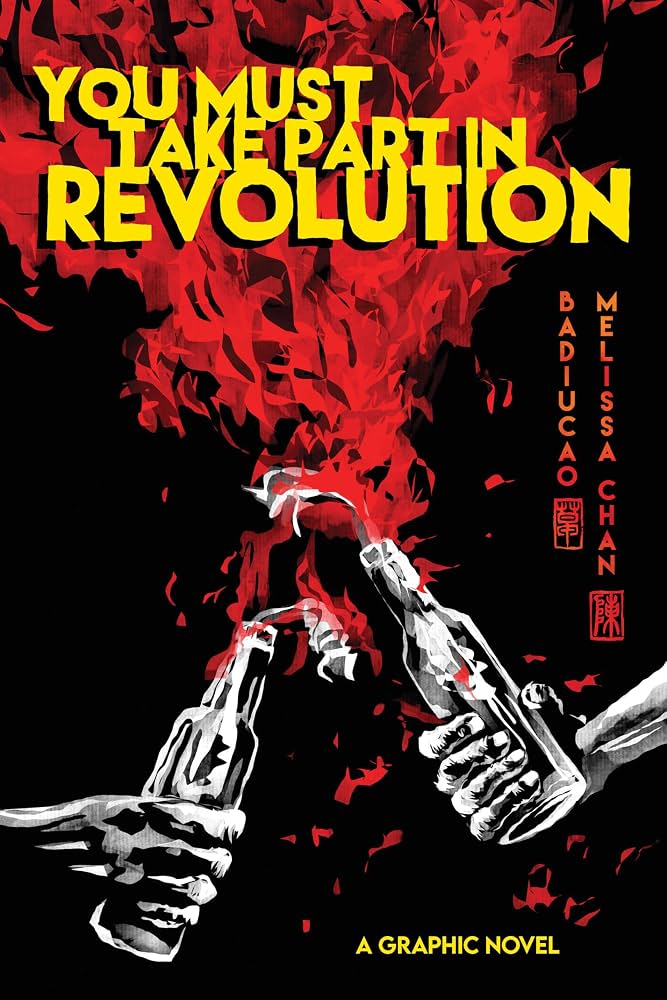
WEPA! Every once in a while a graphic novel walks into the room, kicks your emotional coffee table over, looks you dead in the eye, and says, “Nah, fam, we are not doing comfortable today.” You Must Take Part in Revolution is that kind of book. This is not a casual dystopian snack you read between memes and microwave leftovers. This thing has teeth. It bites. It chews on your nerves. Then it asks you why you were so relaxed in the first place.
Created by Emmy-nominated journalist Melissa Chan and activist artist Badiucao, You Must Take Part in Revolution is a near-future political graphic novel that feels less like science fiction and more like tomorrow morning’s worst headline got dragged through ink, smoke, blood, guilt, and memory. It begins in the shadow of Hong Kong, moves through the wreckage of resistance, and expands into a world where authoritarianism is not just one government, one flag, one villain, or one mustache-twirling clown with a podium. Nah. That would be too easy. This book understands that power wears different outfits depending on the neighborhood. Sometimes it shows up with tanks. Sometimes with cameras. Sometimes with patriotic speeches. Sometimes with slogans about safety. Sometimes with a smile and a spreadsheet. Creepy? Absolutely. Familiar? A little too much, my people.
At the center of the story are Andy, Maggie, and Olivia, three people who begin in the same storm but do not stay on the same road. That is where the book really cooks. In weaker hands, this could have been a flat political lecture with comic panels attached like garnish. Instead, Chan builds a character drama where every choice has weight, every compromise leaves a bruise, and every belief eventually gets dragged into the interrogation room. Andy believes in resistance, but fears what resistance can become. Maggie burns with conviction, but conviction without restraint can become its own kind of monster. Olivia is the most quietly devastating of the three, a person split between loyalty, fear, ideology, survival, and the horrible realization that obedience does not keep you clean. It just keeps your hands busy.
And that is the nasty brilliance of this book. It does not let anybody off the hook. Not the activists. Not the states. Not the soldiers. Not the informants. Not the bystanders. Not even the reader sitting there like, “Well, I would obviously make the right choice.” Yeah? Would you? Deadass? Because You Must Take Part in Revolution is not interested in your fantasy version of courage. It wants to know what you do when the cameras are watching, when your family is threatened, when your friends cross lines, when the government changes the meaning of words, when survival itself starts charging rent. That is a different conversation, papi1
Chan’s writing has that reporter’s backbone, sharp, observant, allergic to nonsense, but she is not just dumping research onto the page like a college professor losing a fight with PowerPoint. The world-building comes through lived moments. A protest. A broken arm. A bowl of wonton noodles. A curfew. A social credit penalty. A prison study session. A military base full of tension. A refugee office where paperwork becomes a border between life and oblivion. The little details hit because they are not little to the people living them. That is the trick. Oppression is not only the big dramatic raid. It is the daily squeeze. The constant adjustment. The way people learn to lower their voice, shorten their dreams, delete their jokes, and pretend they are fine because the walls might be listening.
Badiucao’s artwork is wild in the best possible way. The pages feel scraped out of smoke and charcoal, with red and yellow accents cutting through the gray like emergency flares in a blackout. The visuals do not sit politely on the page. They loom. They smear. They accuse. A crowd of umbrellas becomes both a symbol and a heartbeat. Birds become beauty, weaponry, guilt, and prophecy. Faces crack under pressure. Fire does not just burn, it invades the composition like history refusing to stay buried. The art has a protest-poster soul, but also a nightmare diary intimacy. It is not glossy. It is not trying to be cute. It is trying to make sure you remember. Mission accomplished.
What I dug most is that this book refuses the cheap version of rebellion. You know the type: hero throws a brick, music swells, everybody claps, roll credits. Nah, this is not that sanitized Hollywood revolution meal with extra fries. Here, resistance is necessary, but it is also dangerous. Anger can wake people up, but it can also blind them. Peaceful protest can be noble, but power may still crush it. Violence can feel like agency, but it can also become a trap that gives the state exactly the excuse it wanted. That tension is the engine of the whole book. It does not preach easy answers because easy answers are for people who have never had to choose between two bad options while the clock is ticking.
It also throws a cold bucket of water on the idea that authoritarianism is something that only happens “over there.” That is where it gets spicy. The future America in this story is not presented as some spotless defender of freedom riding in on a bald eagle with theme music. It is fractured, ugly, opportunistic, and flirting with its own fascist impulses. That choice gives the story extra venom because it refuses to turn democracy into branding. Democracy is not a logo. It is not a jersey. It is a practice. You maintain it, protect it, argue inside it, defend the vulnerable through it, and call out the rot when it starts stinking up the room. Otherwise, congratulations, you are just waving a flag over a busted machine.
Is this an easy read? NOOOO…. And good! Some readers may need to lock in because the book is dense with political context, time jumps, ideological conflict, and emotional fallout. This is not a breezy capes-and-punches joint where the villain explains the plan and the hero solves it with one uppercut. There are moments where the exposition gets heavy, and the geopolitical chessboard can feel like it is expanding fast. But for this story, that weight mostly works. The confusion, the pressure, the overload, all of that mirrors the world these characters are trapped inside. You are supposed to feel squeezed. You are supposed to feel uneasy. The book is not serving comfort food. It is serving truth with the hot sauce already mixed in.
Granny Chan deserves a special shoutout because, yo, every heavy political epic needs somebody who can walk in with food, pain, history, and the kind of elder energy that makes everybody sit up straight. She brings humor, heartbreak, cultural memory, and that stubborn people-power spirit that makes the story feel human instead of theoretical. The noodles matter. The jokes matter. The small kindnesses matter. In a book about surveillance, war, prisons, propaganda, and revolution, the warmest moments are not decorative. They are the whole point. A society worth fighting for is not an abstract concept. It is people eating together. Laughing together. Remembering the dead. Protecting the living. Saying, “I got you,” even when the world is acting brand new and stupid.
You Must Take Part in Revolution is powerful because it understands that authoritarianism does not only conquer territory. It colonizes imagination. It tells people what is possible, what is pointless, what is dangerous, who counts, who disappears, and which lies must be repeated until they sound like weather. The book’s greatest act of defiance is not just in its explosions, protests, or prison breaks. It is in its insistence that moral imagination still matters. Compassion still matters. Memory still matters. Even after betrayal. Even after blood. Even after the machine teaches everyone to speak in fear.
This is a graphic novel that belongs in conversations about political comics, protest art, dystopian fiction, journalism, human rights, and the future we keep pretending is far away. Melissa Chan brings the lived intelligence of someone who knows the machinery of repression is not theoretical. Badiucao brings the visual fury of an artist who knows satire and symbolism can be weapons sharper than a blade. Together, they create a book that is angry, mournful, suspenseful, uncomfortable, and, somehow, still lit by hope. Not soft hope. Not bumper-sticker hope. Hard hope. Street-corner hope. The kind that survives curfew.
You Must Take Part in Revolution is a gut-punch graphic novel with brains, heart, rage, and purpose. It is not here to flatter the reader. It is here to wake the reader up. And in a world where too many people treat democracy like it has an automatic renewal plan, this book says, “Yo, check the fine print.” Freedom is not free. Silence is not neutral. And revolution without humanity? That is just another prison with a new coat of paint.
CRUSADERS SCORE:
4.5/5

This one is essential reading, fam. Heavy, yes. Necessary? Absolutely.
Creators: Melissa Chan & Badiucao
Writer / Co-Creator: Melissa Chan
Artist / Co-Creator: Badiucao
Publisher: Street Noise Books
Format: Graphic Novel
PROMO TRAILER:
Leave a Reply
You must be logged in to post a comment.