
Why Superman Needs to Grow Up
·Al Mega
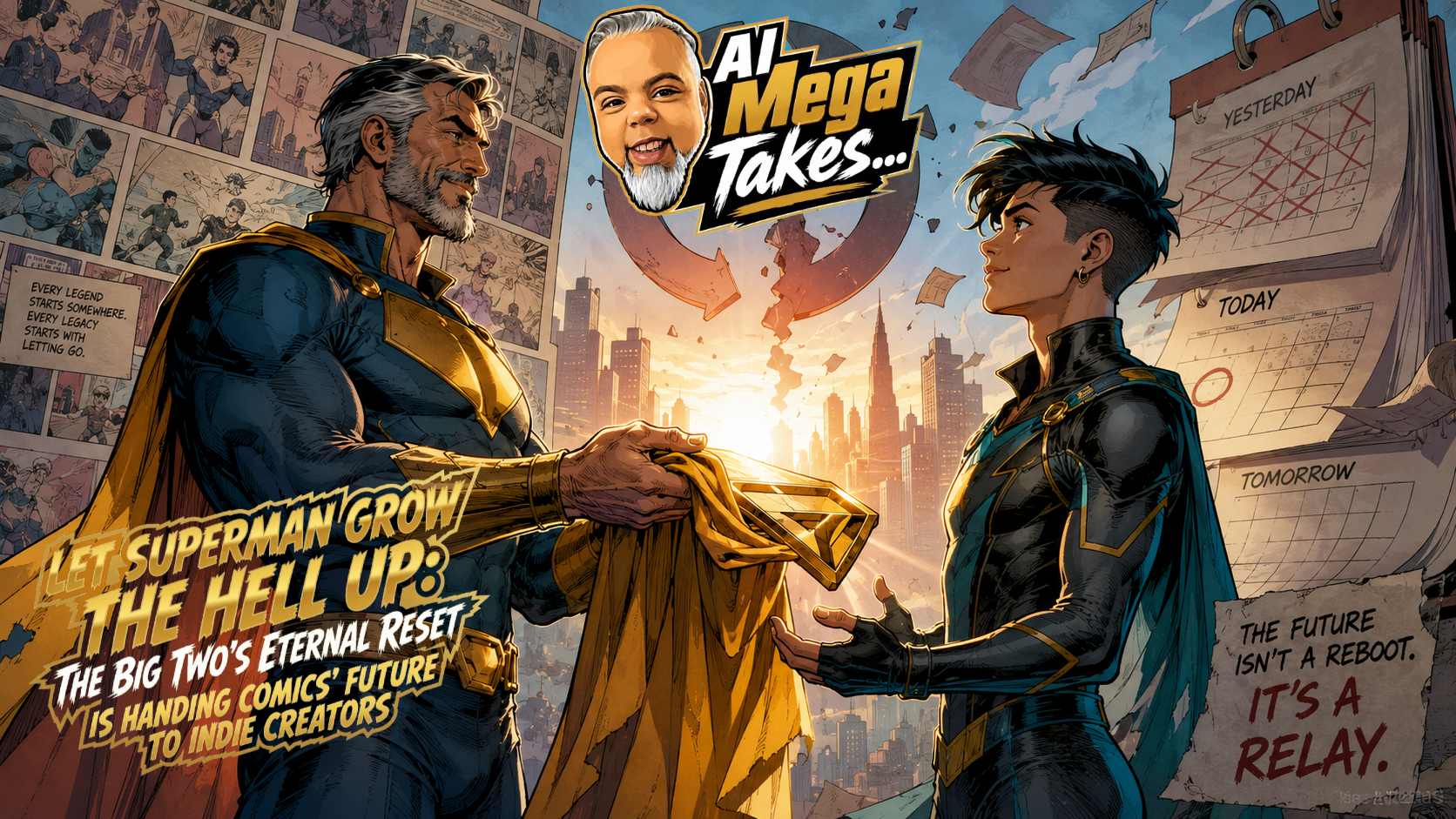
LET SUPERMAN GROW THE HELL UP: THE BIG TWO’S ETERNAL RESET IS HANDING COMICS’ FUTURE TO INDIE CREATORS
Robert Kirkman is right: legendary heroes do not need personality transplants, but their stories desperately need somewhere to go.
Ay yo, let’s say the uncomfortable part out LOUD: Superman is not the problem. Batman is not the problem. Spider-Man is not the problem. The problem is a corporate comics system so terrified of permanently changing its biggest characters that it keeps serving readers reheated character development and calling it a bold new era. New costume. New number one. New creative team. Somebody dies. Somebody gets married. Somebody has a child. The advertisements promise that “nothing will ever be the same.”
Then, two Tuesdays and a crossover later, everything is suspiciously the damn same. Robert Kirkman recently called this refusal to move forward one of the American comic industry’s “original sins.” Speaking at ComicsPRO 2026, Kirkman argued that comics remain overly dependent on characters created generations ago—Batman in the 1930s, Spider-Man in the 1960s and Transformers in the 1980s. To his credit, he even included Invincible among the properties that cannot remain “new” forever. That matters because this was not Kirkman standing outside the club throwing rocks. The man checked his own résumé before checking everybody else’s. And he is right!
That does not mean Clark Kent should wake up tomorrow acting like Homelander after three espressos and a bad therapy session. It does not mean every superhero must become cynical, murderous or emotionally broken because somebody decided goodness is old-fashioned. Superman’s decency is not outdated. His refusal to surrender to cruelty may be more valuable now than ever. But goodness without growth becomes branding. Hope without consequences becomes a commercial. A character can remain moral while aging, becoming a parent, questioning old assumptions, losing people, changing professions, mentoring successors and accepting that saving the future means eventually allowing somebody else to shape it.
Invincible did not connect with a new generation simply because Mark Grayson could punch harder or bleed by the gallon. The series put him through choices that changed his relationships, his understanding of heroism and the direction of his life. Kirkman has described the franchise as an attempt to create a dense superhero universe where motivations and moral boundaries remain complicated rather than dividing everybody cleanly into saints and monsters. Most importantly, the comic moved. Invincible ran for 144 issues over 15 years and then actually concluded in February 2018. Image Comics described the finale as the point where everything since the first issue had been building. Imagine that: a superhero story with a destination instead of a treadmill disguised as a highway.
Erik Larsen has been demonstrating the same principle in Savage Dragon for decades. The original Dragon did not remain eternally parked at age 29. His son Malcolm was born in issue #33, grew up in front of readers, became the lead, married and had children of his own. Larsen has said the joy comes from creating a world with actual consequences, where death is not merely a temporary inconvenience and jobs, locations and relationships genuinely change. That right there is the secret sauce, fam. Not darkness. Not shock value. Progression. Readers who began Savage Dragon as teenagers could eventually look at Malcolm and recognize the passing of time in their own lives. They were not repeatedly dragged back to the same bachelor apartment while an editor explained that the last 200 issues happened during one unusually stressful summer.
Kurt Busiek’s Astro City also allows its universe to breathe. Busiek has explained that the series proceeds in real time: characters introduced as teenagers reached their thirties, Astra went from roughly 12 years old to 21, and aging heroes such as Quarrel and Crackerjack faced the physical reality of approaching 50 while working as costumed acrobats. Busiek’s point was not that older heroes become useless. It was that aging creates stories conventional superhero continuity rarely permits. That is storytelling with a pulse.
Jeff Lemire’s Black Hammer pushed the idea further by allowing Lucy Weber to inherit her father’s mantle and later jumping ahead decades to examine her in middle age—as a wife, mother and former hero wrestling with what remained after the cape came off. Lemire said the time jump made Lucy more complicated and allowed the book to place her family life beside her superhero history instead of repeating a generic succession story.
Even Radiant Black has experimented with the idea that a heroic identity can be larger than one permanently assigned person. Kyle Higgins placed the question of whether Nathan or Marshall would carry the mantle into readers’ hands, using a public vote and parallel timelines during The Catalyst War. That is not traditional real-time aging, but it treats the costume as a living narrative choice rather than museum property nobody may touch without setting off the corporate alarm.
DC itself knows this can work. The Justice Society created a natural bridge between generations, while Infinity Inc. placed younger heroes and successors beside the legends who inspired them. Yolanda Montez became the new Wildcat and fought alongside other JSA legacy characters. DC’s own history describes her as taking up the identity of her godfather, Ted Grant, before joining the younger team. So why is this not done more frequently? Follow the money, mi gente!
Why do the largest publishers freeze their icons? Because those icons generate dependable sales, licensing, merchandise, films, games and brand recognition. Why does that prevent aging? Because a 55-year-old Bruce Wayne, a retired Peter Parker or a Clark Kent who permanently passes the cape creates uncertainty. The successor might not sell as many T-shirts. The film division might want the classic version. Retailers might order cautiously. A new editorial team may dislike what the previous team built.
Why does uncertainty trigger a reset? Because corporations manage characters as renewable intellectual property, not as lives moving toward conclusions. Why does that weaken legacy heroes? Because the successor is rarely allowed to become the unquestioned center. He or she is treated like a substitute teacher while everybody waits for the original to reclaim the classroom. And why does the cycle continue? Because the familiar icon usually delivers immediate numbers even when that short-term security makes it harder for tomorrow’s icon to receive enough time, investment and oxygen to grow. That is the trap!
The Big Two want the excitement of succession without accepting the cost. They want headlines announcing a new Superman, Batman, Captain America or Spider-Man, but they also want the original safely waiting backstage. The replacement receives a limited window, angry readers begin counting down, and eventually the old status quo returns wearing a freshly numbered issue. It is legacy storytelling with a return receipt.
Nah, the move ain’t to throw the old legends in the garbage like yesterday’s takeout. Keep Clark Kent as Superman. Let the kids, the new readers, and the old heads still get that classic version the cape, the hope, the whole nine. But right next to that, build a real legacy line where time actually means something. Let people get older. Let choices stick. Let marriages survive longer than a crossover. Let somebody die and stay dead for once, damn. No panic-button reboot because sales got shaky. No cosmic nonsense undoing ten years of character growth. No “surprise, he was trapped in another dimension with amnesia and a new jacket” foolishness. Come on, son. Let one universe breathe, age, and move forward like the rest of us do.
Give that continuity 15 or 20 uninterrupted years. Let Clark grow older, let Lois change with him and Let Jon, Kara, Conner and characters who have not even been invented yet develop without being trapped beneath the original. Allow Metropolis to remember its disasters. Let institutions evolve. Let enemies reform or refuse to. Let grandchildren ask what the “S” means to them. That would not diminish Superman. It would prove his greatest achievement was building a world capable of continuing without him at its center.
There is also a business case for accessible change. Industry reporting based on Circana BookScan, ComicHub data and retailer interviews found comic-store sales increased 27% during the first eight months of 2025 compared with the same period in 2024. Retailers described younger customers as readers rather than collectors, while contemporary, easy-entry material such as DC’s Absolute line and the Invincible compendiums performed strongly. Read that again: younger customers want to read.
No one is automatically scared of continuity. They are scared of homework that never leads anywhere. There is a BIG difference. A long story can be inviting when readers trust that the journey matters. Manga has built generations of readers around numbered volumes, visible progression and stories that usually belong to coherent creative visions. Kirkman has openly argued that Invincible demonstrates how an American comic can benefit from a close comics-to-animation pipeline, noting that collected-edition sales increased after the animated adaptation found its audience. This is where independent creators have a wide-open lane! Preach Rob!
Indie publishers and creator-owned teams do not need to defeat Superman. That is not the assignment. They need to offer what corporate superhero comics struggle to guarantee: ownership, direction, consequence and endings. Create heroes whose children matter. Let sidekicks become leaders. Allow the city to change. Let romances survive beyond the marketing cycle. Let injuries carry consequences. Let victories create new problems instead of restoring the original arrangement. Build the succession plan into the pitch. Establish who controls the characters when collaborators leave. Protect the mythology contractually. Create accessible collections. Give each generation its own emotional doorway into the universe.
Most of all, stop treating change like damage. Robert Kirkman’s larger warning is not that Batman, Spider-Man or Superman must disappear. It is that an industry obsessed with preserving yesterday can forget to build tomorrow. Every legendary character was once the risky new creation nobody could guarantee would last. Somewhere right now, the next Superman may exist in a sketchbook, a half-finished script, a crowdfunding campaign or an indie comic selling 300 copies. But that character cannot become the future if the entire industry keeps kneeling before the past.
Superman can remain Superman. Let him stand for compassion, courage and hope. Let him inspire people who do not share his powers, his childhood or his century. Just let the man live. Let him change. Let him grow. And when the time finally comes, let the next hero fly without Clark’s cape being tied around their ankles!
The future of superhero comics does not belong to whoever keeps the oldest character young forever. It belongs to whoever has the guts to let a new generation grow up!
The Crusade Never Ends.
WEPAAAAAA…
Sources/Receipts
- screenrant.com – Invincible Creator Calls Out Marvel and DC for Being “Frozen in Time”
- cbr.com – Invincible Creator Slams Marvel and DC Over Huge Fan Concern
- reddit.com – Interview: The Comic Book Industry Is Too Reliant on Older Characters
- instagram.com – Robert Kirkman on Marvel’s Live-Action Movies
- instagram.com – Why Marvel and DC Cannot Let Their Characters Truly Grow
- youtube.com – Robert Kirkman Proved Marvel and DC Wrong
*Ai Disclosure: The main image includes AI-assisted artwork reviewed by Comic Crusaders before publication.
Leave a Reply
You must be logged in to post a comment.