
AI Says It Can Cut Graphic Novel Costs by 70%. Cool. Who Just Lost a Paycheck?
·Al Mega
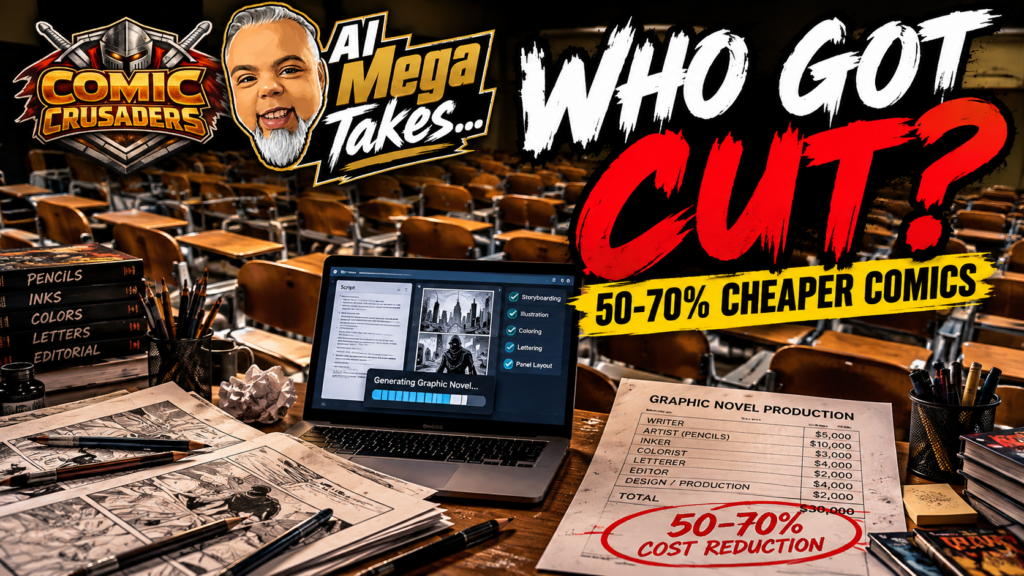
WEPAAAA, comic fam. Nah, this one got under my skin, because every few months somebody rolls into comics with another shiny piece of technology promising to “revolutionize” the business, “democratize” creativity, make production faster and save everybody money. Beautiful words, right? Everybody gets a pony and comics suddenly cost twelve dollars to make. But when Novvel.co starts talking about cutting graphic novel production costs by 50 to 70 percent, my Brooklyn ass immediately has one question: 70 percent of WHAT disappeared?
Because money doesn’t evaporate, fam. Somebody was getting paid with that money. Maybe it was an artist sitting at a drawing table until two in the morning. Maybe it was a colorist trying to make a deadline while juggling three other books because comics ain’t exactly famous for making freelancers rich. Maybe it was the letterer everybody forgets until somebody does the lettering badly. Maybe it was editorial. Maybe it was design. Maybe several of those people are still involved but working fewer hours. Fine. Then show me. Break down the savings and let everybody see where that missing 50 to 70 percent actually went.
Before somebody starts typing, “AL HATES TECHNOLOGY!” Man, miss me with that bullshit. Comic Crusaders uses technology every damn day. I’ve spent twenty years watching this business change, adapt and occasionally trip over its own feet chasing the next shiny object. Technology isn’t the villain here. Opacity is. If AI helps an artist work faster while that artist keeps getting paid fairly, let’s have that convo. If it lets some broke indie writer finally afford a graphic novel they have dreamed about making for fifteen years, I want to hear that story too. But if “efficiency” means six people become two while somebody upstairs pockets the difference, don’t piss on my Timberlands and tell me it’s raining.
Novvel co-founder Anumeha Bisaria told Publishers Weekly that producing a graphic novel can traditionally cost somewhere around $20,000 to $50,000 and take 12 to 18 months. She said Novvel’s system analyzes a manuscript, identifies characters and emotional beats, and generates a storyboard that can bring the project roughly 60 to 70 percent toward completion before humans continue refining it. She also acknowledged something I found mighty interesting: purely AI-generated material can become generic and lack soul.
AYOOOO. There it is. Because what exactly is the “soul” we’re talking about? Where does it come from? It comes from PEOPLE. The weird decision an artist makes that wasn’t in the script. The colorist who realizes a scene should feel sickly instead of warm. The letterer who understands that a balloon placement can change how your eye moves across an entire page. The editor who catches the storytelling problem nobody else saw because everybody has been staring at the damn book for six months. Then I read Novvel’s own Terms of Service, and now the cafecito needed to come out.
Novvel says its AI tools can participate in “creating, designing, illustrating, colouring, lettering” and other portions of production, including scene pacing, dialogue and panel breakdown. Stop right there and look at that list. We’re not talking about spellcheck. We’re not talking about resizing a PDF or automating some boring production task nobody wants to do. Illustrating. Coloring. Lettering. Dialogue. Pacing. Panel breakdown. Fam, those are JOBS!
Those are also crafts. I need people outside comics to understand that distinction because this industry already has a nasty habit of treating creative labor like magic dust that appears on the page. A letterer isn’t somebody slapping words into bubbles. A colorist isn’t filling in somebody else’s coloring book. A sequential artist isn’t a vending machine where you insert a script and press the Batman button. These people make storytelling decisions. They bring experience, taste, instinct, mistakes, personality and, yeah, that inconvenient little thing Novvel itself acknowledges AI can struggle with: soul.
Now we get to the part that really makes my eyebrow twitch. Novvel’s pricing says a process that traditionally costs between roughly $2,500 and more than $30,000 can start at $199 through its service. Its Starter offering promises a completed graphic novel with a cover, illustrations and PDF output, while its higher-end Studio service includes professional editorial and illustration work. Again, I am not accusing Novvel of secretly firing an army of comic creators. We don’t have evidence of that, so I’m not going to manufacture it for a spicy headline. What we DO have is a company publicly advertising dramatic cost reductions while automating portions of work traditionally performed by paid creative professionals. So I’m asking the question.
WHERE IS THE MONEY COMING OUT? Did the illustrator’s hours get reduced? Is there no dedicated colorist? Is lettering automated? Is one editor supervising work that previously required several specialists? Are creators being paid comparable rates while AI accelerates their workflow, which could actually be interesting, or are publishers simply purchasing fewer human hours? Because if you’re saving seventy cents out of every dollar, somebody needs to explain which seventy cents disappeared.
And yo, publishers, I’m looking at y’all too. Don’t hide behind the technology company if this becomes the next gold rush. If somebody walks into your office promising you can make three graphic novels for what one used to cost, I understand why you’re listening. Publishing is a business. Margins matter. Books flop. Printing costs money. Distribution costs money. Marketing costs money. Nobody is asking publishers to run charities. But comics have already spent decades squeezing creators while simultaneously telling everybody how lucky they should feel to be making comics. We really wanna run that experiment again with a machine sitting in the middle?
Then there’s the AI-provider question, and this is where the conversation gets even murkier. Novvel says it uses third-party AI providers and selects providers that don’t, by default, use customer submissions to train their models without another written agreement. Good. Authors absolutely should care whether their unpublished manuscripts become somebody else’s training material. But hold up. Which models? Novvel’s public terms don’t identify them. The company also reserves the ability to add, remove or change models or providers without notice as long as replacements meet its stated standards. Its terms further acknowledge that Novvel cannot guarantee generated material won’t resemble existing works. Fam, you cannot expect comic artists to read that and respond, “Cool, nothing to see here.” Protecting the manuscript somebody uploads today is not the same question as explaining what trained the model yesterday. Where did the visual knowledge come from? Were creators compensated? Was the material licensed? Can a publisher tell precisely which model touched its commercial graphic novel? Can readers? Can the artist hired to clean up the output? I want answers. Not because AI automatically equals evil, but because “trust us” ain’t a licensing agreement.
Copyright adds another layer of arroz con mierda to this whole plate. The U.S. Copyright Office has said that generative-AI output can receive protection where sufficient human-authored expressive elements exist, but prompting alone doesn’t automatically make machine-determined expressive material copyrightable. Novvel’s own terms acknowledge that AI-generated visual material may have different copyright treatment depending on jurisdiction and make no guarantee about the copyright status of those visual elements. Now imagine you’re an indie creator. You spent ten years building a universe. You finally turn your novel into a graphic novel. You want movies, games, merchandise, translations, maybe animation someday. Are you comfortable building that house before knowing exactly which bricks you legally own?
I’m not telling you what your answer should be. I’m telling you to ask the damn question before signing anything. And here’s where I’m going to piss off both sides of the AI argument, because apparently nuance is illegal on the internet now. There is a legitimate upside here. Comics are expensive as hell to produce. There are talented writers who will never see their stories become graphic novels because they simply cannot afford thousands or tens of thousands of dollars in production costs. Small publishers cannot gamble $30,000 every time somebody walks through the door with a great manuscript.
If technology lowers that wall and creates books that otherwise never would have existed, that’s worth discussing. If AI becomes a tool controlled by artists who remain properly compensated, that’s worth discussing too. If an artist can finish a project faster without sacrificing their paycheck or ownership, bring me the receipts because THAT is an efficiency story I’d love to report. But don’t hand me “50 to 70 percent cheaper” and expect me not to look underneath the hood. Because I’ve been around this game too damn long. Every industry loves “efficiency” when somebody else absorbs the efficiency.
So Novvel, publishers, AI companies and anybody else stepping into this space, here’s Uncle Al’s invitation: show us the math. Tell us what humans still do. Tell us what they’re paid. Tell us which models are involved. Tell us what those models were trained on. Tell the reader when significant portions of a commercial graphic novel were generated through AI. Give artists meaningful control over whether their work participates in these pipelines. If the answer is that creators make the same money while doing less grunt work, WEPA! I’ll celebrate with you. If the answer is that previously impossible indie books become financially possible while human creators remain part of the process, WEPA! Let’s talk. But if “70 percent cheaper” eventually translates into 70 percent less money reaching human creative labor, then don’t insult the comics community by dressing it up as democratization.
Call it what it is. Cost cutting. Novvel hasn’t proven that’s where this ends, and I’m not saying it has. That’s precisely why this conversation needs to happen now, before these systems become ordinary enough that everybody stops asking questions. Because the scariest part isn’t some Terminator robot learning how to draw Spider-Man. Man, get that corny shit outta here. The real danger is much more boring. It’s a spreadsheet. It’s somebody looking at ARTIST, COLORIST, LETTERER, EDITOR and DESIGNER and asking, “Which of these expenses can we reduce?”
That’s the part of the AI revolution comic creators better watch like a hawk. Technology can help people make comics. It can lower barriers. It might open doors for voices that never had the money to walk through them before. I genuinely hope some of that happens. But comics are not manufactured by magic. People make them! And when somebody tells me they figured out how to remove 50 to 70 percent of the cost of making comics, this old Brooklyn Puerto Rican is gonna keep asking the same uncomfortable question until somebody shows me the receipts:
Did you remove the cost… or did you remove the people?
WEPAAAA. The Crusade Never Ends.
Publishers Weekly: Novvel.co Pioneers Producing Graphic Novels with AI Assistance
Novvel.co
Novvel Pricing
Novvel Terms of Service
U.S. Copyright Office: Copyright and Artificial Intelligence, Part 2
Leave a Reply
You must be logged in to post a comment.