
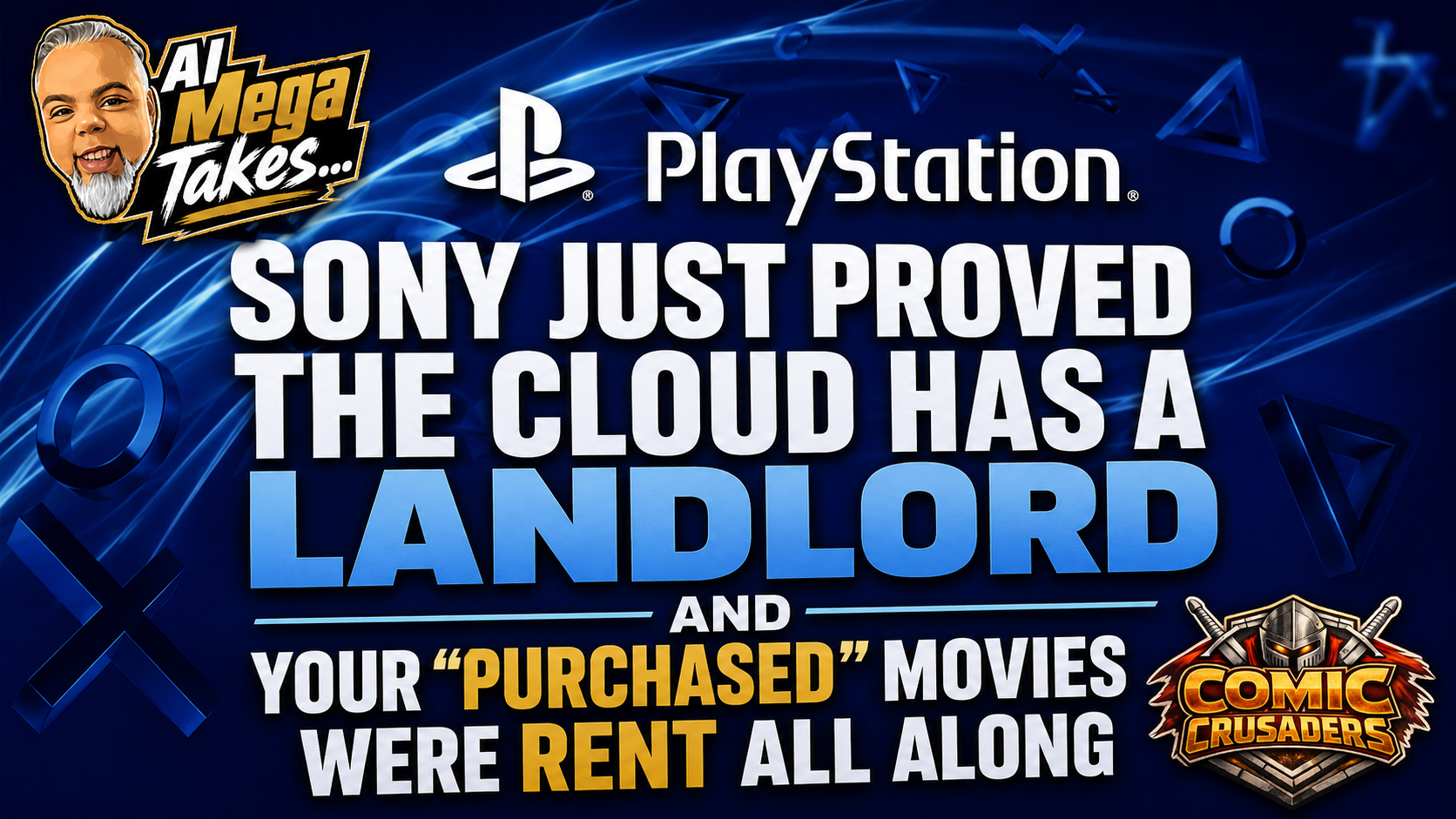
Sony Just Proved the Cloud Has a Landlord And Your “Purchased” Movies Were Rent All Along
·Al Mega
Ay yo, here’s the horror story, fam: nobody broke into your house. Nobody snatched your Blu-ray off the shelf. Nobody came through the window dressed like a corporate ninja and stole Terminator 2 from your entertainment center. Nah, son. This was smoother than that. Colder than that. More insulting than that.Sony put up a legal notice!
That’s it. No dramatic music. No apology tour. No customer-first “we got you.” Just a clean little corporate statement saying that starting September 1, 2026, PlayStation customers will no longer be able to access previously purchased StudioCanal movies and TV shows, and those titles will be removed from their video libraries. The official UK list includes 551 affected titles, from Paddington and Moonlight to Hot Fuzz, The Deer Hunter, Terminator 2, Train to Busan, The Wicker Man, The Imitation Game, and plenty more. Read that again slowly: previously purchased. Not rented. Not borrowed. Not “free with subscription.” Purchased. Paid for with real money. The kind of money that doesn’t disappear from your bank account because Sony’s licensing deal caught a cold. And yet, poof. Gone.
Sony’s explanation is “content licensing agreements.” That might be legal language, but to regular people the customers who clicked “buy,” paid up, and believed they had built a digital library it sounds like a fancy way of saying, “Thanks for the cash, now hold this L.” Wepa, that’s not customer service. That’s a digital mugging with better fonts. Now, let’s be clear because we are not out here playing reckless. A court has not ruled this “theft,” and Sony will almost certainly argue that customers were never buying permanent ownership of the films. They were buying a license. That’s the whole trick. The storefront says “buy” because “temporary conditional access until a licensing agreement expires” does not fit nicely on a button. The lawyers know what it means. The customer usually does not. And that gap that dirty little gap between what companies market and what consumers actually receive is where trust goes to die.
This is not Sony’s first rodeo either. In 2021, Sony stopped selling movie and TV purchases and rentals through the PlayStation Store, but it told customers they could still access previously purchased movie and TV content on PS4, PS5, and mobile devices. Then in 2022, PlayStation users in Germany and Austria were hit with a StudioCanal removal involving hundreds of titles, also tied to licensing agreements. In 2023, Sony posted a notice saying Discovery content would be removed from video libraries, before later updating that the removal was no longer happening due to changed licensing arrangements. So no, this is not some random glitch in the Matrix. This is a pattern. And the pattern is ugly.
PlayStations terms make the bigger issue plain: digital purchases live under agreements most people never truly read, and current PlayStation Store language says purchases are final and non-refundable except under Sony’s cancellation policy. For games and software, Sony is even more direct: the software is licensed, not sold. That matters because once you accept the “license, not ownership” structure, everything in the cloud starts looking less like your property and more like access someone can renegotiate above your head. That’s why this story is bigger than movies. This is about comics. Games. Music. Ebooks. DLC. Cloud saves. Digital storefronts. Entire libraries living behind a login screen like they’re safe because the app icon looks friendly. Fam, the app icon is not your friend!
For comic readers, this should ring every alarm bell in the building. Digital comics have already gone through platform shake-ups. When Amazon folded the standalone Comixology app into Kindle in 2023, customers did not lose their purchases, but they did lose a familiar platform experience and had to follow Amazon’s new reading setup. That is not the same as Sony removing movies, but it proves the larger point: when your library lives inside someone else’s ecosystem, you do not fully control the shelf. You ONLY control your password. Big difference.
Gamers? Ya shouldn’t get comfortable. We are already living in the era of digital-only consoles, live-service shutdowns, delisted games, online-required single-player experiences, and “physical” releases that sometimes come as little more than a plastic case with a code inside. The disc used to be leverage. The cartridge used to be proof. The box used to say, “I have this.” Now the platform says, “You may access this, for now, if all business relationships remain stable and our servers feel cute today.” That is not ownership. That is a rental agreement wearing a fake mustache.
The counterargument is obvious: Sony may not have the legal right to continue distributing StudioCanal content once the license expires. Fine. That may be true. Licensing is complicated. Rights change hands. Territories matter. Studios, distributors, and platforms all have contracts we never see. Nobody serious should pretend these deals are simple. But that does not excuse leaving paying customers holding the bag. If Sony cannot keep the content available, then compensate people. Refund them. Offer store credit. Provide replacement access through another Sony service. Cut a deal with StudioCanal for redemption codes. Offer affected customers a physical media discount. Do something. Anything. Because “you paid us, but our licensing deal changed” is not a consumer solution. It is a corporate shrug. And that shrug is why physical media still matters.
Physical media is not just nostalgia. It is not just collectors being dramatic in the corner surrounded by slipcovers and steelbooks. Physical media is control. It is preservation. It is the simple power of knowing that if a studio gets sold, a licensing contract expires, or some executive decides a service is no longer “aligned with strategy,” your copy of The Deer Hunter does not vanish while you’re making coffee.
This is also why regulators are finally waking up. California’s AB 2426, approved in 2024, targets the way digital sellers use words like “buy” or “purchase” when consumers are really getting a license. The law requires clearer disclosure when access can be restricted or revoked, including situations where the seller no longer holds rights to the digital good. That is the direction consumer protection needs to go, because the old rules were built for a world where buying something meant you could put it on a shelf, loan it to your cousin, resell it, or leave it to your kids. The cloud said, “Nah, papi, we got a new hustle.” And consumers are tired of the hustle. Sony should not be able to market a purchase like ownership, cash the check like ownership, then retreat into license language when the bill comes due. That may be legal. It may be industry standard. It may be tucked neatly into terms of service. But morally? It stinks. It stinks like a subway platform in August with no AC and bad decisions (you ever been on the E Train?).
The comic book industry should pay attention too. Publishers pushing digital-first strategies need to ask themselves what kind of trust they are building. Retailers need to stop acting like physical customers are dinosaurs. Collectors are not crazy. They are archivists with receipts. They understand something the tech world keeps pretending is old-fashioned: culture survives when people can actually keep it! Because this is not just about movies disappearing from a PlayStation library. It is about who controls culture once everything becomes access. If every comic, every game, every film, every album, every book, and every memory lives behind a license, then the future of ownership belongs to whoever controls the server. That should scare everybody.
Sony owes affected customers more than a quiet notice and a “thank you.” It owes them a remedy. Refunds, credits, replacement access, pick one, champ. But don’t sell people “forever” energy and then hit them with “terms may vary” when the lights go out.
The lesson is simple, and it is loud: buy physical when it matters. Back up what you can. Support DRM-free when available. Read the fine print. And never confuse convenience with ownership.
Because the cloud is not your shelf.
It is somebody else’s warehouse.
And Sony just reminded everybody that the landlord has keys!
No WEPA for that!
Disclaimer: This article is an opinion/editorial based on publicly available notices, reporting, and consumer-facing terms. It does not claim that Sony has been found legally liable for theft or wrongdoing. The argument is that the practice is anti-consumer and exposes the weakness of digital “ownership” when access depends on licensing agreements.
Sources:
Sony’s official StudioCanal removal notice and affected-title list; Sony’s 2021 PlayStation Blog announcement about ending movie and TV purchases while preserving access to prior purchases; reporting on the 2022 Germany/Austria StudioCanal removals; Sony’s Discovery entitlement update; PlayStation terms and software license language; California AB 2426 on digital goods disclosure; and reporting on Comixology’s app merger into Kindle.
Legal definition of Ownership: Ownership refers to the exclusive right to possess, use, enjoy, control, and transfer a tangible or intangible asset. It grants the owner ultimate authority over the property, including the right to exclude others and destroy the item as far as the law permits.
*Ai Disclosure: The main image includes AI-assisted artwork reviewed by Comic Crusaders before publication.
Leave a Reply
You must be logged in to post a comment.