
You Signed Away the Next Billion-Dollar Hero: Comic Creators, Read the Damn Contract
·Al Mega
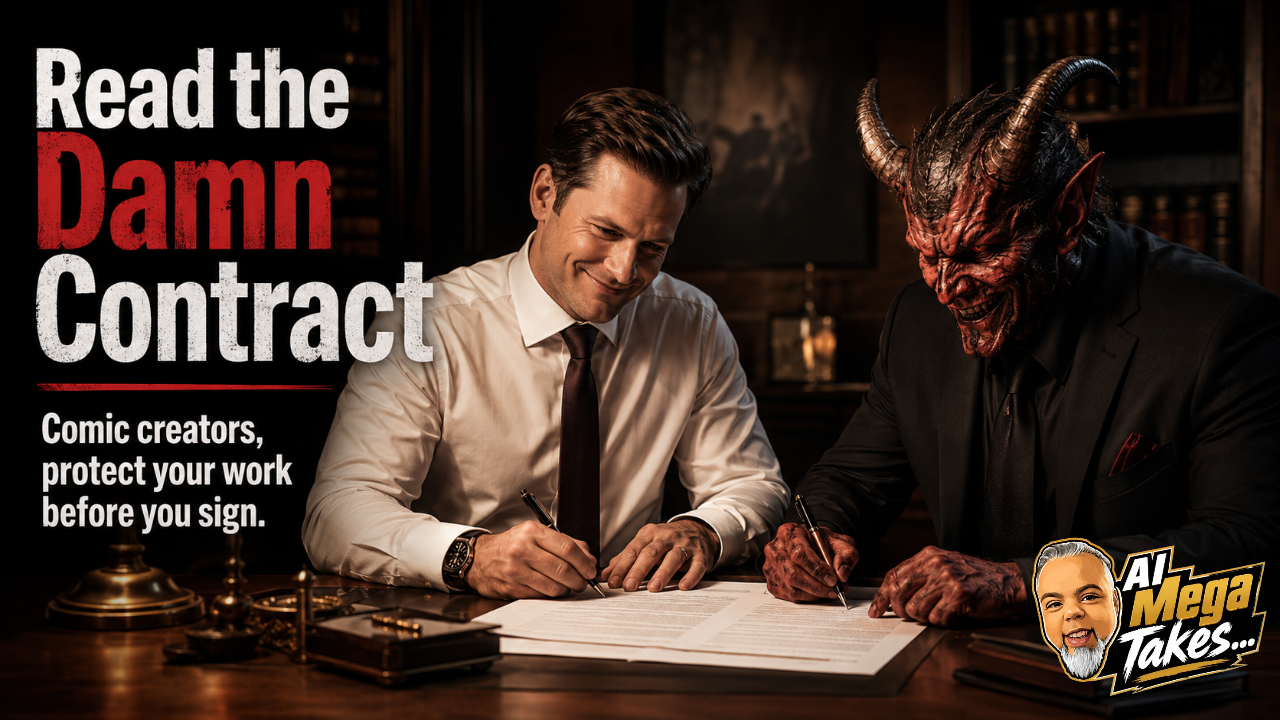
Let’s begin with the part nobody enjoys hearing. When a comic creator signs a valid work-for-hire agreement, delivers a new character to Marvel or DC, cashes the check and then discovers that character appearing in movies, games, toys, cartoons and lunchboxes, the creator may feel robbed but legally, the company may own exactly what the creator agreed to surrender. That does not automatically make the arrangement fair. It does not erase the massive difference in power between an individual freelancer and a corporation backed by armies of attorneys. But creators also cannot treat a signed contract like one of those terms-of-service screens everybody scrolls past before downloading an app. This is your imagination. Your name. Possibly your family’s future. Read the damn paper.
Under United States copyright law, the person who physically creates a work normally begins as its author. Work made for hire is the major exception. When something legally qualifies as work for hire, the employer or commissioning party is treated as the author and generally owns the copyright not the writer or artist whose hands produced it. A properly classified work-for-hire creation is also excluded from the ordinary statutory termination right that can sometimes allow authors to reclaim transferred copyrights decades later. That last part should make every creator sit up straight. You may not merely be licensing the company to publish one comic. You may be helping create an asset the company can exploit across media for generations, while eliminating one of the legal mechanisms that might otherwise allow you or your heirs to recover the copyright. That is not a minor clause. That is the whole damn game.
Jack Kirby helped build much of the foundation beneath the Marvel empire. His heirs later attempted to terminate Marvel’s copyrights in hundreds of works published between 1958 and 1963. In 2013, the Second Circuit Court of Appeals ruled that the disputed works were made for hire under the law that applied at the time. The parties settled in 2014 before the Supreme Court heard the case. The lesson is not that Kirby lacked importance. Anybody claiming that needs to put the comics down and go sit in the corner. The lesson is that cultural importance, creative contribution and legal ownership are three different things. History can call you a genius while the contract calls somebody else the owner.
The same tension continued through litigation involving the estates of Steve Ditko and other early Marvel creators. Those estates sought to terminate copyrights, while Marvel maintained that the characters had been produced as works for hire. Marvel eventually reached settlements, but settlements do not create a clean public rule telling every modern freelancer that everything will work out later. Then there is Ed Brubaker, who co-created the Winter Soldier identity used throughout Marvel’s films and television projects. Brubaker said that he earned more in Screen Actors Guild residuals from his tiny movie cameo with a line that was cut than from creating the Winter Soldier. Read that again slowly.
The acting union delivered more continuing compensation for a deleted line than the comic-book business delivered for a character central to a major entertainment franchise. That is not proof Marvel breached Brubaker’s contract. It is evidence that a contract can be legally enforceable and still produce an outcome that makes ordinary people say, “Yo, this cannot be the best system we’ve got.”
Reports in 2021 described Marvel’s practice in some adaptation cases as offering certain creators a $5,000 payment and a premiere invitation, although compensation varied and some creators reportedly qualified for additional agreements. DC was reported to have an internal payment program as well. Those programs are not ownership, and a discretionary bonus is not the same thing as a negotiated share of the revenue. A premiere ticket is lovely. So is shrimp cocktail. Neither one pays your mortgage while your character is carrying a cinematic universe on its back.
Because Marvel and DC offer visibility, prestige, steady assignments and access to audiences most independent creators cannot immediately reach. A Big Two credit can open doors, increase convention demand and bring readers toward creator-owned work. That opportunity is real. Pretending otherwise would be nonsense. Because the creator often believes the offer is effectively take-it-or-leave-it. Publishers have deep rosters of talented people waiting for an assignment. The freelancer may have rent due Friday. “Walk away” sounds courageous until the refrigerator is empty and somebody else accepts the job by lunch. This is unequal bargaining power in plain clothes.
Mainstream comic creators usually negotiate individually. Freelancers do not have the same industry-wide collective bargaining structure that gives many screenwriters and actors minimum payments, residuals, credit protections and grievance procedures. Even union efforts inside comics have generally involved publisher employees rather than the freelance writers and artists creating the stories. Image Comics employees ratified a union contract in 2023, but that did not create a bargaining unit covering freelance creators throughout the industry. One creator asks for better terms and fears losing the assignment. Ten thousand creators demanding minimum standards would be a different conversation. That conversation has never fully arrived.
Money. Fear. Ego. That is the unholy trinity getting creators cooked before the ink even dries. Some convince themselves a lawyer will cost more than the assignment. Others are terrified that asking one serious question will get them labeled “difficult.” Then you have creators so hyped to write Batman, Spider-Man, or the X-Men that their business sense grabs its coat and leaves the building. Suddenly, they are signing pages like somebody just handed them backstage passes to the Avengers. Fam, recognizing most of the words does not mean you understand the contract. That is like reading a Doctor Strange spell and assuming you are ready to open portals.
A publishing or entertainment attorney is not there simply to scream, “DON’T SIGN!” They are there to explain exactly what the company owns, what you keep, what can be negotiated, how bonuses are calculated, whether you can inspect the accounting, and what happens when that “little supporting character” you created becomes the breakout star of a billion-dollar television franchise. Before your pen touches that paper, start asking questions.
Are they buying only the pages you were hired to produce, or are they claiming every new character, costume, city, weapon, organization, catchphrase, and concept introduced inside them?
Does the agreement call the project work-for-hire and then include a backup clause transferring everything anyway if that classification gets challenged?
When it says “all media,” does that mean comics, film, television, animation, games, toys, merchandise, podcasts, virtual worlds, AI training, synthetic performances, and technologies nobody has invented yet?
What actually triggers more money? Sales? Reprints? Licensing? A movie appearance? The character’s name? Their costume? Their storyline?
And how is that money calculated? Gross revenue? Net receipts? Adjusted gross? Or Hollywood “net profits,” that magical financial creature that disappears faster than free pizza in the Comic Crusaders office?
Who gets the “created by” credit? Where does it appear? Is it guaranteed, or does the company only promise to “make reasonable efforts,” corporate language for, “We will see what happens, champ”?
Will you receive regular statements? Can you audit the books? What happens if the numbers are wrong? Is there a reversion clause? And what does “out of print” even mean when a publisher can leave one dusty digital edition online forever and claim the property never went away?
Ask now, or complain later. Better yet, get a damn lawyer and know exactly what you are signing away!
Alan Moore and Dave Gibbons believed the rights to Watchmen could eventually revert after the work ceased publication. Watchmen became a perennial seller and never experienced the ordinary commercial death that might have triggered the expected return. The contract reportedly contained a reversion mechanism; the practical definition of continued publication became the trapdoor. Never celebrate the presence of a reversion clause before understanding whether it can realistically activate.
No. A signature establishes legal consent; it does not make criticism illegitimate. Workers can honor a contract while arguing that the industry’s standard terms are outdated, opaque or unfair. Companies can comply with the law while creators demand better compensation for the future. But creators must be honest about which argument they are making.
“I did not understand what I signed” is different from “the company violated the agreement.”
“The publisher owns the character, but the compensation system is unfair” is different from “the publisher stole my character.”
Those distinctions matter, fam. Theft, fraud, and breach are not cute little buzzwords you toss into a rage post because the algorithm needs breakfast. Those terms carry real legal weight. Start throwing accusations around without receipts, and you might generate mad social-media smoke, but smoke is not evidence, likes are not damages, and a viral thread is definitely not a courtroom victory.
Now, publishers do have a legitimate argument. They pay for editors, production, printing, marketing, distribution, lawyers, and years of development. Most new characters do not become billion-dollar franchises. Some barely survive three issues and a variant cover. Companies take risks across thousands of projects, and work-for-hire agreements give them the control needed to build shared universes without ownership turning into a legal Royal Rumble every Tuesday.
Fair enough. But that still does not justify adaptation payments being secretive, inconsistent, or completely disconnected from success. A corporation can legally own the character and still properly compensate the human beings who gave that character life. Ownership and fairness can sit at the same table. When a company acts like they cannot, somebody is protecting a business model, not a principle.
Creators must decide what each opportunity is for. A Big Two assignment can be a job: execute the brief, deliver professional work, collect the page rate and use the visibility to build your career. Your original universe can be the asset: the property you protect, develop and publish through a creator-owned arrangement. Image Comics, for example, states that it publishes creator-owned material for which creators retain their rights. That model shifts more financial risk and responsibility onto the creative team, but it also preserves the upside if the property succeeds. Not every idea belongs in the same basket.
Maybe the brilliant new villain you developed would improve your Marvel pitch. Maybe that villain should become the cornerstone of a universe you own instead. There is no universal answerbut there should be a conscious decision. And before making that decision, get a fucking lawyer. Not your friend who watches courtroom dramas. Not your cousin who handled a traffic ticket. Not an artificial-intelligence summary telling you the contract “appears standard.” Hire an attorney who understands copyright, publishing, licensing and entertainment agreements. Ask for a limited-scope contract review if money is tight. Negotiate the legal fee before the review. Get explanations in plain English. Save every contract, amendment, email, royalty statement and payment record.
You are not hiring a lawyer because you expect betrayal. You are hiring a lawyer because the publisher already has lawyers. The Big Two are not automatically villains for presenting work-for-hire contracts. Creators are not automatically fools for accepting them. These assignments can provide income, experience and career-changing exposure. But a creator who signs away expansive rights without independent advice is gambling with an asset whose future value nobody can predict.
Do not wake up 20 years from now angry that the company followed the contract you never bothered to understand. Create boldly. Negotiate intelligently. Know when you are doing a job and when you are building an inheritance. Then sign or walk away with your eyes wide open.
Disclaimer: This editorial discusses general legal and business issues and is not a substitute for advice from a qualified attorney reviewing a specific agreement.
*Ai Disclosure: The main image includes AI-assisted artwork reviewed by Comic Crusaders before publication.
Leave a Reply
You must be logged in to post a comment.