
DC PUTS VARIANT GOUGERS ON NOTICE, NOW EVERY COMIC PUBLISHER NEEDS TO PROTECT THE READERS
·Al Mega
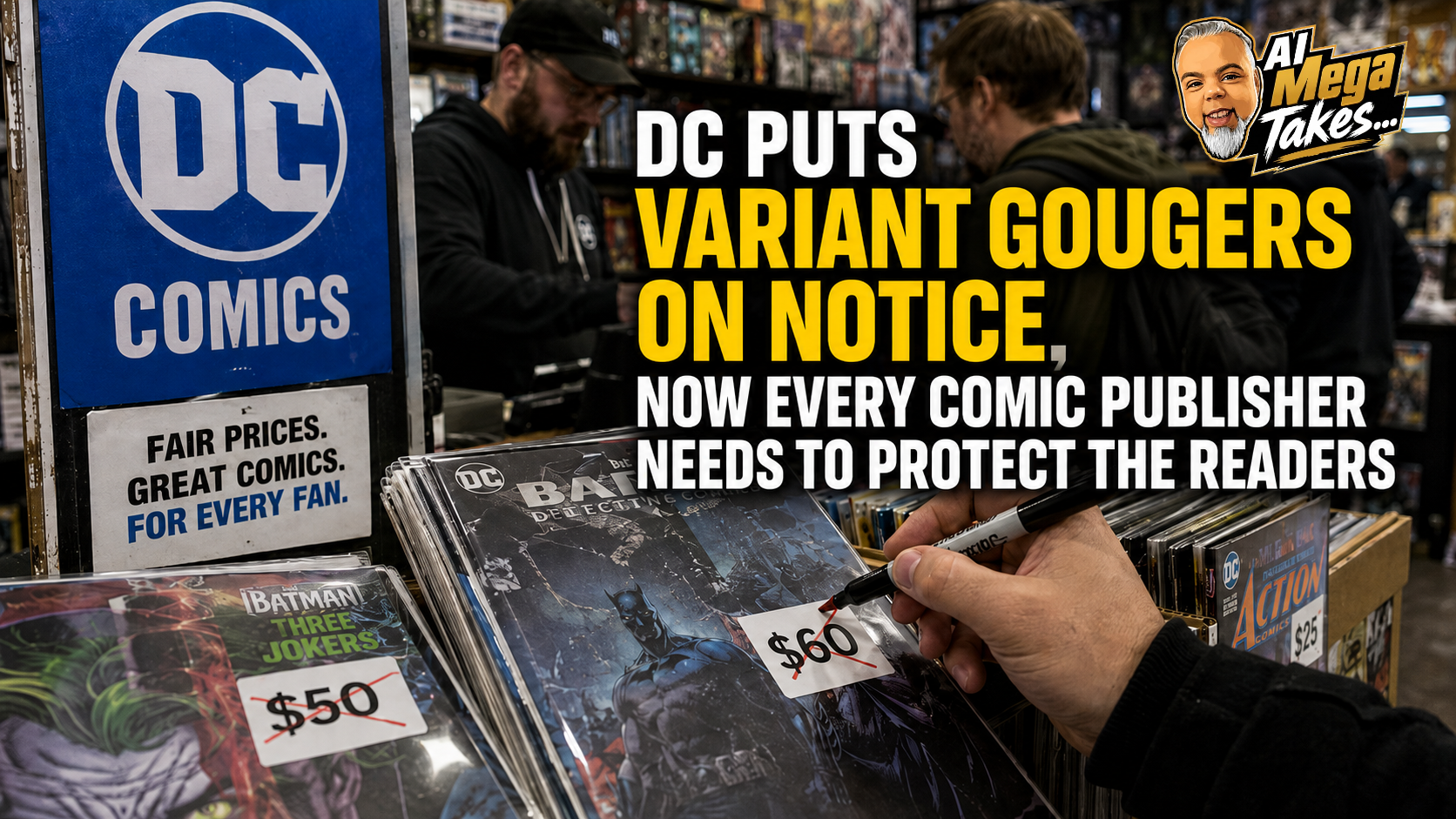
Let me make sure I understand this correctly, fam. A comic book can be announced for $4.99, promoted as the next “must-have” collectible, sliced into multiple exclusive versions, hyped through presales and timed drops and then somehow appear online for $40, $50, $75 or more before most readers have even had a chance to smell the fresh ink? Miss me with that nonsense. For once, DC Comics appears ready to tell part of the variant-cover hustle to fall back.
DC has revised the terms governing its retailer-exclusive variant program. The company now says it does not want to support the price-gouging of its customers and strongly encourages participating retailers to keep unsigned exclusives at no more than five times the regular comic’s suggested retail price. Autographed copies should remain below ten times that price. DC also reserves the right to stop offering future retailer-exclusive variants to stores that exceed those guidelines.
For a regular comic priced at $4.99, that works out to a suggested maximum of $24.95 for an unsigned retailer exclusive and $49.90 for an autographed one. Before anybody starts throwing confetti and calling this the Comics Consumer Protection Act, let us be accurate. DC has not imposed a universal price cap on every comic shop, incentive cover, back issue, convention exclusive or private resale. Retailers participating in this specific program may technically charge whatever they choose. DC is using access to future retailer exclusives as its enforcement weapon. That distinction matters.
This is a meaningful move because DC has finally acknowledged what readers have been yelling about while parts of the industry pretended not to hear them: the modern variant market has developed a nasty little corner where artificial scarcity, manipulation and fear of missing out matter more than the comic inside.
DC’s new terms also prohibit participating retailers from placing these exclusive variants inside blind bags, mystery packs, sealed surprise bundles or similar promotions. The company has established minimum orders of 1,000 copies for most DC and Vertigo retailer variants and 2,000 copies for Absolute Universe exclusives.
That blind-bag ban matters big time, fam. When you spend your money on a comic, you should know what the hell you are buying. Period. This is not Atlantic City, and Batman should not come with loot-box mechanics like we are opening digital crates in a video game. Recent reports pointed to unsigned Absolute Batman retailer exclusives hitting around $50, foil versions pushing $60, and even a $100 blind-bag deal containing two mystery exclusives. Ay yo, $100 and you still do not know exactly what is in the bag? That is not collectingthat is gambling with a pull list. Those offers reportedly ran past DC’s pricing guidance or clashed with the company’s new restrictions on mystery bundles. But let me make one thing crystal clear before anybody starts clutching their long boxes: this is not an attack on every comic shop. Honest retailers are not the enemy. The shady hustle is.
Most local comic stores are not sitting in a secret basement counting stacks of variant-cover money like Scrooge McDuck wearing a Batman cowl. These stores face rent, payroll, shipping, damaged inventory, distributor issues, credit-card fees and books that may never sell. Periodical comics are generally ordered under a direct-market system that places much of the inventory risk on retailers, and industry coverage continues to describe margins throughout comics as painfully narrow. When a shop commits to 1,000 or 2,000 copies of an exclusive, that is real money and real risk. An honest retailer has every right to price that exclusive above the standard cover price, recover its investment, compensate the artist and staff, and earn a reasonable profit.
Profit is not a dirty word, fam. Comic shops gotta eat too. But there is a whole Grand Canyon between making a fair buck and trying to turn Wednesday’s new release into Friday’s mortgage payment. A responsible shop might charge $15, $20 or $25 for a limited exclusive because they paid to make it happen, took the risk and could end up staring at 600 unsold copies for the next three years. That is business. A gouger does something completely different. They manufacture panic, pretend the stock is disappearing, hide books inside mystery bags, release five copies at a time like they are dropping concert tickets and then let collectors fight over them in a bidding war. Ay yo, relax. The book came off the printer last week. Stop acting like somebody just found Action Comics #1 behind a radiator.
This right here, fam, is where the whole industry starts bugging out and loses the damn plot. Why do these prices shoot through the roof before the book even gets comfortable on the shelf? Because the scarcity is being cooked up in the back room before real demand even gets a chance to breathe. Then they hit readers with the same hustle: “Limited cover!” “Hot artist!” “One store only!” “When that countdown hits zero, it’s gone forever!” Ay yo, relax. Throw in some foil, a virgin cover, a sketch edition, a signature, a slab and a few influencers screaming that it is the next big thing, and suddenly nobody is asking the most important question: “Do I actually love this comic?” Now everybody is panic-buying because they are scared the next person might grab it first. That is not collecting, mi gente. That is FOMO wearing a cape and reaching directly into your wallet.
Why do some retailers participate? For the honest shops, variants can provide essential revenue in an unforgiving business. For the bad actors, the answer is even simpler: because panicked customers pay more.
Why have publishers allowed the system to grow this far? Because every variant still counts as another unit ordered. Whether one reader buys one comic or ten different covers of the same comic, the order numbers look mighty pretty from the publisher’s office.
Why should readers care? Because inflated orders can create the illusion of audience growth without necessarily creating more readers. When the excitement collapses, readers are left holding books they overpaid for, stores are left holding inventory they cannot move, and publishers begin searching for the next gimmick rather than building the next generation of fans.
Marvel editor Tom Brevoort recently described how enhanced covers moved from an artistic idea into a recurring sales program during the 1990s. Once the special editions sold well, the thinking shifted from creating something meaningful to finding another enhancement that could keep the machine moving. Even Brevoort acknowledged that the cart eventually began driving the horse. Sound familiar?
We already know how this movie ends, fam. The minute the industry starts treating speculators like they are actual readers, everything gets real goofy, real fast. One dude buying five different covers does not magically equal five new fansstop playing with the math. A comic selling out because a handful of flippers snatched up half the inventory does not make it a cultural phenomenon either. It means somebody cleaned out the shelf hoping to tax the next collector. And please, do not show me some wild eBay listing asking $300 like that proves anything. Anybody can type a ridiculous number into a listing. Show me the completed sale, son. Until then, it is all smoke, mirrors, manufactured hype and enough Mylar to wrap the entire damn Batcave.
Now, to be fair, fam, the other side deserves to speak too. Some collectors and shop owners are saying, “Hold up, if we price these books too low, the flippers are gonna storm in, clean out the whole damn shelf and have them up on eBay, Whatnot or some private group before the store even closes.” And they are not wrong. In that situation, the comic shop takes the financial risk, pays for the exclusive, does all the work and some random reseller who contributed absolutely nothing walks away with the biggest bag. That is backwards as hell. Then there is the other uncomfortable truth: DC helped build this scarcity machine in the first place, and now it is looking at retailers like, “Why are y’all acting like this?” Ay yo, come on. You cannot create the feeding frenzy, toss raw meat into the water and then blame the sharks for showing up. That criticism is valid, and DC needs to own its part in this mess.
DC cannot fix this by wagging one corporate finger at retailers while continuing to pump the market with exclusives, limited formats and scarcity-based marketing. You cannot pour gasoline across the floor, hand everybody matches and then act surprised when somebody starts charging admission to the fire. That is why this policy deserves praise and pressure.
DC should clearly state how long its suggested limits apply. Does the guidance cover only presales and the initial release period, or does it follow a retailer’s remaining inventory for years? What happens when an unsigned book is graded, bundled with an original sketch or sold with access to a signing? How will violations be reported and investigated? Will enforcement be consistent, or will smaller stores be punished while major partners receive the deluxe velvet-glove treatment?
DC should also require transparent print-run information, encourage reasonable per-customer limits during the initial sales window and reserve the right to approve additional printings when demand has obviously overwhelmed supply. Readers should know whether a “limited” book consists of 200 copies, 2,000 copies or several editions that collectively total 20,000. Most importantly, DC should monitor whether its variant strategy is creating long-term readers or merely short-term transactions. And now we arrive at the challenge for everybody else.
Marvel, Image, BOOM! Studios, Dynamite, IDW, Dark Horse, Titan, Mad Cave, Oni Press and every publisher authorizing retailer exclusives or scarcity-based variants should publish clear consumer-protection rules of their own. Set reasonable initial-sale guidelines. Ban mystery bundles containing unidentified exclusives. Require print-run transparency. Create enforceable consequences for retailers that manipulate presales or manufacture fake shortages. Give stores enough room to recover legitimate expenses without allowing customers to be treated like walking wallets suffering from Batman-induced panic attacks.
Publishers cannot keep benefiting from inflated variant orders and then act like the resale frenzy has nothing to do with them. They built the playground. They invited the crowd. They sold tickets to the ride. Now they need to make sure readers are not getting mugged near the exit. DC deserves credit for taking the first serious step. The company has recognized that its characters, its artwork and its reputation are involved when a newly released comic is manipulated into a luxury item before regular customers can buy it.
That is good for readers. It is good for honest comic shops. It may even cool down a speculator market that has started confusing manufactured scarcity with actual historical importance. But the real victory will come when every publisher adopts meaningful protections, DC enforces its own rules consistently and readers stop rewarding anybody who believes a $4.99 comic should cost $75 simply because somebody added foil, removed the logo and screamed “limited” into a livestream.
Buy the cover because you love the artwork. Support the store because it supports the community. Collect because these stories mean something to you. But never let manufactured panic convince you that you must empty your wallet today or somehow failed comics forever.
The Crusade Never Ends but this variant-cover foolishness needs a serious timeout.
Article Disclaimer
This editorial reflects Al Mega’s personal analysis of publicly reported retailer terms and industry practices. It does not accuse every retailer of misconduct. Most comic shops operate on narrow margins and serve their communities responsibly. Criticism is directed toward artificial scarcity, manipulative presales and excessive day-one pricing. DC’s reported guidance recommends limits of five times cover price for unsigned exclusives and ten times for signed copies, with future program access potentially withheld.
Sources
- bleedingcool.com DC Comics Can Now Ban Shops Who Price-Gouge Exclusive Variant Covers
- bleedingcool.com Responses to DC Comics’ Absolute Batman Anti-Price-Gouging Terms
- reddit.com DC Comics New Retailer Terms State They Can Now Ban Shops
- cbr.com DC Comics Reveals New Rules That Ban Shops Over Price Gouging
- bitsandbytesmediagroup.com DC Comics Sets New Rules to Combat Price Gouging
- facebook.com Comic Book Clique Discussion
*Ai Disclosure: The main image includes AI-assisted artwork reviewed by Comic Crusaders before publication.
Leave a Reply
You must be logged in to post a comment.