
Psylocke & Archangel: Crimson Dawn #1–4 Retro Review
·Al Mega
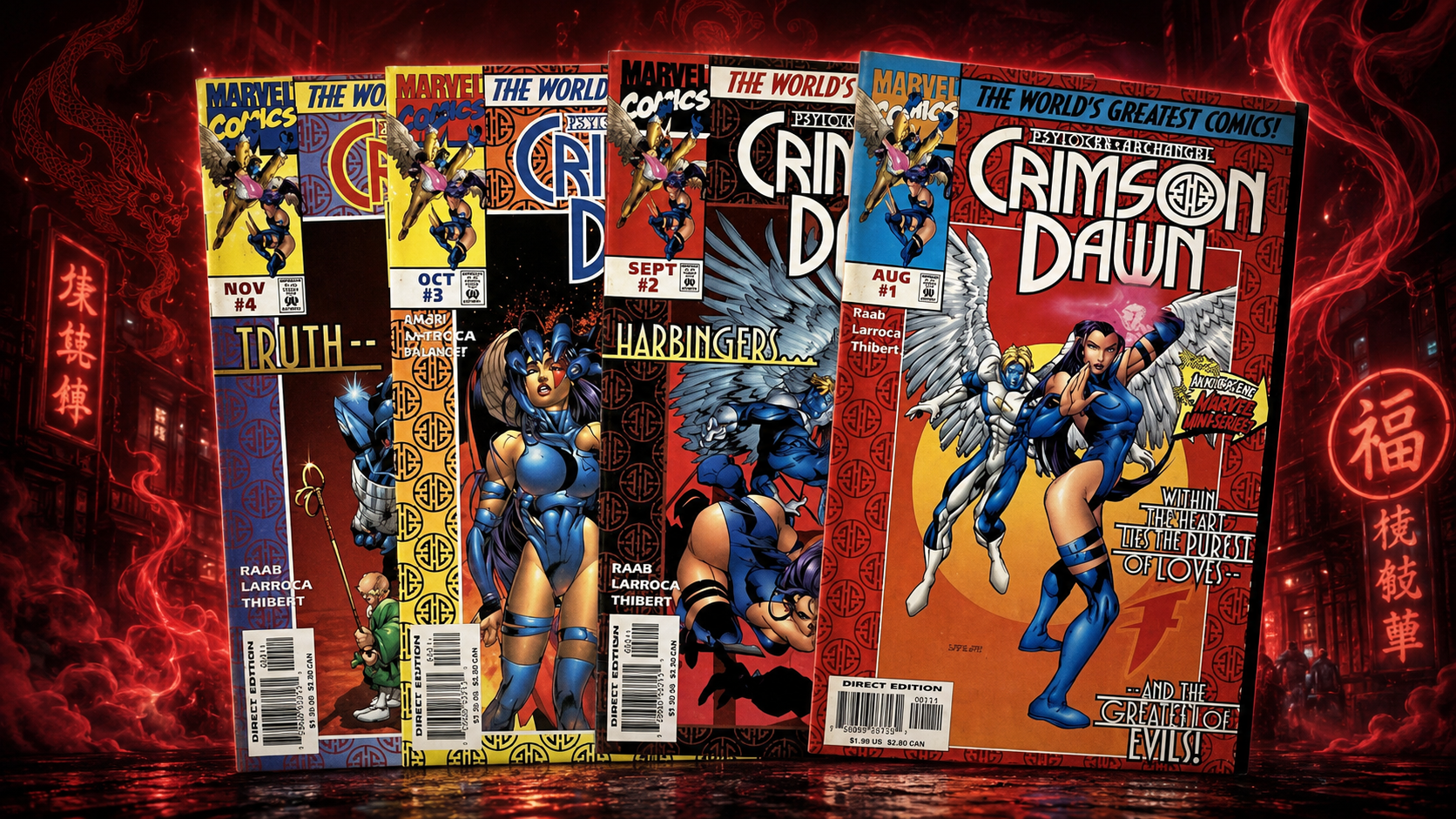
 WEPA! Psylocke & Archangel: Crimson Dawn is four issues of demonic madness, relationship turbulence, psychic trauma and pure late-’90s Marvel excess. Writer Ben Raab and artist Salvador Larroca take Betsy Braddock and Warren Worthington III out of the usual mutant battlefield and drop them into a supernatural nightmare where love, identity and control collide. It is loud. It is dramatic. It is sometimes completely bonkers. In other words, this joint understood the assignment.
The story begins with Kuragari murdering Proctor Tar, one of the guardians separating Earth from the Crimson Dawn. That act cracks open the door for Kuragari and his Undercloaks to target Psylocke, whose life was previously saved and permanently altered by the Crimson Dawn’s magic. Betsy survived Sabretooth’s attack, but she came back colder, more distant and uncertain of who she even is anymore. Warren wants to help, yet every conversation between them lands like two people talking through opposite sides of a concrete wall. He loves her. She knows that. But love does not magically erase trauma, papi.
That emotional tension gives the miniseries its real muscle. Warren keeps trying to repair their relationship while Betsy is still attempting to repair herself. Archangel understands bodily transformation better than most X-Men, but he still struggles to accept that this is not a battle he can win for her. Logan’s appearance  helps knock some sense into him without turning Wolverine into a cigar-smoking couples therapist. Thank goodness. Warren eventually realizes that supporting Betsy means trusting her choices, not constantly trying to drag her back toward the woman she used to be.
Kuragari is not exactly swimming in subtlety. The dude looks like somebody mixed a demon emperor, a heavy-metal album cover and the final boss from an arcade fighter. He wants Psylocke as his queen and believes her transformation gives him ownership over her destiny. Nah, son. Betsy has spent too much of her history being manipulated, rewritten and treated like a prize for another man to define her again. Kuragari may be more theatrical archetype than layered villain, but he works because he represents the control Betsy is fighting against. He is one giant supernatural red flag wearing shoulder armor.
The four issues move quickly once the Undercloaks invade Betsy and Warren’s world. Gomurr the Ancient guides them deeper into the mythology, Archangel’s restored wings become essential to the fight, and Betsy is forced to confront what the Crimson Dawn actually awakened inside her. Some dialogue repeats the same relationship conflict, and the mystical explanations occasionally arrive carrying a whole suitcase of exposition. That is peak 1997 comic-book behavior. Read together, though, the story keeps enough momentum to avoid getting stuck in the fog. Each issue pushes Betsy closer to deciding whether she will be controlled by the Dawn or bend that power to her own will.
 Salvador Larroca brings full mutant spectacle to the page. Psylocke twists through combat like a psychic blade with legs, while Archangel’s wings dominate layouts, slice across panels and give the action serious scale. Larroca’s anatomy can get exaggerated, because this is the ’90s and apparently every superhero had to pose like gravity personally offended them. Still, the action is clear, energetic and stylish. Psylocke may be presented with plenty of era-specific cheesecake, but Larroca also gives her physical authority. Even when trapped or threatened, she never looks spiritually defeated.
The inks from Thibert, Martinez, Parsons and Hack Shack give the artwork heavy shadows and sharp definition, especially throughout the Crimson Dawn sequences. Kuragari feels massive. Warren’s wings have real weight. The demonic environment looks unstable, seductive and dangerous. Liquid Color, Lightner and Lusen hit the pages with blazing reds, electric blues and deep purples that make the supernatural realm feel like it is burning from the inside. Is it subtle? Not even a little. But subtle would have been the wrong flavor for this meal.
Richard Starkings and Comicraft also deserve their flowers. The lettering amplifies the psychic attacks, demonic voices and action without turning every page into visual traffic. The sound effects slam exactly  where they need to, while the captions keep Betsy’s internal conflict alive between the punches. Comics are a team sport, fam, and this crew understood how to make the story feel big without completely swallowing the characters.
The final showdown succeeds because Betsy gets the last word on who she will become. Warren can fight beside her, but he cannot make that decision for her. That distinction is what gives Crimson Dawn more heart than its over-the-top packaging suggests. Beneath the demons, mystical rings and cathedral-sized villain speeches is a story about a woman reclaiming ownership of herself.
Is the series dated? Absolutely. Some of the narration is heavy, Kuragari could use more depth, and the relationship drama circles the same block more than once. But the four issues remain fun, visually explosive and emotionally sincere. Ben Raab gives Psylocke and Archangel a meaningful conflict, while Salvador Larroca brings the kind of unapologetic superhero swagger that made late-’90s Marvel look like every page was trying to win a bar fight.
For Psylocke fans, Archangel fans and readers who miss X-Men stories where romance, trauma and occult insanity all shared the same apartment, Crimson Dawn still delivers. It is messy, passionate and completely committed to its vibe.
WEPA! Sometimes the ’90s really did know how to cook!
CRUSADERS SCORE:
4/5

Writer: Ben Raab
Penciler: Salvador Larroca
Inkers: Thibert, Martinez, Parsons and Hack Shack
Lettering: Richard Starkings and Comicraft, including AD and KF
Colors and Separations: Liquid Color, Lightner and Lusen
Editor: Matt Idelson
Editor-in-Chief: Bob Harras
Publisher: Marvel Comics
Original Publication: 1997


Leave a Reply
You must be logged in to post a comment.