
New York’s AI News Disclosure Bill Is the Transparency Fight Journalism Can’t Duck Anymore
·Al Mega
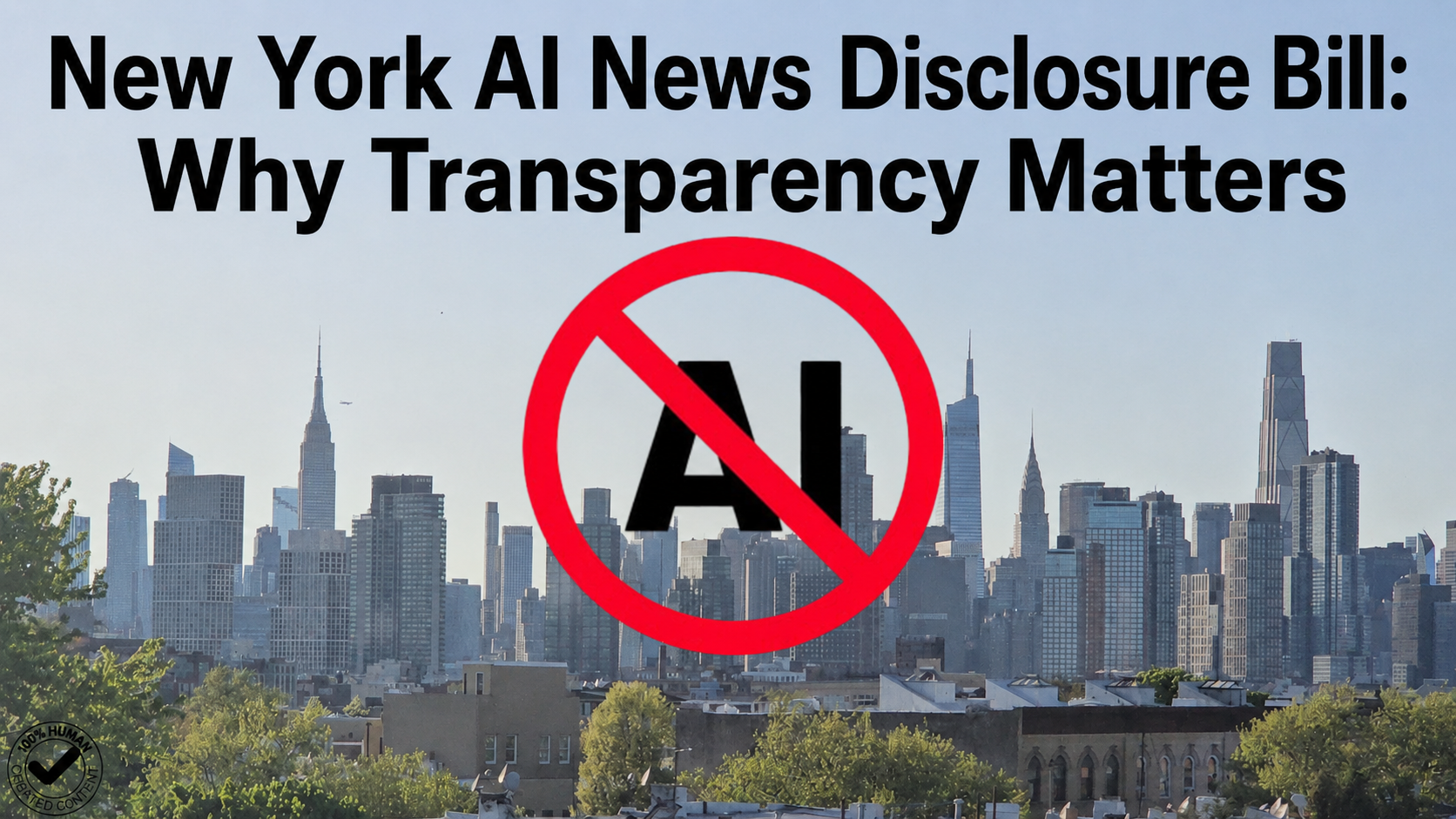
WEPA! Let’s talk about the robot in the newsroom!
Not the cute sci-fi robot that helps you find your keys, makes cafecito, and politely tells you your Wi-Fi password is weak. I’m talking about the new invisible worker in media: artificial intelligence quietly writing, shaping, summarizing, packaging, polishing, and sometimes flat-out generating content that readers may believe came from a human journalist.
New York has passed the NY FAIR News Act, a bill requiring news organizations to clearly disclose when news content is substantially created by generative Ai. It now heads to Governor Kathy Hochul’s desk. If signed, this could make New York the first state in the nation to put this kind of Ai disclosure requirement directly on news media. And let me say this right from the jump: Good!
Not “good” because government should be tap dancing through every newsroom with a clipboard. Not “good” because Ai is evil and should be tossed into the Hudson wearing cement sneakers. Good because transparency is not censorship. Transparency is oxygen. Readers deserve to know what they are reading. Period. Full stop. No salsa step around it.
If a news article, script, image, audio clip, video segment, newsletter, or online report is substantially generated by Ai, then the public should know. That is not a radical idea. That is basic honesty. That is the bare minimum. That is like labeling decaf coffee. You can drink it, sure, but don’t let people think they’re getting the real jolt when the machine is serving them “vibes only.”
The media industry is already in a trust crisis. People do not just question stories anymore; they question the entire system that produces them. Some of that distrust comes from real mistakes. Some of it comes from political spin. Some of it comes from bad-fAith grifters who call everything fake unless it agrees with their group chat. But no matter where it comes from, the damage is real. Now add Ai to the stew.
Generative Ai can create professional-looking copy in seconds. It can write headlines, summarize documents, generate fake quotes, imitate tone, create images, produce audio, and package content that looks slick enough to fool a casual reader. That is the point where we stop pretending this is just another office tool. Spellcheck does not invent sources. A calculator does not rewrite a city council meeting. A camera does not create a fake interview with somebody who never spoke. Ai can be useful, yes, but it can also produce nonsense wearing a necktie. That is why disclosure matters.
The public has a right to know when a human being reported, verified, judged, edited, and stood behind a story and when a machine did a major chunk of the work. That does not mean every use of Ai needs a giant warning label screaming like a fire alarm. If a journalist uses Ai to transcribe an interview, organize research, translate a document for review, or catch typos, that is one thing. Tools are tools. Nobody is asking reporters to disclose that they used a keyboard, a search bar, or a half-dead laptop running on prayer and iced coffee. But when Ai substantially creates the thing the public consumes, that is different. That is where the label belongs. Loud. Clear. No legal fog machine.
Because here is the real issue: Ai is not just a tool in the newsroom. It is also a labor issue, a copyright issue, a trust issue, and a human dignity issue. Writers, journalists, editors, photographers, illustrators, voice actors, anchors, producers, directors, freelancers, and creators across the media world have spent years building skill, voice, judgment, and credibility. These are not disposable parts in some corporate content factory. These are people. People with mortgages. People with families. People who know their beats. People who can tell when a source is nervous, when a public official is dodging, when a statement smells like reheated PR leftovers, and when a community is being ignored. Ai cannot do that.
Ai can imitate a paragraph. It cannot walk into a neighborhood and earn trust. It cannot sit with a grieving parent. It cannot challenge a mayor in a hallway. It cannot hear the tremble in a source’s voice and know there is more to the story. It cannot understand the human cost behind a school closure, a corrupt contract, a workplace layoff, a comic creator getting stiffed, or a local paper being gutted by hedge-fund math. That is journalism. That is human work. That is not a prompt.
So when labor unions and creator organizations support Ai disclosure, they are not being anti-technology. They are saying, “Do not replace us in secret, do not trAin machines on our work without accountability, and do not sell machine output to the public as if human professionals did the job.” That is not fear. That is common sense with a backbone.
Let’s keep it very real: media companies are under pressure. Advertising dollars are tough. Local news is fighting for survival. Digital platforms eat traffic like Galactus with a Wi-Fi signal. Publishers want efficiency. Executives want speed. Ai promises all of that. Faster copy. Cheaper production. More content. More posts. More search traffic. More filler between ads. Boom, boom, boom. But faster is not always better. Cheap is not always smart. And more content is not the same as better journalism.
A newsroom that uses Ai responsibly can absolutely benefit. Ai can help sift through large records, organize timelines, transcribe interviews, scan data, assist with accessibility, and support overworked reporters. That is where the technology can shine. Use it like a power tool. Fine. But do not hand it the whole construction site, fire the workers, and then act shocked when the roof lands in the living room. The danger is not Ai existing. The danger is Ai being hidden.
The danger is a reader clicking on a story and not knowing whether it came from a journalist or a content system. The danger is a publisher using Ai to replace entry-level reporters while pretending nothing changed. The danger is management scraping employee work to trAin internal systems and then using those systems to weaken the very workers who built the value. The danger is synthetic news becoming so normal that nobody knows who made anything anymore. That is not innovation. That is a shell game.
Still, because we are being honest here, the critics do have a point worth taking seriously. Any law that touches the press deserves careful scrutiny. Journalism is supposed to hold government accountable, not invite government to start poking around editorial workflows like a landlord checking under the sink. The First Amendment concern is real. Government should not control what newsrooms publish, how they report, or what editorial decisions they make. That line matters.
A disclosure law must be narrow, clear, and focused on transparency not editorial interference. It should not punish a newsroom for using Ai to help analyze a spreadsheet. It should not treat a transcription tool like a robot reporter. It should not force small publishers into compliance confusion while giant media corporations lawyer up and keep moving like nothing happened. And it definitely should not become a political weapon where officials start demanding labels on stories they dislike. That would be a mess. That would be Albany accidentally building a censorship piñata and handing everybody a stick.
So yes, guardrAils matter. Definitions matter. Enforcement matters. The phrase “substantially created by Ai” needs to be understood clearly. Publishers need practical rules, not vague language that makes everybody slap disclAimers on everything until the label becomes meaningless. If every story says “Ai may have been used,” then nobody learns anything. That is not transparency. That is legal seasoning. But the answer to imperfect regulation is not secrecy. The answer is smarter transparency.
The media industry should have handled this already. Every serious newsroom should have a public Ai policy. Every outlet should explAin how it uses Ai, when it discloses Ai, how humans review Ai-assisted content, how it protects confidential sources, and how it keeps original reporting from being swallowed by automation. The fact that lawmakers had to step in tells you the industry wAited too long to clean its own kitchen. And readers can smell a dirty kitchen.
In comics, we understand credit. We know the difference between writer, artist, colorist, letterer, editor, cover artist, variant artist, designer, and publisher. We care because creative labor matters. You do not look at a comic book and say, “Eh, somebody made it.” No. We want to know who built the world, who drew the emotion, who colored the chaos, who lettered the punch, who shaped the story. Credit is respect!
News should not be any different. If Ai substantially created a piece of news content, say so. If humans reported it, say so. If Ai helped but humans verified and authored it, explAin the policy. Give readers enough information to judge the work. Trust the audience with the truth. What a concept, right? Somebody alert the media, quick!
The pro-transparency case is simple: disclosure does not ban Ai. It does not stop innovation. It does not tell journalists they cannot use new tools. It tells media companies that the audience deserves honesty when those tools cross a meaningful line. And that line is coming fast.
We are entering an era where synthetic content will look real, sound real, read real, and travel real fast. Fake images will be shared before corrections catch up. Ai summaries will strip out context. Automated stories will appear in search results. Audio clones will muddy public trust. Video deepfakes will make people question their own eyes. The future is not wAiting politely at the door. It already kicked it open and asked for the Wi-Fi.
So journalism has a choice. It can embrace transparency now, or it can wAit until the next scandal forces it. It can protect workers now, or it can watch creative labor get treated like trAining data with a pulse. It can respect readers now, or it can keep playing hide-and-seek until nobody trusts the byline, the outlet, or the story.
My position is clear: label Ai when Ai does major work. Protect journalists, writers, artists, voice performers, editors, directors, photographers, freelancers, and every creative professional whose labor makes media worth consuming. Keep humans in control of reporting. Keep confidential sources protected. Keep disclosure simple enough for readers to understand and strong enough that companies cannot dodge it with corporate gymnastics. And yes, keep government on a short leash.
Transparency laws should protect the public, not give politicians a backdoor into editorial decision-making. The press must stay free. But freedom does not mean hiding the machinery from the people you serve. At its best, journalism is a public trust. At its worst, it becomes a content mill with better punctuation. Ai can help the first version survive or help the second version spread like mold in a basement.
The difference is honesty.
So here is the question for readers: would you trust news more if outlets clearly labeled when Ai substantially helped create it?
Because that is the heart of this fight.
Not fear of technology. Not blind worship of technology. Not government grandstanding. Not corporate spin.
Trust.
And trust, my friends, is not generated by a machine. It is earned by people willing to tell you the truth even when the truth comes with a label!
Wepppppaaaaaaaaaaa….
Photo by Al Mega (Brooklyn Rooftop View of NYC)



Leave a Reply
You must be logged in to post a comment.