
Art the Clown’s Scariest Enemy May Be the Fine Print: Inside the Two Lawsuits Haunting the Terrifier Franchise
·Al Mega
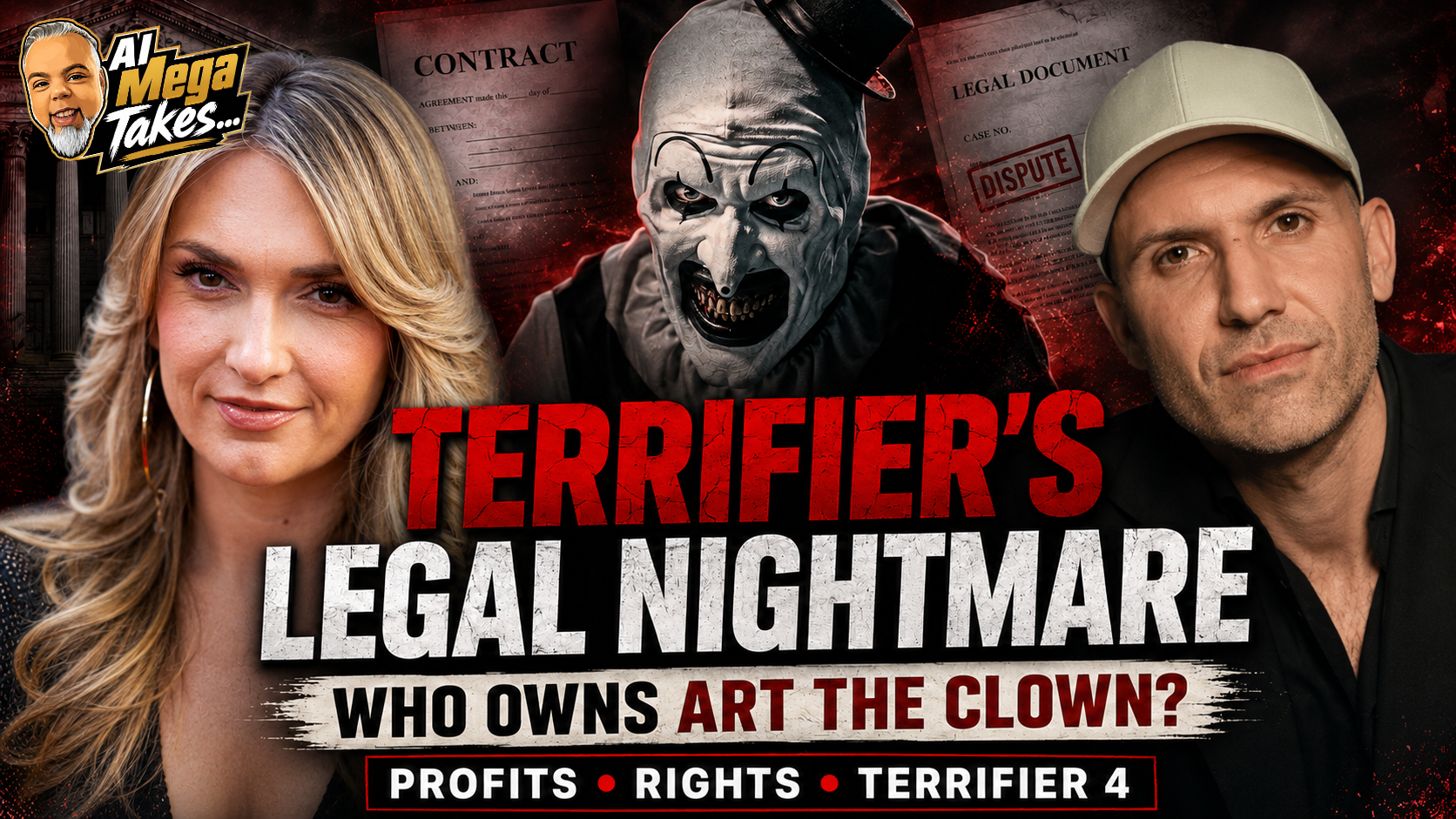
The blood may be fake, but the contracts, ownership claims and questions about performer safety are very real.
Art the Clown has survived gunshots, decapitation, resurrection and enough punishment to make most horror villains call their union representative. Yet the greatest threat facing the Terrifier franchise may not carry a hacksaw or drag around a black garbage bag. It may be buried inside a stack of agreements signed when the property was still a scrappy independent production and nobody involved could have predicted what it would eventually become.
Two separate federal lawsuits are now challenging different parts of the franchise’s rise. Actress Catherine Corcoran, who played Dawn in the original Terrifier, claims she was denied the full profit participation promised under her agreement and has raised serious allegations about the conditions surrounding her infamous death scene. Ruthless Studios, meanwhile, argues that contracts signed years before the franchise exploded transferred ownership rights connected to Art the Clown, the earlier short films and future sequels.
Before the fandom starts putting on legal wigs from Spirit Halloween, we need to be clear about what has and has not happened. Neither lawsuit has reached a final verdict. Allegations are not established facts, and a judge allowing part of a case to continue does not mean the plaintiff has already won. These cases remain active disputes, and both sides deserve to have their arguments examined without the internet deciding the outcome based on which movie poster is hanging in somebody’s bedroom.
Still, the lawsuits expose a hard truth about independent filmmaking. Everybody loves the story of artists building something from nothing. Actors accept low rates, crews work brutal hours, producers scrape together money, friends donate locations and everybody promises to remember one another if the project takes off. Then success actually arrives, the money gets real, and every handshake, casual conversation and vaguely written clause suddenly becomes evidence. That is when the indie dream can turn into an indie legal nightmare.
The Catherine Corcoran case and the Ruthless Studios lawsuit involve the same franchise, but they are not one giant legal brawl. Corcoran’s case focuses mainly on compensation, contract interpretation, consent and working conditions. Ruthless Studios is challenging the ownership and exploitation of intellectual property tied to Art the Clown and the larger Terrifier franchise.
One lawsuit asks who should have been paid and how much. The other asks whether the people expanding the franchise had the right to do so without Ruthless Studios. Both questions carry serious consequences, but the ownership dispute potentially reaches deeper because it may affect future films, licensing arrangements, merchandise and the paper trail distributors expect before putting millions of dollars behind a property.
Word up, that distinction is especially important when discussing Terrifier 4. A compensation dispute can expose a company to damages, accounting obligations and a costly settlement. An ownership dispute can make financiers, insurers and distributors question whether the rights being sold are clean. Nothing sends investors running faster than another company appearing with an old contract and saying, “Hold up, that clown might belong to us.” Corcoran appeared as Dawn in the 2016 Terrifier, becoming part of the sequence that helped transform the film into a word-of-mouth horror sensation. Her character is suspended upside down before Art brutally cuts her body apart, creating one of the most notorious practical-effects scenes in modern independent horror.
According to Corcoran’s lawsuit, she accepted a low SAG-AFTRA daily rate while relying on an agreement that promised her one percent of the profits from Terrifier. She argues that the promise applies not only to the first feature but to the wider franchise, including sequels and other commercial uses tied to the name. The defendants dispute that interpretation and maintain that “profits from Terrifier” referred specifically to the 2016 film in which she appeared.
Their disagreement comes down to a few words that may not have looked dangerous when everybody was trying to finish a tiny horror movie. Did “profits from Terrifier” mean profits from one motion picture, or profits from the franchise that eventually grew around the title? When a production has little money and no guarantee of success, the distinction can feel like legal nitpicking. Once sequels, merchandise, games, convention appearances and international distribution enter the picture, those same words can become worth a small fortune.
In July 2026, a federal judge refused to dismiss Corcoran’s central breach-of-contract claims, finding enough ambiguity in the agreement for the dispute to continue into discovery. That ruling does not mean the court decided Corcoran is entitled to one percent of the entire franchise. It means her interpretation was plausible enough that the case could not be thrown out at the opening stage.
Discovery could now bring accounting records, emails, payment histories and other communications into the case. Those materials may help show what both sides believed the agreement covered and how they behaved after it was signed. The defendants may produce evidence showing that payments and conversations consistently treated the deal as limited to the first movie, while Corcoran may uncover records supporting her claim that the agreement reached beyond the original production. Online, people love turning every court ruling into a knockout. This was not a knockout. The judge simply declined to stop the fight before the evidence could be examined.
The monetray dispute is only one part of Corcoran’s complaint. She also described physically punishing conditions during the production of Dawn’s death scene, alleging that she spent extended periods suspended upside down during a shoot lasting more than ten hours. According to the complaint, filming had to be divided into shorter intervals because of the physical pressure being placed on her body.
Corcoran claims the experience caused cranial swelling and damage to her eardrums. Her lawsuit also describes freezing locations, inadequate bathroom access and problems during the process used to create a silicone cast of her body. The defendants deny wrongdoing, and none of these allegations should be presented as proven facts unless supported by evidence and established through the legal process. They also should not be dismissed simply because the movie was made on a small budget or because horror productions are expected to look dangerous. There is a major difference between performing a violent scene and being placed in an avoidably unsafe situation while creating it. An actor agreeing to appear in an extreme horror film is not agreeing to surrender basic workplace protections.
Independent filmmakers often have fewer resources than major studios. A small crew cannot hire a department for every problem, and productions sometimes depend on people handling several jobs at once. That reality deserves to be acknowledged, but it cannot become a magical excuse for every missing document, questionable decision or safety concern. Passion does not replace planning. Friendship does not replace consent. A killer practical effect is not more important than the human being inside it.
Corcoran also alleged that required procedures were not followed regarding nudity in the scene. She claimed she had not provided proper informed written consent for the topless performance and that nude still photographs were taken during the body-casting process without her permission. The defendants argued that Corcoran understood the nature of the scene and agreed to perform it. They also maintained that footage created for commercial distribution did not carry the type of privacy expectation required under the California statute cited in her complaint.
The judge dismissed Corcoran’s claims involving the alleged nonconsensual distribution of intimate images, finding that the complaint did not sufficiently establish the legal elements required under that particular law. That ruling needs to be described carefully because it did not amount to a sweeping declaration that every action on the set was appropriate. It meant the allegations, as pleaded, did not fit the requirements of the statute used to bring those claims. That may not sound as dramatic as the headline some outlets would prefer, but accurate reporting is not supposed to operate like a carnival barker. A claim can be disturbing without meeting the technical elements of a specific law. A court can dismiss one cause of action while leaving other concerns unresolved.
The SAG-AFTRA agreement in effect during the production period contained protections for performers involved in scenes featuring nudity. Those protections included advance notice, a closed set and prior written consent describing the expected nudity and physical contact. The union’s current guidance is even more detailed, emphasizing written riders, meaningful consent, limits on personal devices, closed-set procedures and restrictions on how nude material may be used outside the finished production. Not every rule in today’s guidance can automatically be applied backward to a movie produced years earlier because union standards and agreements change over time. The correct question is what agreement applied during production and whether those requirements were followed.
The basic principle, however, is not complicated. Consent must be specific, documented and freely given. It should not be assumed because a performer previously agreed to something similar, and it should not be expanded on the day of filming because the production is behind schedule and everybody is tired. “Come on, we already discussed this” is not a nudity rider. It is also not the kind of explanation any responsible producer should want to offer once lawyers become involved.
The Ruthless Studios lawsuit attacks the franchise from a different direction. According to its complaint, agreements signed in 2013 transferred rights connected to the original Terrifier and The 9th Circle short films, including alleged rights involving the characters, sequels, trademarks and derivative works. Ruthless claims those rights were acquired for $5,000.
The company says it financed and produced the anthology film All Hallows’ Eve, which included Damien Leone’s earlier shorts and helped introduce Art the Clown to a wider audience. Ruthless also alleges that Leone later sought permission to make the low-budget 2016 Terrifier feature and that the company granted a one-time exception for that production. That alleged request for permission is central to Ruthless Studios’ case. The company argues that the request showed Leone understood Ruthless possessed rights that had to be cleared. Ruthless says the exception applied only to the first feature and did not authorize Terrifier 2, Terrifier 3 or the broader commercial expansion that followed.
Ruthless claims it was cut out while the franchise became a major horror property. If the company can prove that the original agreements transferred the rights it claims and that the later exception was limited to one film, the case could have serious consequences for future sequels and licensing arrangements. However, Ruthless has not won the case simply because it attached contracts to a complaint. The defendants may dispute the scope of those agreements, the meaning of the alleged exception, Ruthless Studios’ chain of ownership, the timing of the lawsuit or whether later conduct changed the legal relationship between the parties.
The court will have to determine what rights were actually transferred, whether Ruthless validly inherited those rights and whether the defendants exceeded any permission they received. Until those questions are tested, saying Ruthless Studios definitively owns Art the Clown would be irresponsible. Right now, Ruthless says it owns crucial pieces of the franchise. The defendants have not yet had their full arguments tested in court. That is where the verified facts stop, and anything beyond that is fan fiction wearing a courthouse badge.
Corcoran’s lawsuit appears more likely to create financial and reputational pressure than to directly stop Terrifier 4. If she succeeds, the defendants could face damages, accounting obligations or a settlement involving franchise revenue. Her surviving claims do not appear to challenge the basic ownership of Art the Clown or the right to produce another sequel. The Ruthless Studios case presents the more significant potential threat because it challenges intellectual-property rights and the franchise’s chain of title. Chain of title is the paper trail proving who owns a movie, character, script or other creative property. Distributors, insurers, financiers and licensing partners generally want that trail to be clean before committing serious money.
A lawsuit does not automatically freeze production. Ruthless would need to win relevant claims, obtain an injunction or negotiate restrictions through a settlement before it could legally block future exploitation. There is currently no verified basis for declaring that Terrifier 4 has been canceled or shut down by the courts. Unresolved ownership litigation can still create practical problems without a judge officially stopping anything. Insurers may demand additional protection, investors may hesitate and distributors may insist on stronger guarantees before signing agreements. Merchandising partners could also delay deals until they know who has the authority to license the property. The impact could range from no meaningful interruption to added legal costs, delayed agreements, settlement negotiations or changes in how future revenue is divided. Anything stronger would be speculation at this stage, and speculation is not reporting no matter how confidently somebody types it in all caps.
It’s fair to note that both disputes became worth pursuing only after the franchise achieved major success. Supporters of the filmmakers may argue that Corcoran is reading a limited agreement more broadly now that the name Terrifier carries significant value. They may also question why Ruthless Studios allegedly allowed several sequels and years of public expansion before filing its ownership case. Those are legitimate questions. A court may examine when Ruthless became aware of the allegedly unauthorized activity, whether it objected, whether the defendants relied on its silence and whether legal deadlines limit any portion of the claims. Timing could affect both credibility and the available legal remedies. The filmmakers may also argue that early agreements were never intended to carry the expansive meanings now being claimed. Independent productions often operate under intense financial pressure, and contracts created during those periods may use broad language without anyone imagining the property will someday support sequels, merchandise and major licensing deals.
However, timing alone does not prove that either lawsuit is opportunistic or dishonest. Backend disputes become meaningful only when profits exist, and intellectual-property rights may not be worth the expense of federal litigation while a project remains small. Once a franchise begins generating substantial revenue, language that once appeared harmless suddenly matters. Money does not prove the plaintiffs are correct. Money explains why everybody is finally reading the contract. The real story reaches far beyond Art the Clown. Independent films are often built on sacrifice, trust and people doing more than they are being paid to do. Actors work for reduced rates, crew members handle multiple positions, producers finance expenses on credit cards and friends donate locations or equipment because they believe in the project.
That type of spirit can create something incredible, but it can also create dangerous blind spots. A performer agreeing to one percent of profits needs to know exactly which profits, from which production, calculated using which expenses and reported on what schedule. A filmmaker transferring rights needs to know whether the agreement covers one short film, a character, sequels, remakes, merchandise or every future use imaginable. A nudity agreement needs to describe what will be filmed, who will be present and how the footage or still images may be used. A physically demanding effect needs a safety plan that protects the performer even when the clock is ticking and the budget is crying in the corner.
Alot of these protections are not corporate nonsense designed to kill creativity. They are what prevent collaborators from becoming enemies after a project succeeds. Clear contracts protect actors from being denied promised compensation, and they protect producers from unexpected claims that arrive years later. Proper ownership records protect creators from losing control of their work while also allowing distributors and investors to know exactly what they are buying.
Please read the contract before signing it. Have an entertainment attorney explain what the words mean, not what everybody hopes they mean. Put backend formulas in writing, document every transfer of ownership and obtain proper consent before the performer arrives on set. People are very friendly when a project has no money. Once the property becomes valuable, memories have a funny way of changing shape.
It would be easy to turn this into a simple story with heroes and villains, but that would be lazy. Corcoran may prove that her agreement covered more than the defendants paid her, or the defendants may establish that it applied only to the first film. Ruthless Studios may demonstrate that its contracts gave it broad control over the property, or Dark Age Cinema and Art the Clown LLC may show that Ruthless is overstating the reach or current validity of those agreements.
The courts will decide those questions based on evidence, contractual language and applicable law, not fandom loyalty. What can already be said is that independent film productions need stronger protections for everyone involved. Artists should not lose control of valuable creations because they signed documents they did not understand, performers should not be forced to chase compensation years after a franchise becomes successful and producers should not build sequels on rights they cannot clearly prove they own.
The indie dream should not require people to gamble their safety, compensation or creative ownership. When Terrifier was a tiny production, the contracts may have looked like paperwork standing between the filmmakers and the movie they were desperate to create. Today, those same agreements could shape the future of one of modern horror’s biggest success stories.
Art the Clown may be able to survive almost anything. We are about to find out whether the franchise can survive the fine print.
Editorial Disclaimer
This article examines allegations and legal arguments contained in pending federal lawsuits. The claims discussed have not been proven at trial, and no final ruling has established liability or ownership of the Terrifier franchise.
Comic Crusaders does not represent Catherine Corcoran, Ruthless Studios, Damien Leone, Dark Age Cinema, Art the Clown LLC or any other party involved in the litigation. This article is published for news reporting, commentary and public-interest analysis. It does not provide legal advice. Readers seeking legal guidance should consult a qualified attorney and review the original court filings.
Receipts/Sources
- hollywoodreporter.com – “Terrifier” Actress Had Deal for 1 Percent of Profits
- facebook.com – The “Terrifier” Horror Franchise Is Facing Two Federal Lawsuits
- pjlesq.com – Terrifier Lawsuit Intellectual Property Analysis
- indiewire.com – “Terrifier” Actress Claims Breach of Contract
- reddit.com – “Terrifier” Franchise Hit With Lawsuit Over Art the Clown
- hooked-on-horror.com – Terrifier Hit With Second Lawsuit
*Ai Disclosure: The main image includes AI-assisted artwork reviewed by Comic Crusaders before publication.

Leave a Reply
You must be logged in to post a comment.