
Seven Wives #1 Review: IDW Crime Debuts With a Blood-Soaked Mystery
·Al Mega
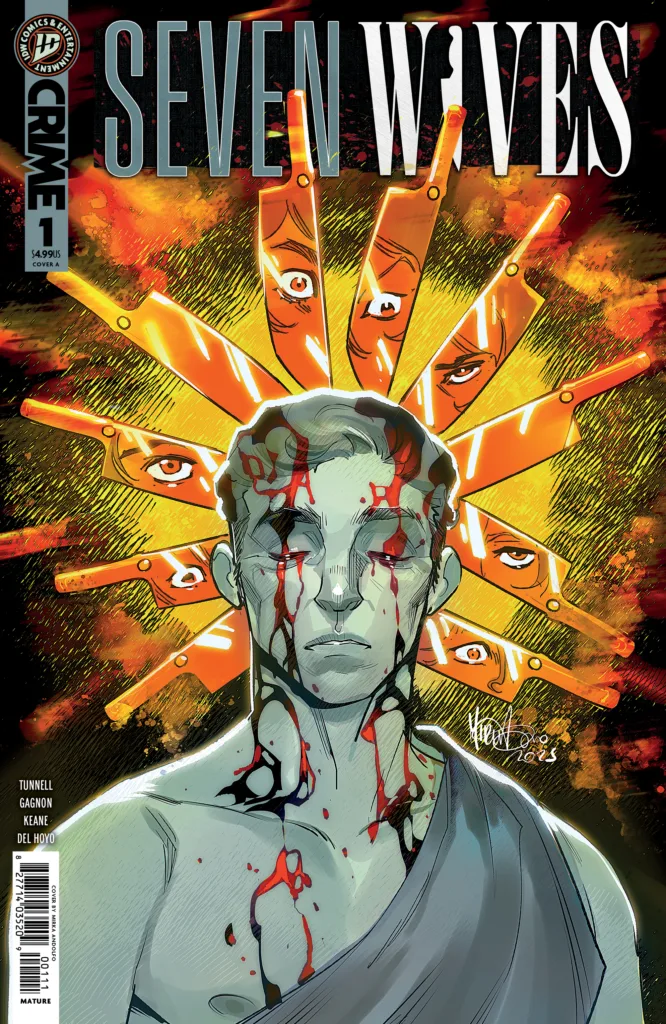
Forty-nine witnesses. Seven wives. One dead husband. And right out the gate, Seven Wives #1 walks into the room like a true-crime documentary wearing church shoes and carrying a bloody knife behind its back. This is not your “somebody died, let’s find the killer” mystery where the victim gets framed as some noble soul lost too soon. Nah. Matthew Dunn is introduced as the kind of man whose death immediately raises a nastier, more interesting question: who did it… and are we absolutely sure we want them punished for it?
That is where Zoe Tunnell’s script gets deliciously dangerous. The setup is tight, nasty, and instantly readable. Detectives Aguilar and Halwell arrive at the Dunn family compound in South Bluff, Arizona, after Matthew Dunn, the patriarch of this isolated Fundamentalist Church of Jesus Christ of Latter-Day Saints community, is found stabbed at the pulpit. Blood on the floor. Scripture in the air. Fear in every corner. The kind of scene where the walls feel like they are testifying before anybody opens their mouth.
But this book is not interested in cheap cult-story spectacle. That would have been the lazy route. Seven Wives has more bite than that. Tunnell takes a premise that could have easily leaned into lurid shock value and instead builds something far more uncomfortable, far more human, and far more gripping. The seven wives are not treated like props in a murder-board puzzle. They are people. Guarded people. Wounded people. Complicated people. Some are scared. Some are loyal. Some are furious beneath the softness. Some have learned how to survive by saying exactly what they were trained to say. That is the hook, mi gente. The mystery is not only “who killed Matthew Dunn?” The real mystery is how many truths had to be buried before one knife finally came out.

Tunnell’s strongest move is how she turns silence into a weapon. Every memorized line of scripture, every polite answer, every sweet little phrase that sounds rehearsed enough to have fingerprints on it, tells you this family has been living inside a pressure cooker. The wives’ modest clothing, braided hair, and quiet voices are not presented as simple visual shorthand. They are armor. They are camouflage. They are survival tools. In a lesser comic, these women would all blur together into one big “cult wife” stereotype. Here, even when the first issue is still introducing the full scope of the family, you can feel each woman trying to control what gets revealed, what stays hidden, and what the detectives are allowed to understand.
That gives the book a real electric pulse. The interrogation scenes do not feel like exposition dumps. They feel like chess matches happening across cracked glass. Aguilar and Halwell are trying to pry open a locked community, but the people inside are not just protecting a killer. They may be protecting each other. They may be protecting children. They may be protecting the only world they have ever known. That moral fog makes this debut sing. Wepa, this is the kind of crime comic that knows the body is only the beginning.
V. Gagnon’s artwork brings a restless, uneasy texture to the issue. The pages feel bruised, scratched, and haunted, like the visuals themselves are trying to remember something the characters refuse to say out loud. The opening murder sequence is especially strong, cutting between pulpit, blood, panic, and religious imagery in a way that immediately sets the tone: sacred space has been violated, but the “sacred” part was already rotten before the knife arrived. Gagnon does a fantastic job making the compound feel isolated without making it visually dead. Houses, hallways, windows, trees, and temple interiors all carry a sense of surveillance. Somebody is always looking. Somebody is always listening. Somebody is always pretending not to know.
Maria Keane’s inks give the linework the grit it needs. There is a fragile roughness to the faces, an emotional tremble in the bodies, a heaviness in the rooms. The characters do not feel polished into superhero perfection, and that is exactly right for this story. These are people living with pressure marks on their souls. The art lets you feel that without turning every panel into melodrama.

Antonio Del Hoyo’s colors are doing serious storytelling labor here. The book shifts through blood-red dread, pale institutional light, dusty desert warmth, and deep blue nocturnal secrecy. Those red-drenched memory fragments hit like alarms. The cooler night scenes bring a different kind of fear, less “crime scene” and more “somebody knows too much.” The palette helps separate time, mood, trauma, and revelation without waving a giant sign in the reader’s face. That is classy comics craft right there.
Brian Kolek’s lettering and design also deserve love because this book depends on rhythm. The dialogue has to feel controlled, clipped, rehearsed, and tense. The captions need that procedural texture without killing the mood. The sound effects need to slice in but not take over. Kolek keeps the reader moving through pages that are emotionally dense and visually ambitious. In a mystery this loaded with names, glances, lies, and half-truths, clean lettering is not decoration. It is navigation.
Now, let’s keep it real: Seven Wives does ask the reader to pay attention. There is a big family structure, a lot of emotional history, and a compound full of suspects, victims, accomplices, and survivors. Some readers may need an extra pass on certain pages to fully lock in who is connected to whom, especially because the wives are intentionally presented through a shared cultural and religious visual language. But honestly? That is not a deal-breaker. That is the book asking you to sit up in your chair and read like the detective board is already in your living room. This is not fast-food mystery. This is a slow-burn plate with seasoning in the corners.
What makes Seven Wives hit so hard is that it understands the best crime stories are not really about death. They are about systems. Control. Power. Who gets believed. Who gets silenced. Who gets labeled sinful when they are simply trying to breathe. Matthew Dunn may be the corpse, but the real villain is the structure that allowed him to become untouchable in life. That gives the murder weight beyond the shock of the act itself. The book is asking whether justice always looks like law enforcement, whether survival can look like sin from the outside, and whether a community built on obedience can ever tell the truth without collapsing.

As the launch title for IDW Crime, Seven Wives makes a strong statement. IDW is not just tossing a detective story into the market and calling it a new imprint. This debut has purpose. It is character-forward, socially sharp, visually moody, and nasty in all the right ways. It knows the genre. It respects the reader. It gives you a dead man, seven possible murderers, and enough emotional dynamite to blow the chapel doors clean off.
Seven Wives is a confident, unsettling, and beautifully uncomfortable debut. Zoe Tunnell, V. Gagnon, Maria Keane, Antonio Del Hoyo, Brian Kolek, and editor Riley Farmer come out swinging with a crime comic that is not just about solving a murder, but about surviving the world that made murder feel inevitable. This one is dark. This one is smart. This one has teeth under the hymnal. Put it on the pull list, keep your eyes on every wife, and do not trust a single polite smile.
Seven Wives is a bloody, brainy, emotionally loaded crime debut that proves IDW Crime came to play. It is tense, layered, beautifully moody, and built for readers who like their mysteries with trauma, teeth, and a little “oh damn, who really did it?” energy.
CRUSADERS SCORE
4.5 / 5

Writer: Zoe Tunnell
Artist: V. Gagnon
Inker: Maria Keane
Colorist: Antonio Del Hoyo
Letters & Design: Brian Kolek
Publisher: IDW Publishing / IDW Crime

Leave a Reply
You must be logged in to post a comment.