
Salvation’s Child Review: Adrian Tchaikovsky Turns Cosmic Terror Into Human Heart
·Al Mega
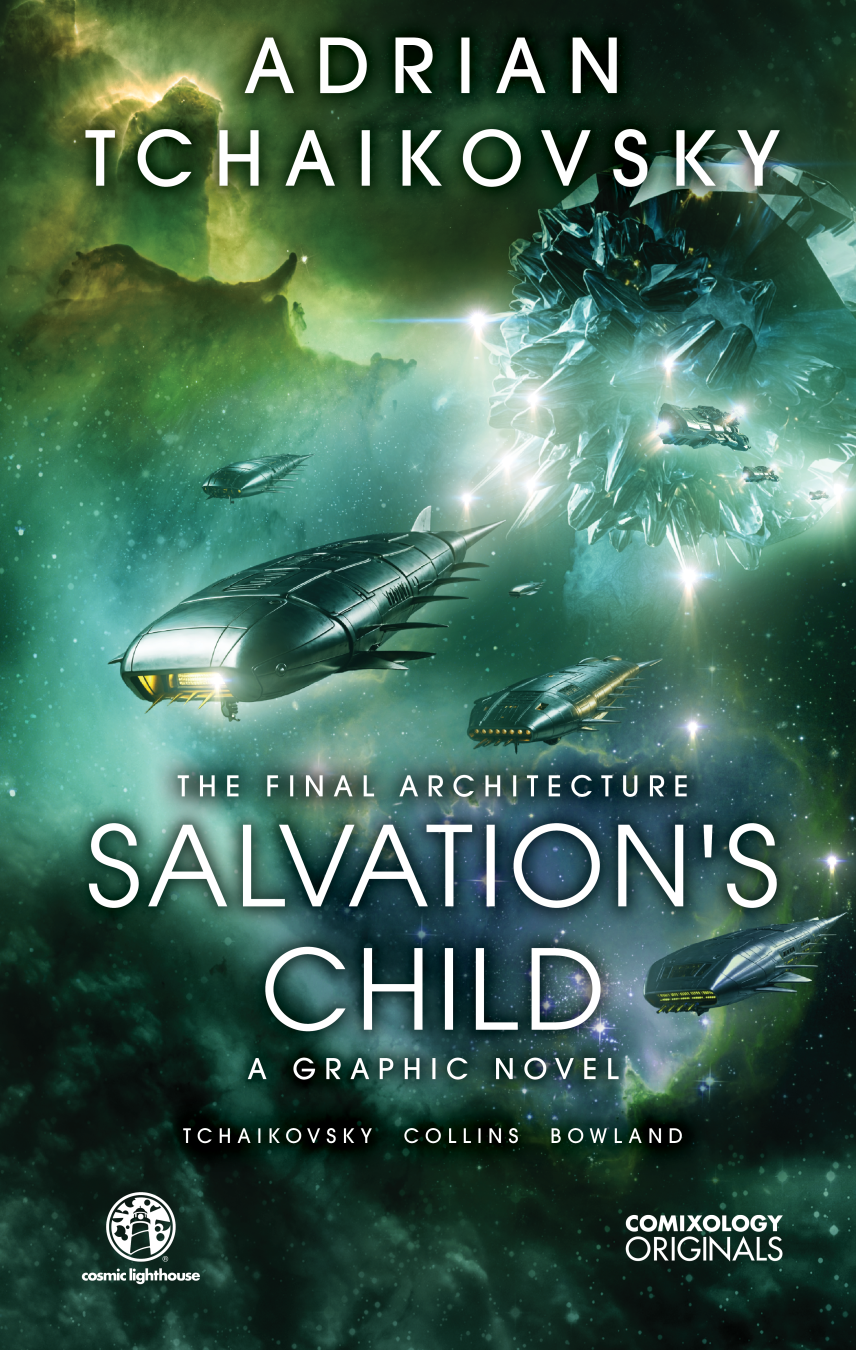
Salvation’s Child is the kind of graphic novel that walks into the room wearing space boots, carrying existential dread in one hand and a beating human heart in the other. This is big sci-fi. I mean BIG big. Moon-sized cosmic horror, refugee trauma, political tension, alien culture, faith, survival, motherhood, and mystery all packed into one sleek Comixology Originals release that feels like somebody took a space opera, ran it through a philosophical thunderstorm, and said, “Yeah, now make it personal.” WEPA, this thing does not play small.
Written by Adrian Tchaikovsky with art by Mike Collins, colors by Pippa Bowland, letters by Simon Bowland, cover art by Steve Stone, editing by Paul Cornell, design by Dylan Todd, and an introduction by Sophie Aldred, Salvation’s Child plants itself inside the universe of The Final Architecture and opens the door for readers who love high-concept sci-fi with soul. Now, if you already know Tchaikovsky’s world, you are going to feel that delicious brain-sizzle of lore clicking into place. If you are new? Don’t panic. This story gives you enough emotional gravity to stay locked in, even when the universe starts throwing concepts at you like a cosmic fastball pitcher with no chill.
At the center of this story is Marta Torino and her daughter Xavienne, better known as Xavi, and that relationship is the engine that keeps this whole machine roaring. Yes, there are Architects, those terrifying, unknowable, planet-warping entities that make humanity look like ants trying to negotiate with a hurricane. Yes, there are alien species, strange ships, cult politics, religious manipulation, battlefield panic, and space-faring desperation. But the real fuel here is a mother trying to protect her child in a galaxy that keeps turning children into symbols, tools, miracles, and weapons. That is where Salvation’s Child punches hardest. Not with the explosions. Not with the cosmic spectacle. With the terrible question of what survival costs when the world decides your kid might be useful.
Tchaikovsky writes this with tremendous control. The story never feels like it is simply showing off a universe. It has all the grand machinery of space opera, but it remains anchored in loss, migration, class instability, and that awful limbo of people who are always being moved along because disaster has made them inconvenient. Marta’s life after catastrophe is not glamorous sci-fi heroism. It is camps, bad jobs, temporary homes, hard choices, and one more ship, one more station, one more place that may not last. That gives the book real grit. This is not shiny space fantasy where everyone gets matching uniforms and a clean moral compass. This is messy, battered, frightened humanity trying to keep breathing while the stars themselves feel hostile.
And Xavi? She is fascinating. She is written like a child who is both completely innocent and quietly terrifying in the way only children in great sci-fi can be. She senses things others cannot. She experiences reality sideways. There is something inside her perception that brushes against unspace, against the Architects, against the impossible. But Tchaikovsky wisely never turns her into a simple “chosen one” cliché. She is not some smug little cosmic wizard tossing out prophecy like she downloaded the premium universe package. She is a kid. Curious. Scared. Gifted. Misunderstood. And that makes her powerful in a way that feels tragic before it feels triumphant.
Mike Collins deserves a serious salute here because the visual storytelling is doing heavy lifting from page one. The Architects are rendered with that beautiful nightmare energy, massive, luminous, impossible, like frozen lightning sculpted by a god having a panic attack. Collins understands scale. When these beings appear, they do not just enter a panel; they dominate the visual oxygen. Ships look vulnerable around them. People look microscopic. Even planets feel like they are holding their breath. That is exactly how cosmic horror should feel. You should not look at the threat and think, “Oh, cool monster.” You should think, “My insurance does not cover this.”
But Collins is not just about the huge spectacle. The quieter panels land, too. Marta’s expressions carry exhaustion, suspicion, tenderness, rage, and that particular parent-energy of “I will fight the galaxy with a spoon if I have to.” Xavi’s face does so much subtle work, especially when she is trying to understand things nobody around her can explain. The alien designs also give the book its own personality. The Hanni, the Castigar, the Hivers, the Partheni they all bring texture to the world. This galaxy feels populated, not decorated. That matters. Too much sci-fi gives you aliens that feel like background furniture. Here, each species feels like it has its own social rhythm, body language, and worldview.
Pippa Bowland’s colors bring the whole thing into hyperspace. There is a smart contrast between cold space blues, clinical station environments, alien warmth, religious reds, and that strange luminous terror surrounding the Architects. The book knows when to feel vast and when to feel cramped. It knows when to go bright and when to make a room feel like trouble is hiding in the ceiling pipes. Simon Bowland’s lettering keeps the pace moving through a story that has a lot of concepts, a lot of voices, and plenty of sound-driven intensity. The lettering never gets in the way of the art, but when the book needs alarm, panic, or alien enormity, it hits.
What I really appreciate is how Salvation’s Child handles faith and fanaticism without flattening everything into a basic “religion bad, science good” setup. The Hegemonic Cult adds tension because they understand the power of myth, fear, and spectacle. They know how people cling to meaning when the universe has ripped their lives apart. That makes them dangerous. Not cartoon-villain dangerous. Human-dangerous. Political-dangerous. The kind of dangerous that smiles before it locks the door. The book uses them to explore how miracles become ownership claims, how frightened societies build cages around wonders, and how quickly protection can become exploitation.
The pacing has a strong cinematic feel. It begins with emergency and displacement, then gradually widens into a full-blown collision of factions, belief systems, alien intelligence, and survival strategy. The middle section gives the reader enough room to breathe inside this world before the pressure returns like a meteor with bad intentions. And when the story escalates, it escalates with purpose. This is not noise for noise’s sake. Every burst of action is tied to someone trying to control, save, use, understand, or escape Xavi.
The ending is what gives the book its sting. Without spoiling the full impact, Salvation’s Child does not hand you a clean victory parade with confetti and space cupcakes. It gives you something more complicated and far more memorable. It asks what happens after the miracle. Who gets credit? Who gets power? Who gets studied? Who gets protected? Who gets erased? That final emotional note lingers because the story understands that history often turns living people into useful legends before they have finished being human.
Salvation’s Child is a gorgeous, thoughtful, emotionally charged expansion of The Final Architecture universe and a strong reminder that great science fiction is not just about strange worlds. It is about what strange worlds reveal about us. This book has cosmic dread, alien wonder, political bite, and a mother-daughter heartbeat that keeps the whole thing alive. Adrian Tchaikovsky brings the brain. Mike Collins and the art team bring the spectacle. Together, they deliver a graphic novel that feels massive without losing its soul. Comic Crusaders verdict? This is premium space-opera fuel with heart, horror, and heavyweight imagination. Strap in, Crusaders. The galaxy is beautiful, terrifying, and absolutely not done with Xavi.
CRUSADERS SCORE:
4.5/5
Available from Comixology on May 26, 2026
Writer / Story & Script: Adrian Tchaikovsky
Art: Mike Collins
Color Art: Pippa Bowland
Letters: Simon Bowland
Cover Art: Steve Stone
Editor: Paul Cornell
Designer: Dylan Todd
Introduction: Sophie Aldred
Publisher: Cosmic Lighthouse in association with Comixology / Comixology Originals
Leave a Reply
You must be logged in to post a comment.