
Ashes Over Neon Turns Society’s Outcasts Into the Loudest Revolution in the Room
·Al Mega
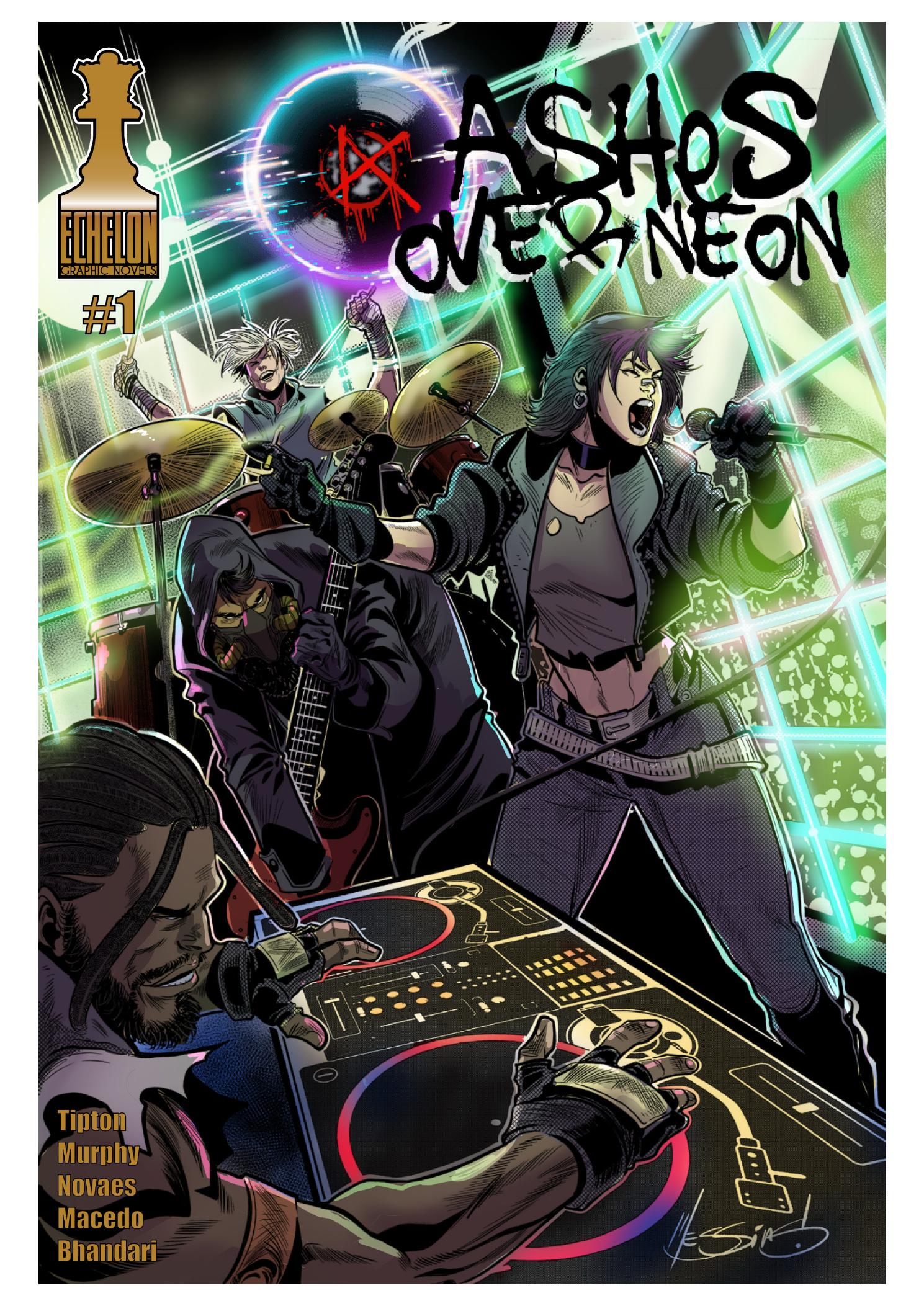
Some revolutions kick down government doors. Others grab a microphone, blow out every speaker in the building, and make the people upstairs wonder why the floor suddenly started shaking. Ashes Over Neon belongs to that second crew. This retro-futuristic graphic novel drops readers into a city divided by status, geography, opportunity, and the kind of polished corporate machinery that can manufacture celebrity while pretending real culture grows inside a laboratory. Jake Tipton, Dan Albertson, Ethan Murphy, and the creative squad come roaring out of the garage with a story about music, identity, exclusion, and the dangerous moment when somebody finally hears what they have been trained to ignore. Wepa, mi gente, this engine does not purr. It growls.
“Life in the Gutter” opens with Sera walking into a big corporate presentation carrying all the right information and nowhere near enough faith in herself. The second those executives start staring, her confidence begins coughing like an old engine on a freezing Brooklyn morning. She knows their language, understands the business, and clearly did the homework, but knowing your stuff and owning the room are two very different animals, fam. Meanwhile, the company is busy trying to engineer music like it came off a factory belt, polished, packaged, approved, and stripped of anything too unpredictable to monetize. Sera can feel something wrong beneath all that expensive shine, even if she has not found the nerve to say it yet. That nervous energy makes her easy to connect with because she does not enter the story acting like destiny already handed her the keys. She is smart, rattled, overlooked, and dragging around enough buried history to fill every seat on the tour bus.
After getting smoked in that corporate meeting, Sera stumbles into Down in the Gutter, the kind of underground music joint where the drinks are questionable, the equipment has survived at least three near-death experiences, and somebody is always one bad decision away from starting a fight or forming a band. Sector One may have the expensive toys, pressed suits, and entertainment polished until every ounce of personality gets buffed clean off, but the Gutter has pulse, baby. Sweat on the walls. Noise in the floorboards. Musicians carrying beat-up gear, ugly history, and enough attitude to make security reconsider the paycheck. Tipton and Murphy do not stop the party to hand us some dusty lecture about how this city works. They let us smell the difference. Sector One feels like a showroom where touching anything gets you escorted outside. Down in the Gutter looks like the fire marshal changed his number years ago, but every busted speaker, stained wall, and crooked stage tells you somebody came here, ate pavement, got back up, and cranked the volume even higher.

Dante becomes the spark plug Sera did not realize she needed. He is a performer with charisma, humor, old-school instincts, and enough confidence to lend some out when hers hits empty. Their conversation works because it does more than march the plot forward. There is flirtation, suspicion, recognition, and the sensation that these two share more history than either one plans to unpack in front of strangers. Dante sees through the suit. Sera sees beyond his swagger. Murphy allows their rhythm to develop through teasing and interruption, which keeps the exchange loose even when it carries serious information about social divisions and personal reinvention. Sera’s red hair becomes “Red,” her business attire becomes a “uniform,” and one small nickname starts peeling corporate paint off an identity she has been wearing for too long.
Music is the book’s nitrous button. Once Dante reaches the stage, Gustavo Noveas loosens the panel construction, Gabriel Macedo floods the room with radioactive greens and hot purples, and Karan Bhandari lets the sound effects crash across the artwork like another instrument. You do not literally hear Dante’s performance, but the pages communicate physical impact through movement, crowd reactions, distorted light, and kinetic typography. A DJ deck becomes command central. Bodies stretch beyond ordinary anatomy. The audience’s energy folds back into the performer until the club feels like one living organism. Plenty of comics place a guitar in somebody’s hand and expect readers to imagine the rest. Ashes Over Neon puts in the visual labor. You can practically feel the bass rearranging nearby furniture.
Noveas gives the cast expressive faces that carry embarrassment, attraction, hostility, delight, and panic without forcing the dialogue to do everything. Sera’s performance anxiety is particularly convincing. Her shoulders tighten. Her eyes dart. Her posture changes depending on who controls the room. When music grabs her, the same character looks physically different because confidence alters the way she occupies the panel. The club patrons also receive memorable designs instead of becoming generic background wallpaper. Punk textures, futuristic streetwear, altered bodies, masks, glowing interfaces, and battered musical gear establish a subculture living several floors beneath the city’s manufactured perfection. Eder Messias captures that attitude beautifully on the cover, where the cast looks ready to either headline a forbidden concert or steal the vehicle parked behind the venue. Possibly both.

Macedo’s colors carry a significant amount of narrative weight. Sector One leans toward controlled daylight, pale interiors, steel blues, and sterile corporate surfaces. Once the story descends into the Gutter, those restraints explode into magenta haze, acid green soundscapes, bruised violets, and burning stage light. The palette is not merely decorative cyberpunk frosting. It identifies who holds power, where people feel free, and how music transforms physical space. Olivia Satterfield’s graphic elements reinforce the retro-futuristic atmosphere through screens, signage, interfaces, and branding that feel integrated into the environment. The world has enough visual specificity to suggest a much larger culture beyond these pages without drowning the reader in made-up terminology.
Bhandari handles a challenging assignment because this is a talkative opening chapter. Several scenes carry dense conversations, overlapping reactions, lyrics, sound effects, digital notifications, and internal emotional pivots. Most of the reading order remains clear, while the strongest effects become part of the performance itself instead of sitting politely on top of the artwork. A few dialogue-heavy pages could breathe more. Some balloons crowd the figures or compress an exchange that might land harder with fewer words. The first act also spends substantial track time on Sera’s presentation before revealing the book’s musical engine. Her anxiety makes those pages worthwhile, but trimming a little corporate explanation could get the story into the Gutter sooner and give the band more room to establish individual personalities.
Calling Ashes Over Neon “KPop Demon Hunters meets Linkin Park” sells the flavor, although this preview chapter is not chasing either property with tracing paper. The pop spectacle is present. The nu-metal sincerity, outsider anger, electronic aggression, and found-family potential are absolutely warming up behind the curtain. Still, the book’s strongest idea is its own: society has separated acceptable culture from the people who actually create it. The system wants rebellion after it has been sanitized, focus-tested, monetized, and fitted with a tracking number. The musicians down in the Gutter are the raw, beautiful chaos those corporate culture vultures could never build in a boardroom, no matter how many focus groups they feed. These cats come with scars, baggage, bad attitudes, real history, and absolutely no interest in behaving for anybody holding a checkbook.

The whole crew has not gotten an equal turn at the mic yet, and honestly, that is the one thing keeping the book’s “band of misfits” hook from fully detonating. Sera and Dante run this opening set while everybody else slides through just long enough to make you wonder what kind of glorious dysfunction they are bringing to rehearsal. Trust me, the potential is sitting right there with the amp already humming. Fly outfits and neon swagger can get a band through the door, but they cannot carry an entire graphic novel. I want the beef, the buried history, creative egos bouncing off the walls, rehearsals going straight to hell, and those rare moments when a room full of hardheaded personalities somehow locks into the same groove. “Life in the Gutter” plugs in all those cables while setting up the real battle ahead: music made from scars and soul going head-to-head with an industry trying to package rebellion, slap a barcode on it, and sell it back to the streets.
Ashes Over Neon arrives with its amplifiers plugged in, its city glowing, and its heart beating beneath a sharp coat of futuristic grime. The chapter has occasional first-issue congestion, and the larger cast needs more runway, but the emotional hook is real, the artwork comes alive during performance sequences, and Sera’s collision with the Gutter gives the story a compelling ignition point. Tipton, Albertson, Murphy, Noveas, Macedo, Bhandari, Satterfield, Garcia, and Messias have built a world where music is not background decoration. It is identity, contraband, memory, resistance, and maybe the only language capable of crossing every wall this city constructed.
Turn it up, fam. The revolution has a set list!
CRUSADERS SCORE:
4/5

Kickstarter runs September 9 – October 23:
https://www.kickstarter.
Original Story by: Jake Tipton
Produced by: Jake Tipton
Written by: Ethan Murphy
Illustrated by: Gustavo Noveas
Colored by: Gabriel Macedo
Lettered by: Karan Bhandari
Graphics by: Olivia Satterfield
Credits by: Beau Garcia
Cover Art by: Eder Messias
Publisher: Echelon Graphic Novels
Chapter: “Life in the Gutter”
Created by: Jake Tipton and Dan Albertson



Leave a Reply
You must be logged in to post a comment.