
Too Much Blood Review: Superheroes, Politics and One Bloody Mess
·Al Mega
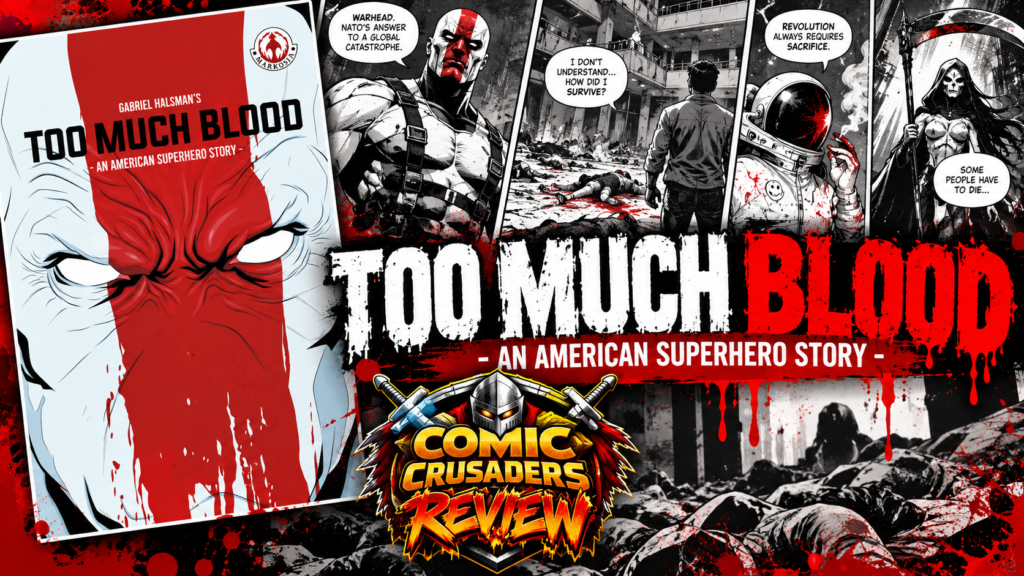
Somebody tell these so-called saviors to put the damn capes down for five minutes, because Too Much Blood: An American Superhero Story is not interested in playing nice! Gabriel Halsmans takes the whole idea of government-backed superheroes, drags it through political paranoia, and leaves everybody looking guilty. We’ve got a NATO-sponsored super-team, an extremist organization with its own grand plans, a guy trapped in a shopping mall surrounded by bodies, and one smiling astronaut who looks like he wandered out of a children’s birthday party from hell. Coño, this is some twisted business! Markosia put out a book that wants to pick a fight with the superhero genre itself, and you know I had to see whether it could back up all that attitude.
The opening introduces the Warhead, a metahuman squad supposedly created to prevent global catastrophe. Sounds beautiful on paper, right? Captain Blood leads the operation, Mr. Ramirez brings the muscle, and the rest of the crew comes with powers and personalities that could fill a whole separate series. Then the story yanks the rug out. A devastating attack turns a shopping mall into a graveyard, and suddenly we’re following a battered man named Tom trying to understand how the hell he survived. Halsmans doesn’t hand us a comfortable tour guide. The answers arrive through blood, confusion, and conversations with people whose version of saving the world might be even scarier than the people they’re fighting.
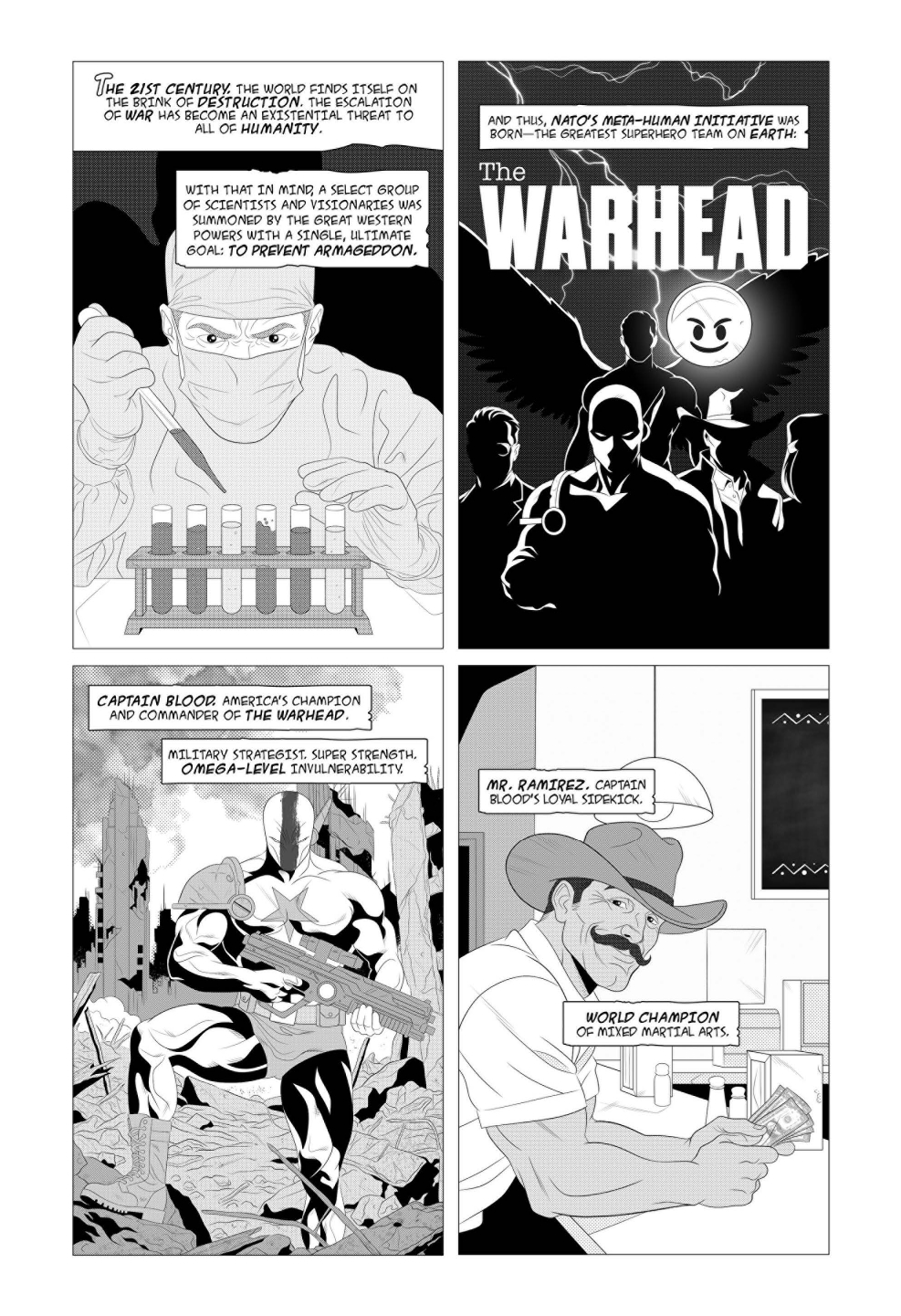
One of the strangest players is Lipstick, an astronaut-looking figure with a cracked, dark visor and a voice that can go from philosophical to downright unsettling without warning. This cat talks revolution, capitalism, exploitation, and sacrifice like he’s delivering a manifesto between cigarette breaks. His organization, the E.N.F., insists it wants to tear down the systems crushing ordinary people. The problem? Innocent bodies are piling up while everybody explains why their particular cause is worth the cost. Fam, I’ve heard enough people in real life excuse terrible decisions with beautiful speeches. Halsmans understands that hypocrisy, and the conversations between Tom and Lipstick are some of the book’s most interesting material.
Tom gives us the human perspective, which this madness desperately needs. He’s scared, injured, angry, and not especially impressed by anybody’s political sales pitch. His exchanges with Lipstick keep dragging the story back to a simple question: who pays when powerful people start treating human lives like chess pieces? The book also throws in Jihad Jane, a grim reaper-like presence, and a broader clash between factions that all claim some higher purpose. Nobody’s handing out moral gold stars here. There’s a nasty sense that the heroic imagery itself has become a costume for competing forms of control. It’s an ambitious idea for a short graphic novel, and I respect the nerve.
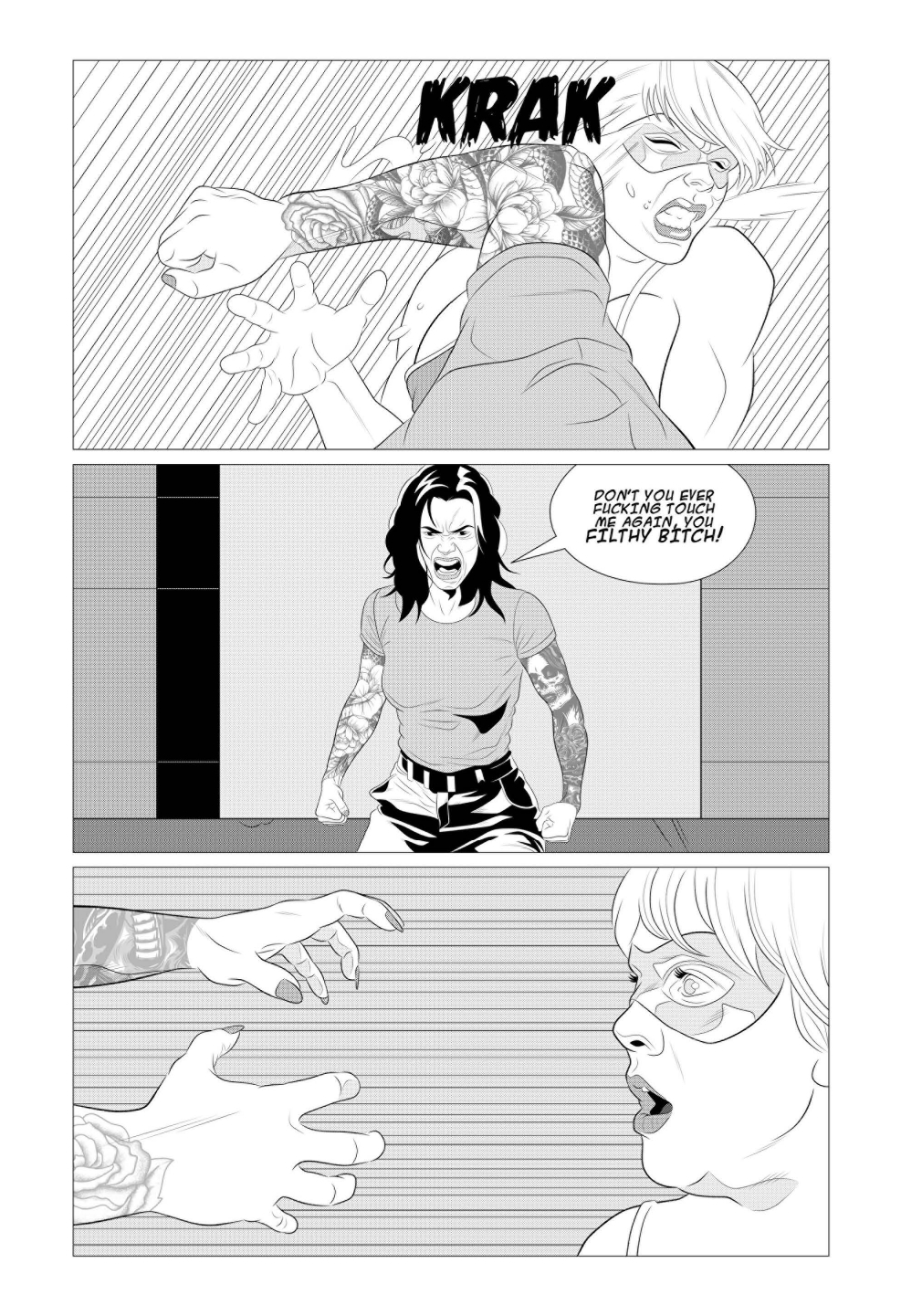
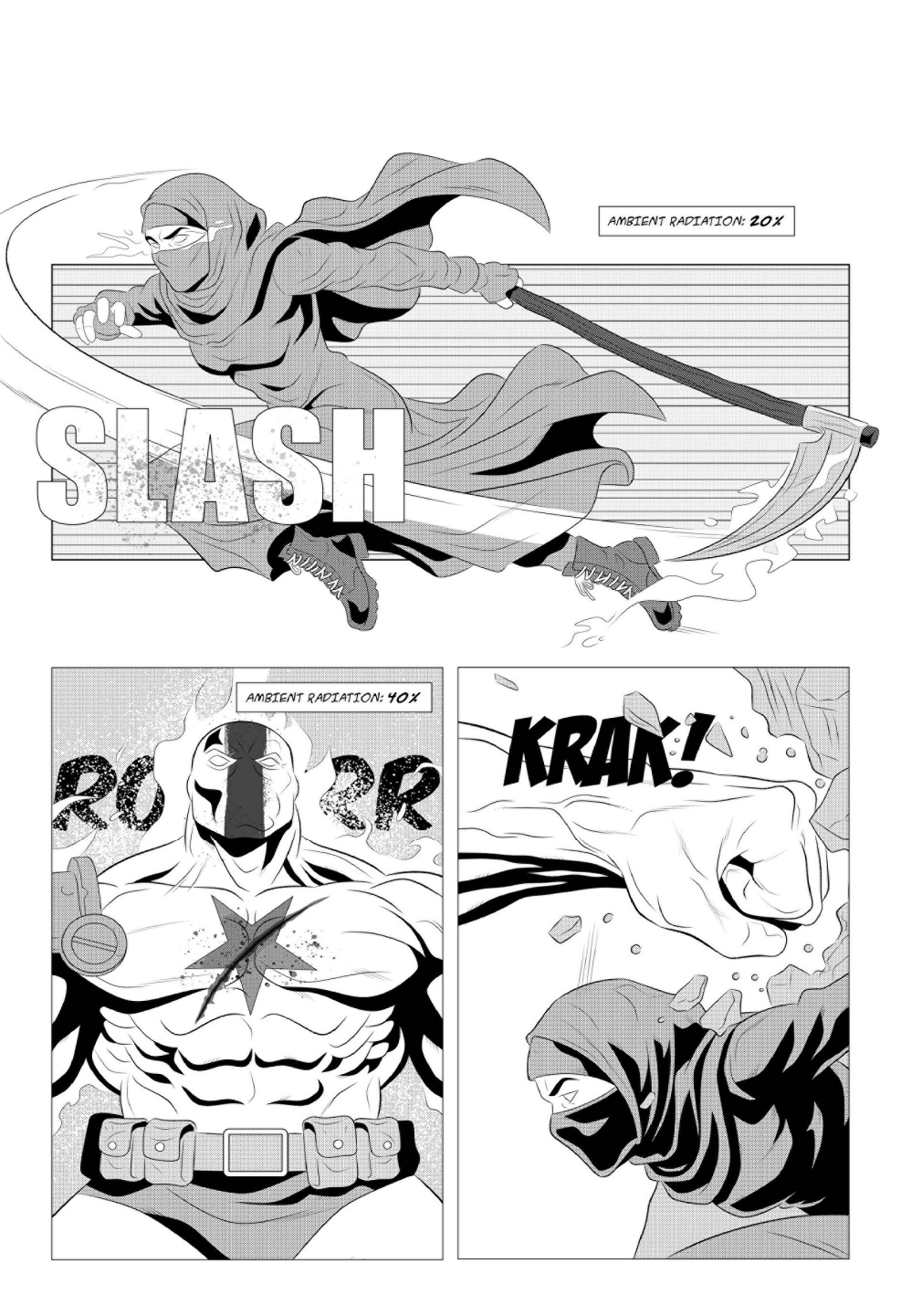
Visually, Halsmans leans hard into black and white, and that choice gives the book a mean little personality. Heavy shadows, stark white backgrounds, cracked faces, blood splatter, and those creepy expressionless masks create an atmosphere that feels cold even when the violence gets loud. I especially dig the contrast between Captain Blood’s muscular superhero silhouette and Lipstick’s almost toy-like astronaut suit. The mall sequences have this empty, haunted quality, while the later confrontations get more kinetic with slashing blades, brutal impacts, and sharp panel-to-panel cuts. When the layouts loosen up, you can feel the danger. WEPA! There’s real visual ambition in these pages.
Now, the artwork isn’t flawless, papo. Some figures look stiff, and a few facial expressions don’t quite land the emotion the dialogue is reaching for. Certain panels are packed with speech balloons while others race through action so quickly that you have to look twice to follow the geography. The mostly grayscale approach creates atmosphere, but it can also flatten the distinction between characters and settings during the busier sequences. Lettering remains generally readable, although the long ideological speeches sometimes crowd the art. This is where I wanted the book to trust its pictures more. You’ve already shown us a massacre and a world falling apart. You don’t always need another character explaining why everything’s terrible.
Halsmans also swings at some enormous targets: American power, military intervention, revolutionary violence, class resentment, media spectacle, and the superhero fantasy of solving politics with a fist. That’s a whole damn buffet for a book this size! Some of the satire bites, especially when characters justify collateral damage with absolute confidence. Other stretches feel like the characters are arguing positions instead of speaking like flesh-and-blood people. The shifting allegiances and late reveals are intriguing, but the pacing gets jumpy once the confrontation expands beyond Tom’s immediate predicament. I would’ve liked more time with the Warhead as individuals before everything starts collapsing around them.
Still, there’s something admirably nasty about a comic that refuses to give us a clean hero to root for. Too Much Blood isn’t trying to sell you the next lunchbox-friendly champion. It wants you uncomfortable. The ticking-clock structure keeps the pressure on, the title earns its grim reputation, and the final stretch has the kind of bleak energy that makes you stare at the page for a second after you’re done. Some of the messaging is about as subtle as a brick through a barbershop window, sure, but I would rather see an indie creator take a dangerous swing than deliver another interchangeable cape book that disappears from my memory before dinner.
Too Much Blood: An American Superhero Story has ideas, attitude, and a wonderfully unsettling visual identity. Gabriel Halsmans isn’t afraid to put the whole superhero establishment on trial, and the black-and-white artwork gives this political nightmare its own flavor. The heavy exposition, uneven pacing, and occasional stiff storytelling keep it from hitting every target, but there’s enough bite here to make the experience worthwhile. This one’s for readers who like their superhero fiction cynical, confrontational, and willing to get its hands dirty. Just don’t expect anybody to come out smelling like roses.
CRUSADERS SCORE:
3.5/5
Creator: Gabriel Halsmans
Publisher / Managing Partner: Harry Markos
Special Projects Coordinator: GM Jordan
Creative Consultant: Andy Briggs
Editor in Chief: Ian Sharman
Publisher: Markosia Enterprises
Leave a Reply
You must be logged in to post a comment.