
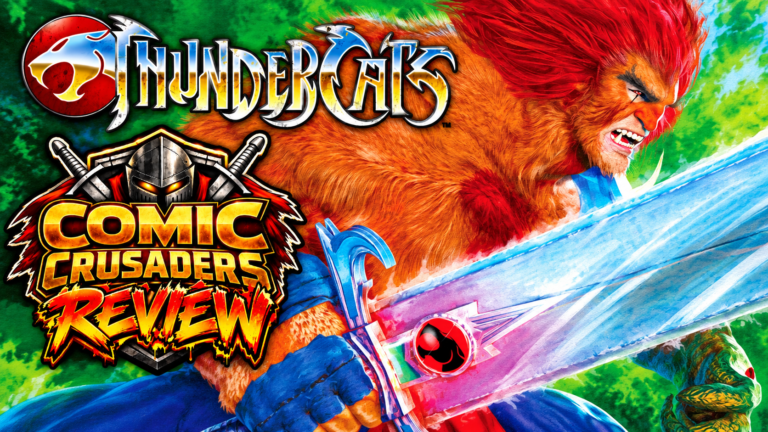
THUNDERCATS: CHEETARA #1 REVIEW: YOU CAN OUTRUN AN ENEMY, BUT GOOD LUCK OUTRUNNING YOUR OWN HEAD
·Al Mega

Cheetara has always been the ThunderCat who can outrun damn near anything, so Saladin Ahmed immediately putting her against something speed cannot solve is the right damn move. ThunderCats: Cheetara #1 gets inside her head and turns one of the character’s established strengths, her heightened perception, into something frightening. She is hearing things nobody else can hear, seeing things she cannot explain and slowly realizing that whatever is happening may be tied to something bigger than the immediate threats facing the ThunderCats.
Ahmed understands that Cheetara does not need another story whose entire pitch is “look how fast she runs.” Yes, we get the speed, and Andrea Arcari gets opportunities to make those sequences pop, but the hook here is uncertainty. Cheetara is hearing a song that challenges what she believes about the Book of Omens, the ThunderCats and even the Mu’Tants. That is a much stronger foundation for a solo book than simply finding another enemy for her to race.

The voices are what got me because Ahmed doesn’t immediately reduce them to an easy good-versus-evil gimmick. Cheetara does not know whether she is receiving prophecy, manipulation, buried memory or some combination of all three. That uncertainty pushes her away from the safety of the team and turns a character usually defined by confidence and motion into somebody forced to stop and question what she thinks she knows. When your hero can move faster than almost everybody around her, making the real threat something she cannot physically outrun is smart storytelling.
Arcari sells the hell out of Cheetara’s movement. When she runs, the pages actually feel fast rather than merely telling us she is fast. There are stretches where panel shape, perspective and body positioning pull your eye through the page with her, and the fight choreography has a loose kinetic snap that fits the character beautifully. Andrew Dalhouse gives the ThunderCats world the bright energy you expect, but the visions introduce stranger palettes that tell you immediately when reality is starting to get slippery.

The quieter expressions impressed me just as much. Cheetara moves between frustration, exhaustion, fear, stubbornness and genuine curiosity without becoming melodramatic. Her conversations with Tygra are especially useful because their history gives Ahmed somewhere to expose what she is feeling without having her narrate every emotion directly at us. Then, when she ultimately heads toward the Temple of Song, the decision feels like something she needs to do rather than something the plot ordered her to do.
I do think the middle slows down slightly while reinforcing information we already understand about the voices and Cheetara’s isolation. It never becomes a serious problem, but trimming a little repetition might have made the escalating mystery bite even harder. Once the final stretch arrives and the story shifts into discovery, danger and that cliffhanger, Ahmed has already done enough to make issue two an easy pickup!

ThunderCats: Cheetara #1 works because it treats her like a character instead of a power set. There is plenty here for longtime ThunderCats fans (Hoooooooooooo…), but the mystery does not require thirty years of homework to understand why it’s important. Cheetara is being called toward something she doesn’t understand, and for once the fastest ThunderCat alive can’t simply run away from the answer. Yeah, I’m coming back! WEPAAAAAAAAAAAAA
CRUSADERS SCORE:
4/5

Writer: Saladin Ahmed
Artist: Andrea Arcari
Colorist: Andrew Dalhouse
Letterer: Jeff Eckleberry
Main Cover Artist: Mark Spears
Editor & Packager: Nate Cosby
Publisher: Dynamite Entertainment
On Sale:
9/9/2026
Leave a Reply
You must be logged in to post a comment.