
Godzilla vs. War of the Worlds?! Kyle Baker Just Let the Kaiju Loose!
·Al Mega
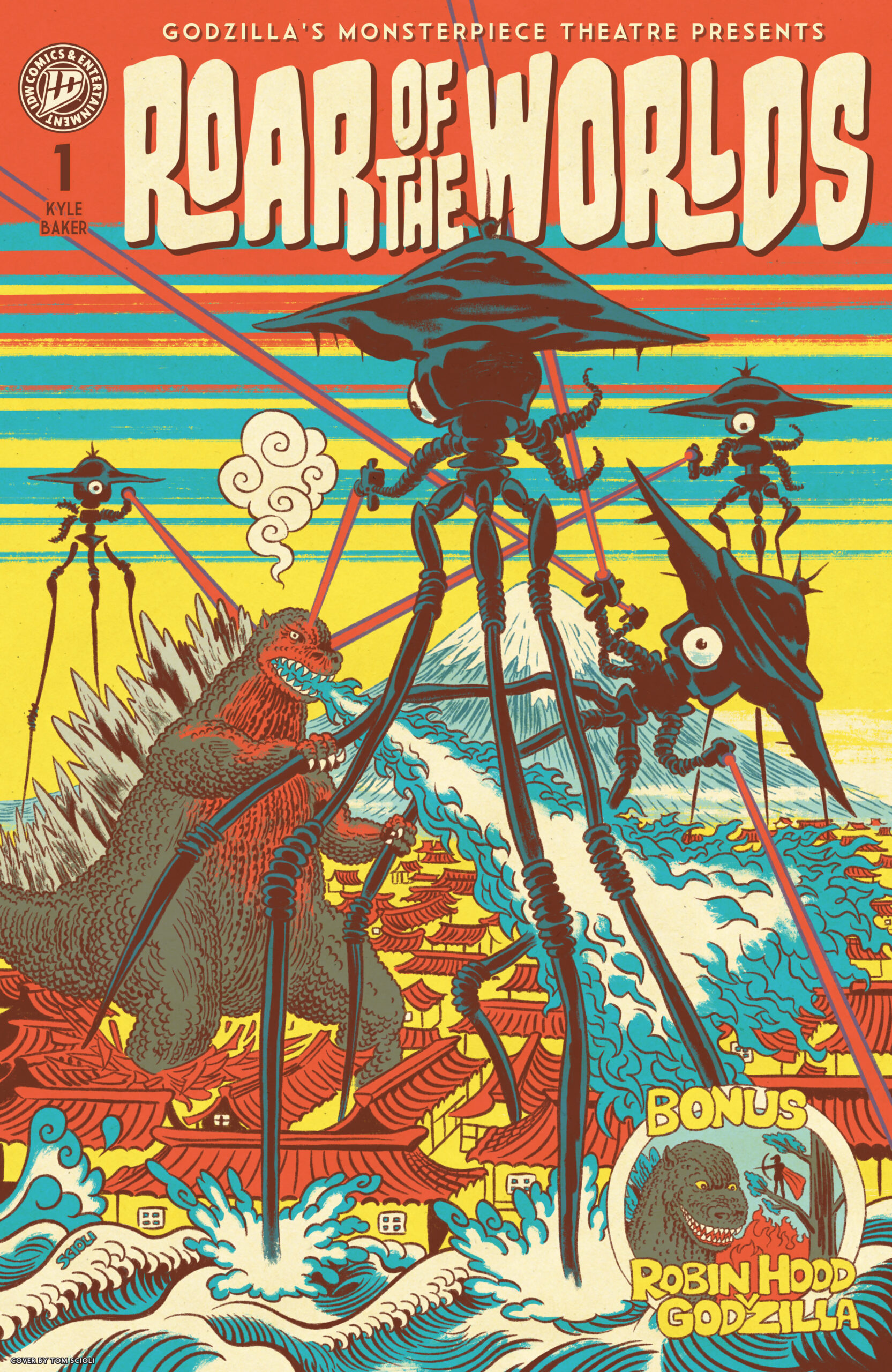
Yo, somebody should have sent Mars the memo: if you are planning an invasion of Earth, maybe do a little neighborhood research first. Because rolling into Japan with giant murder tripods while Godzilla is anywhere in the vicinity is like stealing a car in Brooklyn and wondering why everybody on the block suddenly knows your business. Godzilla’s Monsterpiece Theatre Presents: Roar of the Worlds #1 takes the beautifully ridiculous premise of H.G. Wells’ The War of the Worlds, relocates the invasion to Japan in 1900, tosses radium, family drama and early twentieth century militarism into the mix, then gives writer, artist and letterer Kyle Baker the keys. My dude does not cruise with this concept. He stomps the accelerator. What could have been a one-joke literary mash-up becomes this wild retro monster comic packed with personality, giant sound effects, human stakes and the kind of Godzilla mayhem that reminds you why watching gigantic creatures wreck each other never gets old. WEPA!
Baker takes his time before the Big G starts handing out Martian eviction notices, and that choice makes the eventual insanity hit harder. We begin with strange activity on Mars, scientists trying to understand what they are seeing, and a complicated human situation involving Aiko, Hiroshi, the Takahashi household and expectations about love, marriage, family and service to country. There is some old-school melodrama running through these early pages, but it fits the period instead of feeling like exposition somebody duct-taped onto a kaiju fight. Baker lets relationships simmer while also introducing radium as a mysterious new source of power, so when the Martian cylinders arrive and those walking machines start cooking everything in sight, the comic already has people worth worrying about. You are not simply waiting for Godzilla to punch something. Okay, you are definitely waiting for Godzilla to punch something, because come on, fam, we know why we bought the ticket, but there is enough meat on the human story that the wait actually works.

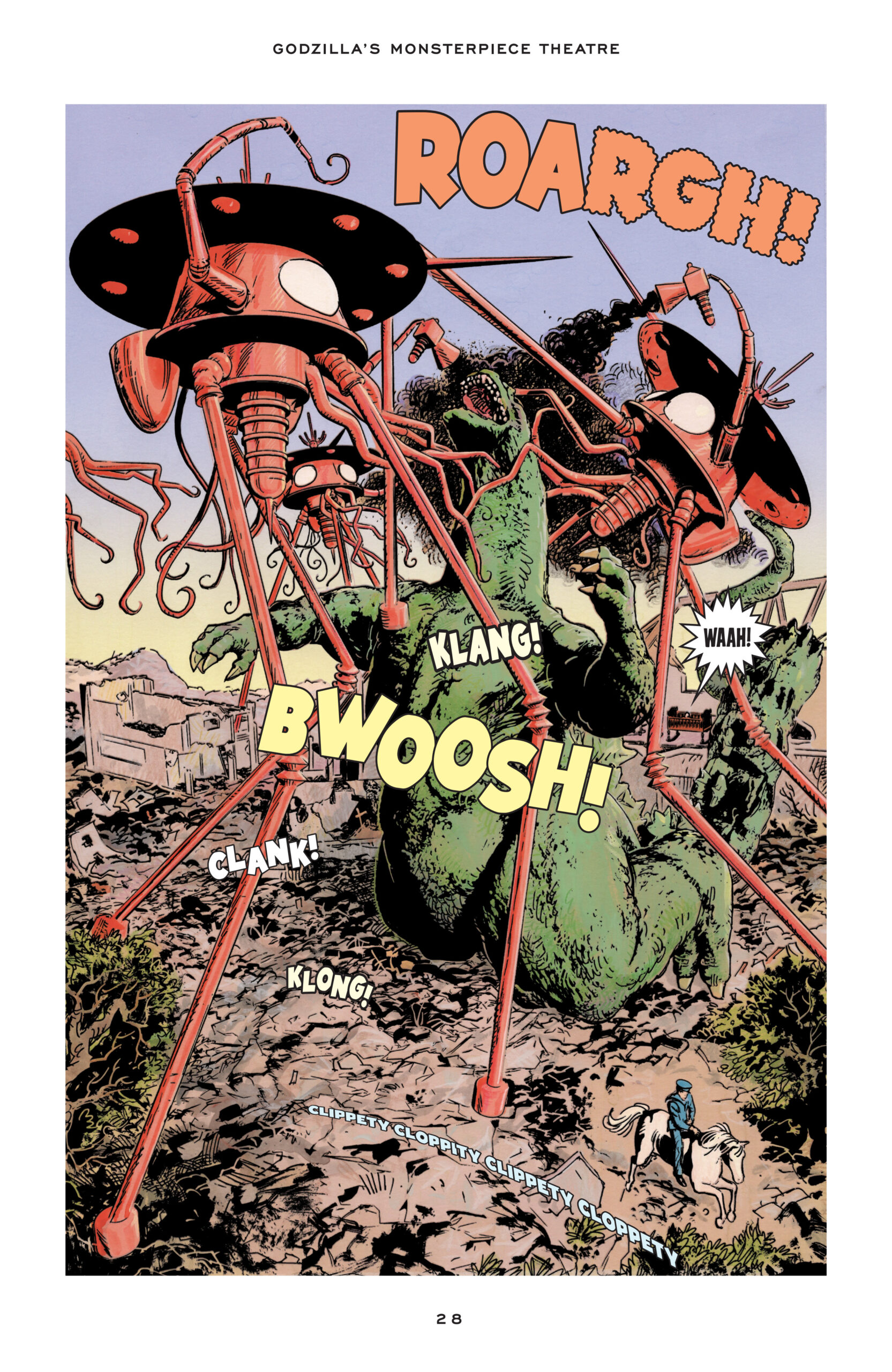
Then those Martians start wilding out. GOOD LORD. Baker handles the invasion like an artist who knows exactly when to quit talking and start wrecking property. The Martian machines feel alien without getting overly complicated, part tripod, part flying saucer, part mechanical squid nightmare, with these thin articulated legs and whipping appendages slicing through architecture and civilians like somebody unleashed homicidal kitchen utensils from space. Their heat rays rip across the pages while oversized ZOWMMM, WHOOOMMM, KABOOM and SPLASH effects become part of the physical environment. Baker is lettering his own work, and you can feel it because the words are not sitting politely on top of the artwork. They are moving through it. They slam, curve, crowd panels and occasionally become almost as important as the machines themselves. The whole thing has this beautifully tactile pulp-comic rhythm where you can practically hear the pages making noise.
Then Big G clocks in. Fam. The first proper Godzilla entrance is worth the admission by itself. Baker understands that Godzilla should not merely appear, he should completely change the temperature of the room. One moment humanity is staring down what looks like extinction-level Martian technology, the next this gigantic green problem rises into the equation and suddenly the invaders realize they landed in the wrong zip code. Baker draws Godzilla with thick limbs, heavy mass and that classic almost suit-like personality that immediately evokes an earlier era of kaiju cinema. He is enormous without becoming visually sterile. Every punch, grab, stomp and collision has weight, while the gangly Martian walkers create the perfect visual contrast against Godzilla’s brute physicality. Watching him grab these machines, body them, smash them into the ground and send pieces flying is pure comic-book candy. No pretension needed. Sometimes you need complex symbolism. Sometimes you need Godzilla turning alien hardware into a Home Depot clearance aisle.
What I really loved though, is Baker does not let the monster business flatten the human story underneath it. Hiroshi’s struggle between orders, survival, duty and the people he cares about keeps running parallel to the destruction, and there is a sly criticism buried in the way authority operates around him. Men are expected to follow commands, preserve honor and sacrifice themselves, even when the commands make absolutely no damn sense while alien war machines are vaporizing the countryside. Hiroshi keeps getting pulled between obedience and basic humanity, and Baker uses that friction without stopping the comic to deliver a lecture. Even Godzilla becomes part of the irony. Humanity cannot defeat the Martians with its supposedly advanced systems, but this giant prehistoric force crashes into the war and changes everything through sheer animal instinct. Under all the ROOOAAARRRs and Martian demolition, there is a surprisingly sharp conversation happening about control, pride and whether following orders automatically makes a man honorable. It gives the comic some backbone without taking the fun out of the room.

Visually, Baker is cooking with some beautifully strange ingredients. The pages look like somebody found a forgotten monster comic in a 1960s spinner rack, cleaned it up just enough to survive another century, then injected modern story telling instincts underneath the hood. Colors stay mostly muted and earthy during the human sequences, with dusty pinks, greens, creams, faded blues and blacks creating that aged-print character, but once the invasion erupts the oranges, reds and yellows start screaming across the page. His panel arrangements constantly change gears too. Traditional grids suddenly break into tall action panels, circular inserts, enormous splash images and dense chains of smaller impacts when the fighting speeds up. There is one sequence where Godzilla is practically swimming in an army of Martian machines, and Baker lets the panels become this percussion track of KLANK, CLANG, WHIP, CRUNCH and SMASH. It should feel chaotic. Instead, your eye knows exactly where to go. That is veteran cartooning right there.
The oversized package also slips in Tom Scioli’s Godzilla and the Golden Arrow, bringing Robin Hood into the Monsterpiece Theatre madness, because apparently historical literature has not suffered enough. Scioli goes in a completely different visual direction from Baker, with chunky medieval figures, blazing reds, greens and blues, strange storybook architecture and compositions that look like illuminated manuscripts went out drinking with Silver Age comics. Robin Hood gets himself tangled up in another gloriously stupid trap involving an archery contest, Godzilla is nearby making castles very nervous, and the whole five-page piece plays like the next serial chapter from some comic your grandfather swears existed but nobody can prove. It ends on a continuation hook, so it is more appetizer than full meal, but I dig that. It reinforces what makes the Monsterpiece Theatre idea work. Different cartoonists can grab Godzilla, collide him with literature, history and mythology, then completely rebuild the visual language around him.
Roar of the Worlds #1 is exactly the kind of crossover craziness comics should be willing to attempt more often. Baker respects Wells, respects Godzilla and respects the reader enough to know that none of those things require him to behave. The literary framework gives the chaos flavor, the human drama gives it stakes, and Godzilla gives those Martians the interplanetary ass-whupping their travel agent forgot to mention. Could some of the early relationship mechanics breathe a little longer? Sure. An oversized one-shot still has a lot of road to cover, and a few emotional turns happen quicker than I would have preferred. But once the invasion begins, the book finds its groove and never loses it. Kyle Baker delivers a loud, clever, visually rambunctious monster comic that understands exactly why this mash-up is funny while refusing to treat it like a throwaway joke. If H.G. Wells could see this thing, I have no idea what he would say. Godzilla? Godzilla would probably just roar and step on the tripod. Works for me.
This is kaiju pulp with brains, bruises, busted Martian machinery and enough retro comic swagger to make the whole ridiculous experiment sing. Mars came looking for Earth. Mars found Godzilla. Bad move, papi!
CRUSADERS SCORE:
4/5

Writer: Kyle Baker
Illustrator: Kyle Baker
Letterer: Kyle Baker
Bonus Story: “Godzilla and the Golden Arrow”
Written by: Tom Scioli
Illustrated by: Tom Scioli
Lettered by: Tom Scioli
Cover / Gallery Artists featured in the issue
Tom Scioli
Kyle Baker
Flops
Nicole Goux
Editor: Jake Williams
Publisher: IDW Publishing
Godzilla: © TOHO Co., Ltd.
Leave a Reply
You must be logged in to post a comment.