
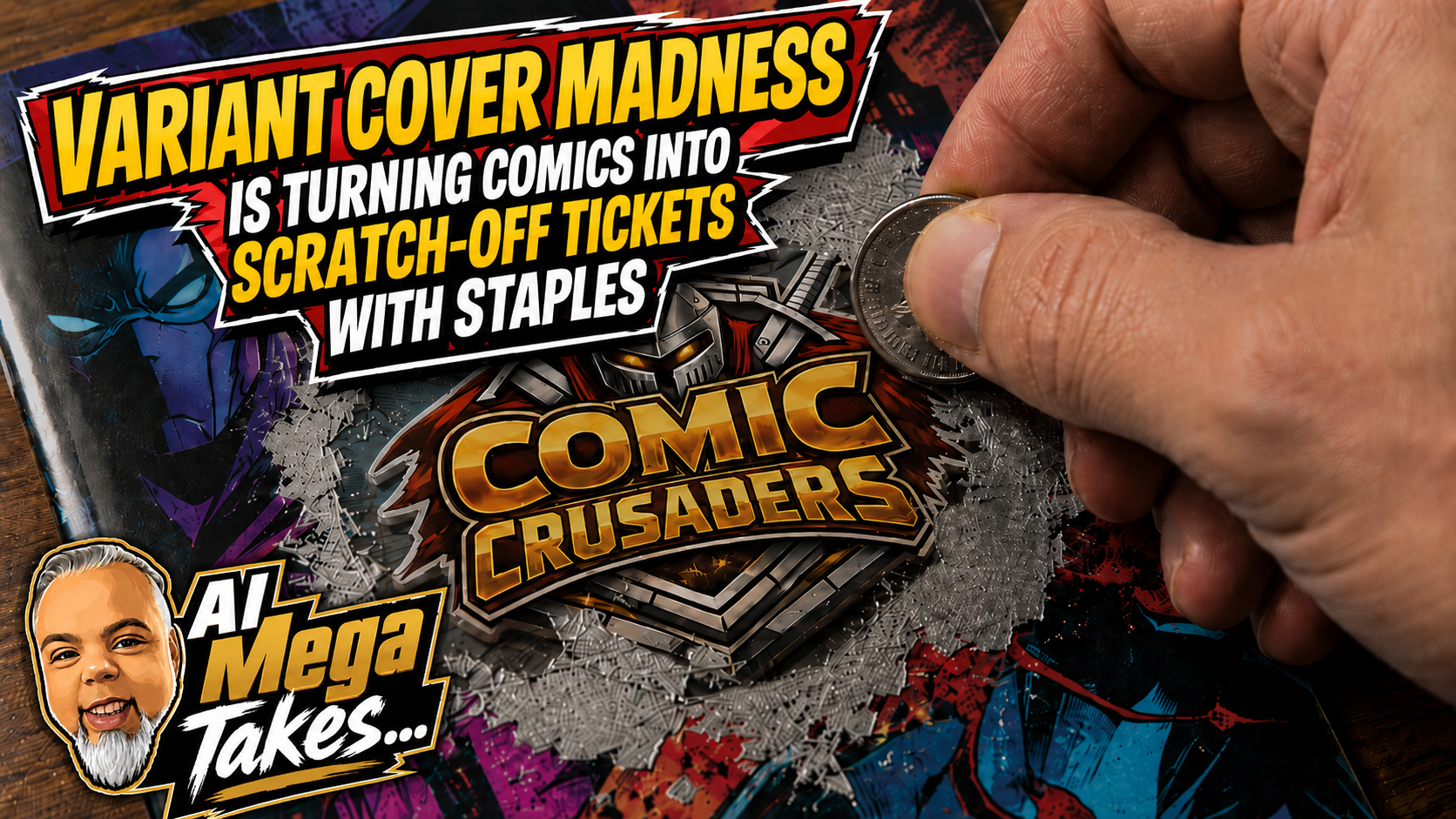
Variant Cover Madness Is Turning Comics Into Scratch-Off Tickets With Staples
·Al Mega
Ay yo fam, what’s poppin’? Let’s talk about the elephant in the comic shop and no, I don’t mean the guy blocking the long boxes while arguing about whether a 9.6 should’ve been a 9.8. I mean the variant cover machine. The shiny, foil stamped, blind-bagged, ratio-chasing, wallet draining monster that keeps showing up every Wednesday like, “Hey fam, you wanted one comic? Cool. Here are 23 versions of it. Choose wisely, peasant.” Enough.
I love comics. Dead-ass. This is not some bitter old-head rant from a dude yelling at the spinner rack like it owes him money. Comic books are art, culture, memory, rebellion, escape, and sometimes the only thing getting somebody through a brutal week. Covers matter. They always have. A great cover can stop you in your tracks. A great cover can make you pick up a book you never planned to read. A great cover can become history. But what we’re watching now? This ain’t just cover art appreciation. This is cover addiction with a marketing department holding the lighter.
Somewhere along the line, the industry confused excitement with exhaustion. It confused collector joy with collector pressure. It confused “give fans options” with “throw so many covers at the wall that the story starts feeling like the least important part of the book.” And I’m sorry, but when a single issue starts looking like a sneaker drop, a lottery pull, and a credit card trap all at once, somebody has to say: yo, what are we doing here? Word!
Nobody needs twenty covers of the same book. Nobody. Not the reader, not the shop, not the casual fan trying to jump in, not the kid who just wants Batman, Spider-Man, Spawn, Turtles, or Catwoman without needing a spreadsheet and a second mortgage. Yes, some collectors love the hunt, I know I do. Respect. The thrill is real. But there’s a difference between collecting and being psychologically cornered into buying multiples because you’re scared the “real” one is hiding in a sealed bag somewhere behind the counter. That’s where the game gets wack.
The variant cover used to feel special. You had a main cover, maybe an alternate, maybe a retailer incentive that felt like a rare little treasure. Cool. That’s seasoning. But now? The whole adobo jar fell into the pot. We’ve got open-order covers, ratio variants, store exclusives, virgin covers, foil covers, negative space covers, connecting covers, homage covers, hidden gem covers, sketch covers, blind-bag covers, display-box exclusives, and covers that feel like they were designed less for readers and more for the algorithm. And before anybody says, “But Al, nobody is forcing you to buy them,” let’s keep it a buck: nobody is forcing anyone to buy overpriced popcorn either, but the whole theater is built to make you smell it. Marketing is not accidental. Scarcity is not accidental. FOMO is not accidental. These systems are designed to make collectors feel like hesitation is failure. Miss the cover, miss the moment. Miss the moment, miss the flip. Miss the flip, now you’re watching some dude on eBay ask $89.99 for a comic that came out yesterday. Come on, son!
This is the part where publishers will say variants help sales. And they’re not completely wrong. Variants can move units. They can spotlight artists. They can help retailers offer something different. They can turn a launch into an event. They can get fans talking. And listen, I’m not anti-artist. Never that. I love seeing legends and rising stars get cover work. Some of these variants are gorgeous. Museum-wall gorgeous. “I need this as a poster” gorgeous. But a beautiful hustle is still a hustle.
The question is not whether variant covers sell. The question is whether they build healthy readership. Because those are not the same thing. Selling ten copies to one speculator is not the same as bringing ten readers into a story. Selling a blind bag is not the same as building loyalty. Pumping up orders on issue #1 does not mean people care about issue #6. And if your whole launch strategy depends on collectors buying multiples before they even know whether the story hits, that’s not confidence in the comic. That’s confidence in the chase. And the chase is starting to feel like the product.
That should worry everybody. Publishers, retailers, creators, fans, all of us! Because comics have been down this road before. The 1990s did not collapse because people loved comics too much. It collapsed because the industry got high on artificial heat. Collector editions. Speculator energy. “This one is gonna be worth something.” “Buy five, bag three, flip two.” Everybody thought they were sitting on future gold until the market reminded them that scarcity means nothing when everyone’s closet has the same “rare” book wrapped in plastic. History doesn’t repeat exactly, but it does remix like a DJ with bad intentions.
Today’s version is slicker. The paper is nicer. The artists are bigger. The social media machine is louder. But the core temptation is the same: sell the appearance of scarcity, inflate the moment, and pray nobody notices that the story is fighting for oxygen underneath all the packaging. And let’s talk about the local comic shop, because that’s where this nonsense lands hardest. The publisher gets the campaign. The distributor gets the order. The online chatter gets the dopamine. But the shop owner? They have to make the call. How many copies do they order? How many customers actually want the book versus the chase cover? How many ratio variants require extra ordering? How many blind bags will move? How many sit there like little sealed-up reminders that hype has an expiration date? That’s not a game. That’s inventory risk.
A comic shop is not Amazon with a pull list. It’s a neighborhood ecosystem. It is community, memory, recommendation, Wednesday ritual, and sometimes free therapy with action figures on the wall. When publishers overload shops with variant programs, they are pushing small businesses into gambling on consumer behavior. And when those bets go bad, the publisher has already moved on to next month’s “historic” #1. You know who gets stuck holding the bag? Literally? The shop.
That’s why retailer fatigue matters. Because when retailers start saying they need more community tools and fewer variant covers, people should listen. Shops don’t hate making money. They hate being forced into hype cycles that don’t build lasting customers. Give them preview pages. Give them posters. Give them creator videos. Give them signing support. Give them reading guides. Give them promotional material that helps sell the story, not just another cover that makes the ordering sheet look like a diner menu at 2 a.m. And fans deserve better too. Not less art. Not less choice. Better choice.
There is nothing wrong with loving covers. I love covers. You love covers. We all love covers. Covers are the handshake before the story invites you inside. But when every book has a small army of covers, the handshake turns into a sales pitch. The magic gets diluted. Iconography gets harder to build. Think about the covers we remember. They stick because they became the face of a moment. If every issue has thirty faces, which one becomes history? That’s not a small question. That’s culture.
Comic books survive because they mean something to people. They are not just units. They are not just SKUs. They are not just collectible objects waiting to be slabbed and resold like tiny pieces of Wall Street with capes. The industry keeps saying it wants new readers, younger readers, diverse readers, casual readers, lapsed readers. Cool. Then stop making the front door look like a casino cage. Imagine being a new fan. You walk into a shop because you heard a comic is hot. You ask for issue #1. The retailer says, “Which cover?” You say, “The normal one.” Then they show you twelve. Then someone nearby starts talking about ratios. Then another person asks if the blind bags were weighed. Then you realize this hobby has side quests before you even meet the main character. That’s not onboarding. That’s hazing with cardstock.
Here is the uncomfortable truth: variants can help the direct market in the short term while damaging reader trust in the long term. They juice orders. They create buzz. They feed social media. But if the story itself is not treated like the star, the whole system starts leaning on gimmick instead of craft. And once fans start feeling like they are being played, good luck getting that trust back. So what’s the solution? Not “ban variants.” That’s too simple and honestly, not realistic. Variants are part of comics now. Artists deserve the work. Retailers deserve tools to sell. Collectors deserve fun. But the industry needs balance before the whole thing turns into a scratch off economy.
First, cap the chaos. A main cover and a handful of meaningful variants? Bet. Twenty-plus covers for one issue? Relax, Thanos. Nobody asked you to snap half our bank accounts.
Second, make blind bags transparent. If there are rare covers, publish the odds. If there are display box exclusives, say exactly what’s in play. Don’t make comic fans decode the process like they’re trying to open the Ark of the Covenant.
Third, support the shops beyond the gimmick. Give retailers promotional assets that drive readership, not just purchases. Events. Preview packs. Creator interviews. Sell the story. Sell the characters. Sell the reason this book matters after the cover is bagged and boarded.
Fourth, stop treating issue #1 like the only issue that counts. The real health of a comic is not how loud it launches. It’s whether readers come back. Build arcs. Build trust. Build momentum. Make issue #2 matter. Make issue #5 hit. Make the trade something people hand to a friend and say, “Yo, read this.”
Fifth, remember the kid. Always remember the kid. The kid saving allowance money. The new fan. The reader who can only afford one copy. The person who wants to be part of this world but doesn’t want to feel like they showed up underdressed to a collector convention. Comics should invite people in. Not make them feel broke at the door.
Word up, to the publishers, I say this with love, sarcasm, and both eyebrows raised: stop acting like every comic needs to be a financial instrument. We don’t need every launch to feel like a limited-edition whiskey raffle. We don’t need every cover program to look like somebody lost a bet in marketing. We need great comics. Strong stories. Memorable characters. Covers that mean something because the book means something. The cover should be the invitation. Not the entire party.
Comic fans are not stupid. Retailers are not endless wallets. Collectors are not ATMs with pull boxes. And readers are not obstacles standing between you and a sales spike. This industry has survived moral panics, distribution chaos, bankruptcies, market crashes, movie booms, movie fatigue, digital disruption, and more “comics are dying” headlines than anybody can count. But one thing keeps saving it: people care about the stories. So let the stories breathe.
Give us covers that make us stop. Give us variants that feel earned. Give us artist showcases that celebrate creativity, not anxiety. Give shops tools that build community. Give readers books they can love without needing to chase twelve versions of the same damn thing like it’s the Infinity Stones.
Because right now, variant culture is starting to feel less like celebration and more like extraction. And the difference matters.
Comics don’t need to trick us into caring. They just need to be good enough that we can’t help ourselves.
And if the book is truly great? Trust me, fam, one cover can still change the whole room.
Wepaaaaaa…
*Ai Disclosure: The main image includes AI-assisted artwork reviewed by Comic Crusaders before publication.

Leave a Reply
You must be logged in to post a comment.