
The CREATOR Act Is a Much-Needed Punch Back Against AI Art Theft But Creators Better Read the Fine Print
·Al Mega
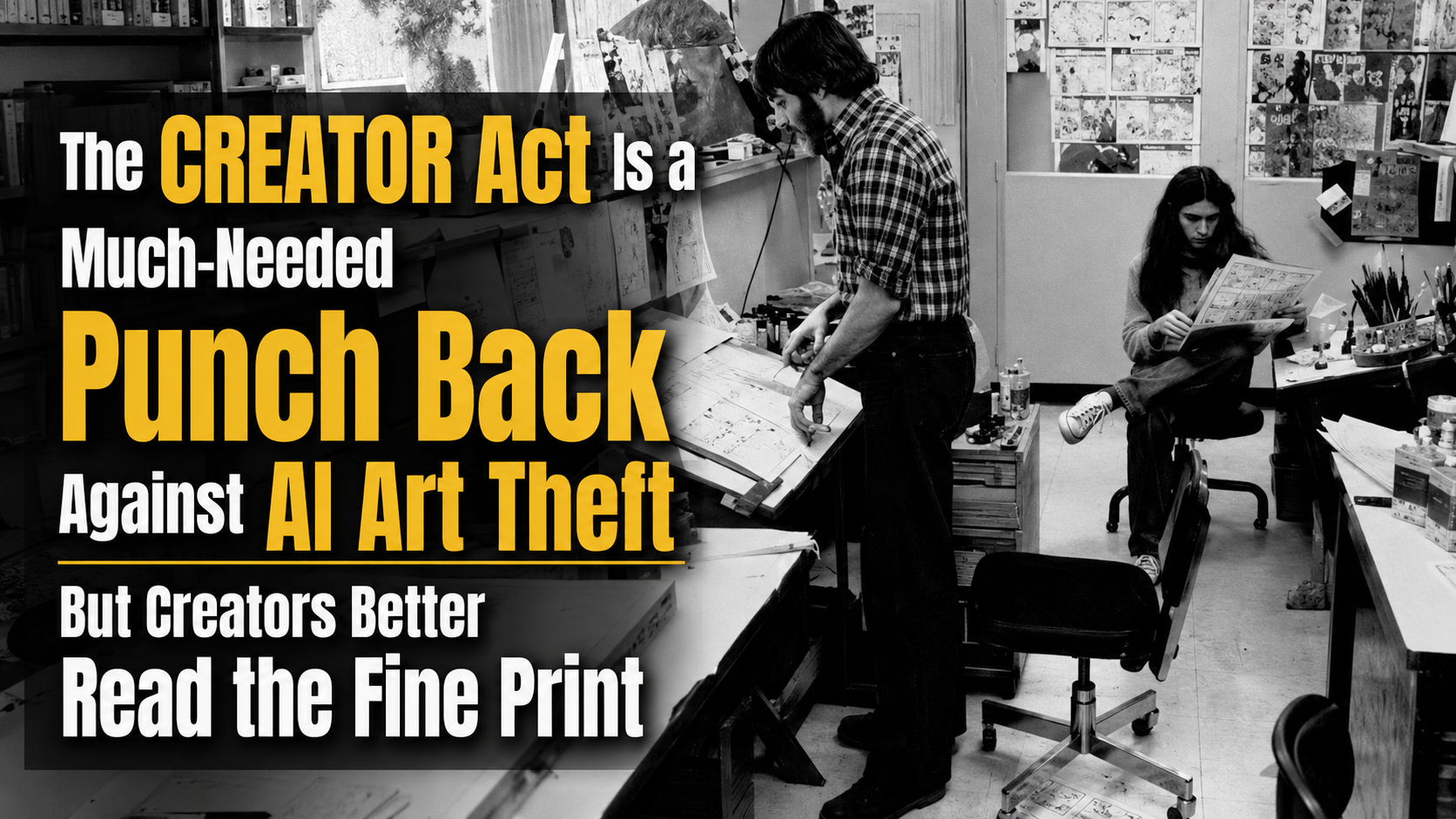
Ay yo, let’s talk about the big ugly monster standing in the middle of the comic book studio right now. And no, I do not mean Galactus, although this thing has the same appetite. I’m talking about AI style theft. That funky little game where somebody takes years of an artist’s grind, their brushwork, their line, their color choices, their whole visual heartbeat, runs it through a machine, and then pops out something that looks close enough to fool people but cheap enough to sell like fast food. Then they have the nerve to call it “innovation.” Nah, fam. That is not innovation. That is somebody jacking your jacket, putting it on, walking into your own house, and asking where the snacks are.
For comic creators, illustrators, cover artists, designers, and visual storytellers, style is not decoration. Style is identity. Style is the part of the work that makes somebody stop scrolling and say, “Yo, I know who made that.” That recognition does not just fall out of the sky like Spider-Man landing on a taxi. It is built page by page, failure by failure, convention table by convention table, commission by commission, and late night by late night when the rest of the world is asleep and the artist is still at the desk chasing one line that finally feels right. That is labor. That is culture. That is somebody’s living, breathing fingerprint. So when AI tools get used to mimic an artist’s style for commercial gain without permission, that is not some harmless tech experiment. That is theft wearing a clean shirt. And that is why the CREATOR Act matters.
The CREATOR Act, formally known as the Creative Rights Ensuring Artists’ Technique and Originality Are Reserved Act, is a proposed federal law aimed at protecting visual artists from unauthorized AI-generated imitations of their distinctive style when those imitations are used commercially. In regular people language, if somebody uses AI to intentionally bite your style, confuse the public, and make money from it, this bill is trying to give creators a way to swing back.
Let me be clear because I do not want anybody twisting the message like a bad plot reveal in issue five: I support this. All day. Creators need protection. Period. Artists should not have to sit there watching a machine eat their portfolio, copy their sauce, undercut their price, confuse their fans, and then have some tech bro with a fleece vest tell them, “Well actually, this is just the natural evolution of creativity.” Stop it.
Some of these people say “democratization” when what they really mean is, “We found a way to make money off your work without asking.” They say “training data” like that phrase magically cleans the fingerprints off the crime scene. They say “the future” like the future has to be built by running over the people who made the culture worth caring about in the first place. Miss me with that. Artists are not against tools. Comic creators have always adapted. Digital coloring changed the game. Tablets changed the workflow. Webcomics changed discovery. Crowdfunding changed access. Social media changed audience building. Creators are not sitting in a cave screaming at electricity. That is lazy nonsense.
The issue is not technology. The issue is consent, credit, compensation, and control. Those four ideas should be the foundation of any serious conversation about AI and art. Put them on a wall somewhere, maybe next to the coffee machine, because some people clearly need to wake up. The CREATOR Act is important because copyright law has always had a weird blind spot when it comes to style. Copyright protects finished work: the actual image, page, panel, cover, or published piece. But style lives in a gray area. Everybody knows style has value. Everybody recognizes it when they see it. But legally, it can get slippery fast. That was already a problem before AI. Now AI turned that problem into a five-alarm fire.
Before generative AI, if you wanted to imitate an artist’s style, you had to at least put in the work. You had to study the forms, practice the hand, understand the timing, and maybe fail for three years until your page stopped looking like discount leftovers. There was friction. There was effort. There was a learning curve. Now a bad actor can type a few words, upload references, scrape public portfolios, flood an online shop, make fake covers, build ads, sell prints, and still have the nerve to say, “But I didn’t copy one exact image.” That is the hustle right there. They are not stealing one sandwich. They are stealing the whole recipe and acting like the kitchen came with the building. The CREATOR Act tries to address that by targeting deliberate commercial impersonation. That word matters: impersonation.
We need to be grown about this. Influence is not theft. Homage is not theft. Learning from legends is not theft. Comics would not exist without influence. Every artist is in conversation with the ones who came before. Jack Kirby is in the DNA. Moebius is floating around the galaxy somewhere. Jim Lee changed superhero anatomy for a whole generation. Alex Ross made capes feel like marble statues with a heartbeat. Fiona Staples, Peach Momoko, Tradd Moore, Sanford Greene, Frank Miller, Daniel Warren Johnson, Jill Thompson, Bill Sienkiewicz — pick your lane, pick your era, pick your flavor. Artists inspire artists. That is how the whole medium breathes.
There is a difference between being inspired by somebody and trying to commercially wear their face. Influence says, “You helped shape me.” Impersonation says, “I’m going to sound like you, look like you, sell like you, and hope nobody catches me until the money clears.” That is the line. That is the fight. And that is where this bill needs to be sharp, because if it is too vague, it can create new problems while trying to solve old ones. Here is where creators need to celebrate with one hand and keep the other hand on the contract, because the CREATOR Act has promise, but promise is not protection by itself. A good idea can still get swallowed by weak wording, bad enforcement, and loopholes big enough to park the Batmobile in.
The first thing creators need to watch is enforcement. A right only matters if you can actually use it. That sounds obvious, but the law loves making simple things expensive. If you are an indie artist in Brooklyn, San Juan, Atlanta, Chicago, Texas, Florida, or anywhere else, and some company uses AI to jack your style, are you really going to have the money to go after them? Are you going to lawyer up against a platform with a legal team stacked like the Avengers? Are you going to spend months chasing screenshots while bills keep coming in and your hand still has to draw the next page?
That is the real-world problem. A law that says “you can sue” is not enough if only celebrities, major studios, big estates, and deep-pocketed creators can afford the fight. That turns protection into a VIP lounge, and creators already know how that game goes. If lawmakers are serious, the bill needs practical teeth. We need affordable claim systems, meaningful damages, fee-shifting in the right cases, fast takedown processes that do not put all the burden on the artist, and real consequences for repeat offenders. Creators do not need another symbolic trophy. They need a shield that actually blocks something.
The second thing to watch is platform safe harbor. On paper, safe harbor makes sense. Platforms cannot instantly know every bad upload the second it appears. Fair. Nobody is saying a site should explode legally because one clown uploaded stolen-looking AI art at 2:13 in the morning. But let’s not play dumb either. Creators already know takedown systems can become a joke with a login screen. You file a complaint, you wait, the work comes down, and then it pops back up. You file again. The seller changes the title, crops it, alters one detail, reuploads it, and keeps moving like nothing happened. Now the creator is playing whack-a-mole while the platform says, “We followed the process.”
Cool. The process is broken, my guy. If safe harbor becomes a shield for companies doing the absolute bare minimum, then the CREATOR Act could end up making creators responsible for policing the internet forever. That is not justice. That is unpaid security work. Responsible platforms should be protected. Lazy platforms should not. If a site is repeatedly hosting AI works that imitate living artists for commercial gain and keeps shrugging like, “Not our problem,” then yes, it should become their problem quickly.
The third thing to watch is how the law defines “style.” This is the spicy part, because style is real, but style is also messy. One person looks at a painted superhero cover and says, “That feels like Alex Ross.” Another person says, “That is just dramatic lighting.” One person sees black shadows and says, “Frank Miller.” Another says, “That is noir, bro, calm down.” One person sees big eyes and soft colors and says, “That artist stole manga style.” Another says, “That is an entire visual tradition, relax before you embarrass yourself.”
So the law needs precision. We cannot have people claiming ownership over broad vibes. Nobody owns moody shadows. Nobody owns cyberpunk rain. Nobody owns big emotional eyes. Nobody owns gritty city streets with dramatic lighting. Nobody owns watercolor fantasy girls looking mysterious near a moon.
If the bill is too broad, it could accidentally hurt young artists, indie creators, fan artists, parody makers, critics, and legitimate visual storytellers who are working inside shared genres. Comics are built on shared visual language. Superhero comics have grammar. Horror comics have grammar. Manga has grammar. Noir has grammar. Underground comix have grammar. Webtoons have grammar.
You cannot protect creators by turning every artistic influence into a lawsuit waiting in the bushes. The standard has to focus on deliberate, recognizable, commercial impersonation of a specific creator’s visual identity. Not “this has similar energy.” Not “this reminds me of someone.” Not “I saw crosshatching and got nervous.” We are talking about bad actors using AI to create work that an ordinary person could reasonably think is connected to, authorized by, or intentionally imitating a specific artist for money. That is where the hammer should drop.
The fourth thing to watch is the lack of an easy proof system. If the bill does not create a registry or clear proof process for artists, creators may still have to do a lot of heavy lifting to prove their style was copied. I understand why a registry can be dangerous. Artists should not have to register their “style” with the government before they are allowed to be protected. That could leave out younger artists, low-income artists, underground artists, webcomic artists, international creators, and anybody who does not know the legal system like that. Art does not need a permission slip to exist. But no proof system also means things can get messy. So creators need to start thinking like archivists, not just artists.
Keep receipts. Save your layered files. Save your roughs. Date your sketches. Keep your contracts. Archive your posts. Document your commissions. Keep portfolio pages live or backed up. Register important finished works when possible. Save process videos. Track where your work appeared. None of that sounds sexy, I know. You want to draw, paint, write, create, vibe, drink your coffee, complain about deadlines, and post a fire panel at 1:00 a.m. like a normal creative goblin. But if somebody tries to AI-mimic your style and profit from it, your history becomes evidence. Your receipts become armor.
The fifth thing to watch is contracts. This one right here is the sneaky villain in the shadows, the one smiling in issue one that you already know is going to betray everybody by issue six.
If the CREATOR Act creates rights around stylistic impersonation, creators need to make sure those rights do not get quietly swallowed by publishers, platforms, apps, contests, marketplaces, or work-for-hire contracts. A company can say, “We love creators,” and then slide over a contract that says, “By submitting, you grant us broad, perpetual, worldwide rights to use, modify, reproduce, train, adapt, simulate, derive, promote, and exploit your work.” Legal language can be slick. Real slick. Subway-platform-in-January slick.
Creators need to ask direct questions. Can my work be used to train AI? Can my style be imitated? Can the company generate derivative works using AI? Can my work be used in datasets? Can my name, art, or visual identity be used for promotional AI tools? Do I keep the right to bring a claim if my style gets copied? Can the publisher bring that claim without me? Can they settle it without me? Can they license my style to a third party?
If the answer is vague, get clarity. If the contract gets weird, slow down. If they pressure you to sign fast, that is not a red flag; that is the whole fire truck. Creators have already been burned by bad work-for-hire deals, unfair royalties, rights grabs, vague media clauses, and “we’ll figure it out later” nonsense. We cannot let AI become the new back door. Protection that can be signed away without creators understanding it is not protection. It is just bait with nicer branding.
Now, let’s be fair, because good journalism means not just yelling into the void, even when the void deserves it. There are legitimate concerns about overreach. Parody needs protection. Satire needs protection. Criticism needs protection. Education and research need room. Artists need the freedom to learn, remix, reference, and grow. A young artist should not get dragged into court because their superhero page has dramatic shadows, speed lines, and a cape blowing in the wind. A critic should not be punished for showing an example. A parody artist should not be silenced because they imitate a style to make a point. A teacher should not need a legal defense fund to explain visual influence in comics. That would be ridiculous. It would also hurt the exact creative culture the bill is trying to protect.
So yes, the CREATOR Act needs guardrails. Strong ones. Clear ones. But asking for guardrails does not mean letting the thieves drive the bus. Big Tech loves to hide behind free expression when money is involved. They will act like any limit on AI impersonation is an attack on creativity. Please. Some of these companies did not suddenly become defenders of art because they read a zine and felt something. They are defending business models. They are defending scale. They are defending the ability to scrape, simulate, sell, and shrug. That is why creators need to stay loud. Silence is exactly what bad actors want. They want artists divided, fans confused, lawmakers bored, and the conversation buried under tech buzzwords and fancy panels where everybody says “ecosystem” seven times and nobody mentions rent.
Comics are not built by ecosystems. Comics are built by people with wrists that hurt, deadlines that chase them like horror-movie villains, and worlds in their heads that refuse to leave them alone. They are built by people drawing at kitchen tables after work, selling prints at conventions hoping to make table money back, and building stories no one asked for because something in their chest would not shut up.
That is the part AI cannot fake. It can imitate surface. It can copy patterns. It can remix the visible stuff. But it does not know what it feels like to be a kid from the block staring at a comic page and realizing, “Yo, maybe I can make something too.” It does not know the emotional math behind a panel. It does not know why one line lands and another line dies. It does not know the heartbreak behind the work. It can only consume the evidence. That is exactly why law matters here. Not because law can protect every feeling. It cannot. But law can set boundaries around exploitation. It can say that you do not get to build a product out of someone’s identity and call that progress. It can say that artists deserve control over commercial impersonation. It can say that if you want to use the sauce, pay the chef.
For comic artists, this is not theoretical. Covers sell books. A recognizable visual identity can launch a Kickstarter, build a Patreon, move a convention line, attract a publisher, or land a licensing deal. Style is not some fluffy bonus feature. It is part of the business. That is especially true for indie creators. Sometimes the style is the marketing. Sometimes the style is the hook. Sometimes the style is the thing that makes a reader stop and give a new book a shot. So when AI-generated knockoffs flood the same digital spaces, undercut pricing, confuse attribution, and train audiences to accept cheaper imitation, real creators lose more than money. They lose visibility, trust, and momentum. In comics, momentum is everything. You can be the most talented artist in the room, but if the room gets flooded with machine-made lookalikes, good luck being seen.
That is why I support the CREATOR Act’s mission. But I want it stronger. I want it cleaner. I want it built for working creators, not just famous names. I want indie artists, comic book veterans, young creators, cover artists, colorists, designers, illustrators, and visual storytellers protected. I want platforms held accountable when they keep profiting from obvious abuse. I want contracts watched like hawks. I want AI tools to respect consent before taking anything. And yes, I want room for parody, learning, criticism, and real artistic influence, because that is part of the culture too. This does not have to be complicated. Do not steal. Do not impersonate. Do not profit from an artist’s identity without permission. Do not build a business on the backs of creators and then act shocked when creators start swinging back.
If you are a creator reading this, do not wait for Congress to finish the arc. Protect yourself now. Register key finished works when you can. Update your contracts. Ask about AI clauses. Keep your process files. Archive your public posts. Watermark strategically. Use provenance tools if they help. Talk to other creators. Push publishers for clear AI policies. Ask marketplaces what they allow. Ask conventions where they stand. And if something smells funny in a deal, trust your nose. Brooklyn rule: if the fish smell wrong, do not wait for a lab report.
The CREATOR Act is not perfect. No bill is. Lawmaking is messy, slow, and sometimes it looks like a committee tried to assemble IKEA furniture during an earthquake. But this bill matters because it says something the creative world needs to hear loudly: artists are not raw material. They are not free fuel. They are not style packs. They are not content farms. They are people, and the work they make has value beyond whatever a machine can imitate. AI is here. Fine. The toothpaste is out the tube, the robot is in the studio, and somebody already named it “assistant” like that makes it less weird. But the future does not get to be built on theft just because the theft got faster.
Creators deserve tools that serve them, not tools that replace them after eating their archive. They deserve innovation with consent, protection with teeth, contracts that do not rob them in paragraph twelve, platforms that do not shrug while stolen style gets monetized in public, and fans who understand that the human behind the art is not optional. So yes, I support the CREATOR Act. But I am also watching the fine print, because protecting creators cannot just be a nice headline. It has to survive lawyers, platforms, loopholes, lobbyists, bad contracts, and the usual nonsense that shows up whenever there is money on the table. This is not anti-tech. This is pro-creator, pro-consent, pro-respect, and pro-culture.
If someone deliberately uses AI to impersonate an artist’s hard-earned visual identity for commercial gain, they should face real accountability. That means meaningful damages, takedowns that actually work, and consequences strong enough for the whole industry to hear them. Comics do not come from machines. They come from people with stories in their bones, ink on their hands, and dreams big enough to survive this ridiculous business. The pencil, the brush, the page, and the people behind them all deserve protection, not as a slogan, but as a serious legal and cultural priority.
To every creator trying to keep your style, your name, your art, and your future safe: keep your receipts, read your contracts, watch the fine print, and never let anyone tell you your life’s work is just data.
Nah, fam. That is your voice.
And your voice is worth fighting for… WEPAAAAAAAAAA!
Read the complete CREATOR (Creative Rights Ensuring Artists’ Technique and Originality Are Reserved) Act at:
https://www.congress.gov/bill/119th-congress/house-bill/9112
Leave a Reply
You must be logged in to post a comment.