

Sony’s Disc-Free Future Is Not Progress, It’s a Warning Shot at Ownership
·Al Mega
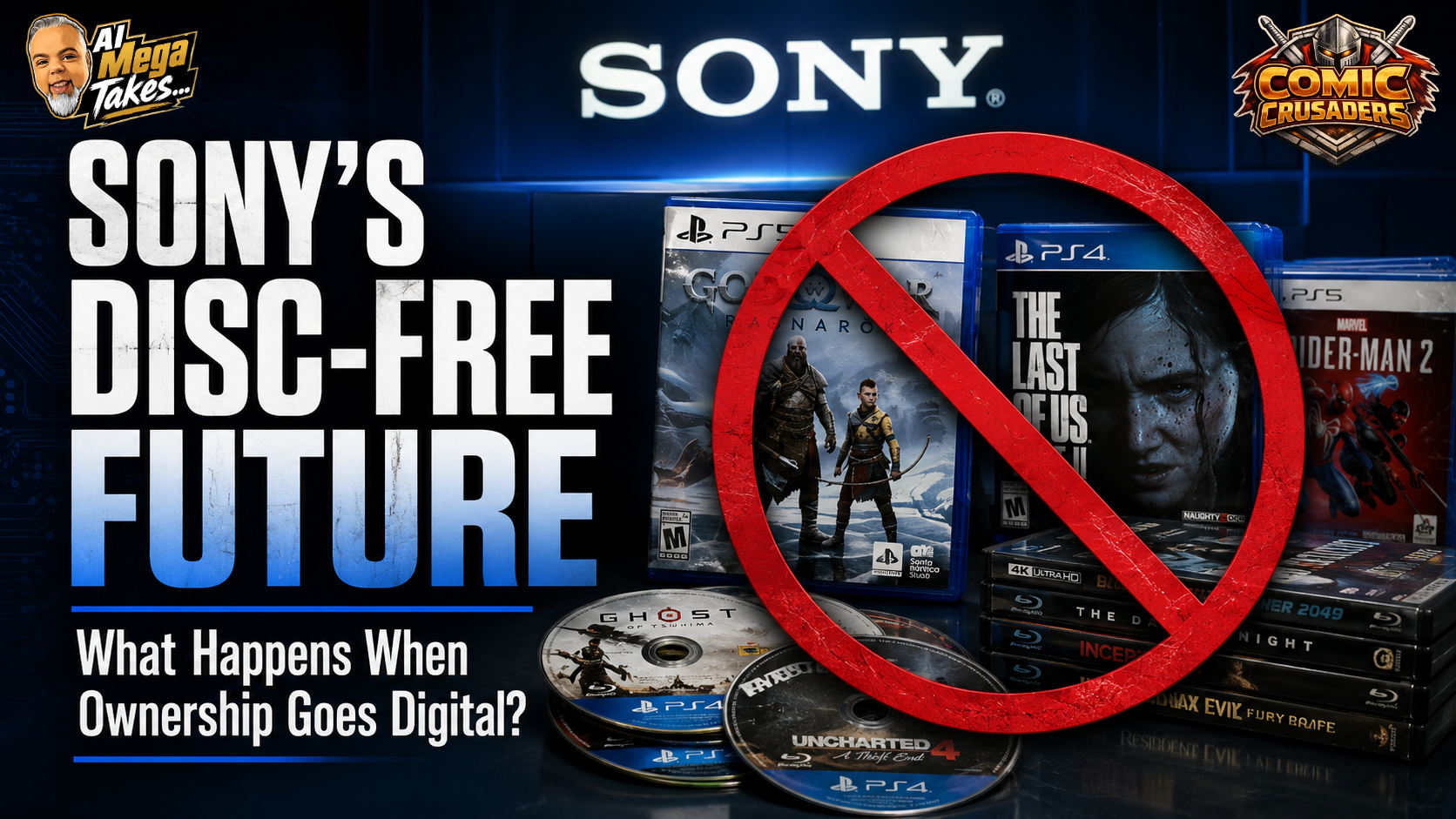
After Sony’s reported 2028 move away from physical PlayStation discs, the fight over digital ownership is no longer some nerdy collector debate. It is about who controls your library after you pay for it.
Wepa… here we go again! Sony, apparently not satisfied with already giving digital media customers a migraine the size of a Manhattan rent bill, has now reportedly announced that it will end production of physical game discs for new PlayStation console releases beginning in January 2028. According to Sony’s own PlayStation Blog, the transition will not affect games already released or games scheduled to release on disc before that January 2028 cutoff, but for new releases after that point, the message is clear: the physical disc is being shown the door.
Let’s not dress this up like a corporate holiday card. This is a major shift, and not the cute kind where everybody gets a tote bag and free coffee. This is the industry pushing players closer to a world where the box, the disc, the resale shelf, the used-game bin, the collector’s edition, the “yo, I still own this” proof of purchase all of it gets replaced by a license agreement nobody reads because it is written like a hostage note from a law firm. And after Sony’s recent StudioCanal mess, this news hits different.
Once a company proves it can remove access to “purchased” digital movies due to licensing agreements, then turns around and moves the gaming business further away from physical media, consumers have every right to ask: what exactly are we buying anymore? A game? A license? A handshake with a cloud server? A pinky promise from a corporation that may change its mind when the spreadsheet starts sweating? That is the real story here.
Sony says this is part of a “natural transition” toward digital distribution, and sure, the market has been moving that way for years. Ars Technica reported that the announcement is already raising concerns about game ownership, especially as players look at a future where access depends more on accounts, servers and storefront policies than plastic discs sitting safely on a shelf. But “natural transition” is doing a lot of heavy lifting here, fam. Natural for who? Consumers? Collectors? Preservationists? Parents who buy used games to save money? Players in rural areas with trash internet? Or natural for companies that would rather control every transaction from purchase to deletion, with no resale market, no lending, no used copies and no physical proof that you own the thing you paid for?
Because when discs disappear, power shifts. It shifts from the player to the platform. From the shelf to the server. From “I own this” to “I can access this as long as the terms allow.” That may sound dramatic, but the industry has already shown us the trailer. Digital storefronts close. Games get delisted. Online servers shut down. Licensed music disappears. Patches break old content. And when the company says, “Sorry, licensing issue,” the consumer gets left standing there like somebody stole their sneakers at a Brooklyn house party. You paid. They kept the money. The access changed. That is not innovation. That is control wearing a hoodie and calling itself convenience.
The Hollywood Reporter described the move as a major change for the video game industry, while CNBC also reported that PlayStation will end physical disc production for new console games beginning in 2028. And once Sony makes that move, the bigger question becomes obvious: who follows next?
Microsoft already sells disc-free Xbox hardware. The Xbox Series S launched as an all-digital system, and the market has been conditioned for years to accept consoles without drives as normal. So if Sony walks away from discs for future releases, and Xbox already has digital-only hardware in the wild, the industry could quietly slide into a new standard: no disc, no resale, no borrowing, no physical archive, no escape hatch. That is not just a format change. That is a cultural shift.
Physical media matters because it gives consumers friction against corporate control. A disc does not solve every problem anymore yes, modern games still need patches, downloads and server support but a physical copy is still a form of leverage. It can be traded. It can be sold. It can be collected. It can sit in a library, a basement, a store, a museum, a kid’s bedroom, waiting to be rediscovered years later. It exists outside the mood swings of a digital storefront. That matters.
Ask comic collectors. Ask film collectors. Ask music heads who watched streaming platforms turn entire catalogs into here-today-gone-tomorrow ghosts. Ask anybody who bought something digitally and later found out “buy” meant “until further notice.” The lesson is always the same: if the company controls the only door, the customer is not the owner. The customer is a tenant. And tenants can be evicted.
This is where the language becomes important. Companies love the word “purchase” because it feels permanent. It feels simple. It feels like the old world. You click buy. You pay. You own. Boom. Done. Except in the digital economy, “purchase” often means you bought permission. You bought access. You bought a license that can be limited, modified, revoked, region-locked, server-dependent or tied to an account you do not fully control. That is the hustle.
Surely, let’s say the quiet part loud: to the average customer, it feels like robbery. Maybe not robbery in the legal sense nobody here is pretending a judge has ruled that but in the common-sense, working-person, “I paid real money and now I have less than I thought I bought” sense? Absolutely. It feels like getting played. It feels like the fine print reached out of the cloud and picked your pocket.
The industry will argue that digital is cheaper, cleaner, faster and more convenient. Sometimes that is true. Digital downloads are convenient. No one is denying that. Nobody wants to pretend swapping discs in 2028 is the peak of human civilization. But convenience is not ownership. Convenience is a service feature. Ownership is power.
DRM-free purchases are the closest digital media gets to real consumer control. When you can download the file, store it, back it up and access it without permission from a storefront, you are closer to ownership. But closed digital ecosystems are different. They are permission machines. They make every purchase dependent on the company’s continued willingness and ability to honor it. And when the physical option disappears, consumers lose choice.
That is the part that should bother everybody, even people who buy all-digital already. This is not about shaming digital buyers. Buy how you want. Live your life. No judgment. But when physical disappears completely, digital stops being a choice and becomes a cage with a Wi-Fi password. That is when the market changes from “options” to “obey the platform.”
Windows Central framed the move as another poor industry decision, tying it directly to concerns about ownership and preservation. That concern is not nostalgia. It is not old-head yelling at clouds though, yes, sometimes the old heads are right and the clouds deserve to be yelled at. It is about whether art and entertainment can survive outside corporate servers.
Game preservation already has enough problems. Entire online games vanish. Licensed titles disappear. Old patches become hard to find. Digital storefront closures create dead zones in gaming history. If physical media becomes rare or obsolete for new console releases, future preservation depends even more on companies that have every incentive to sell you the next thing, not protect the old one. That should make every gamer, collector, critic, journalist and creator sit up straight.
This is not just about PlayStation. This is about the future of comics, movies, games, music and books. If the entire entertainment economy becomes cloud-based and license-driven, then ownership becomes a marketing illusion. Your library becomes a dashboard. Your collection becomes a subscription-adjacent blob. Your shelf becomes an app. And when the app changes? Good luck, champ.
Sony has every right to chase the future. But consumers have every right to ask whether that future is being built for them or built around them. A digital-only gaming world may make distribution easier for publishers and platform holders, but it also strips away consumer protections that physical media naturally provided. No used market. No lending. No physical backup. No true collecting. No guarantee that the thing you bought will remain accessible in the same way years from now. So, what should Sony do?
First, be honest. Stop hiding behind “purchase” language if what consumers receive is a revocable license. Say what it is. Put it in plain English. Not legal gobbledygook. Not twelve pages of digital chloroform. Tell people, clearly, what they can lose.
Second, if physical discs are being phased out, then build real consumer safeguards. Guarantee long-term access. Offer DRM-free archival downloads where possible. Protect preservation. Create refund or credit policies when access is removed. Allow ownership transfers. Support offline play. Stop pretending that “trust us” is a business model.
Third, give collectors and consumers a premium physical path. Limited-run discs. Archival editions. Publisher-direct physical releases. Something. Because not every player wants their collection living inside a corporate vending machine.
Lastly, regulators need to keep watching this space. If a company sells something using language that suggests ownership, then later argues the customer only bought temporary licensed access, that deserves scrutiny. Consumers should not need a law degree to understand what “buy” means.
Sony’s reported 2028 disc decision may be framed as the next step in digital evolution. But after years of delisting’s, licensing fights and disappearing purchases, it feels less like evolution and more like enclosure. The open field is being fenced. The landlord is putting up cameras. The tenant is being told to smile because the new gate has an app.
Nope! We see the play. Physical media matters because ownership matters. DRM-free matters because access without control is fragile. Consumer rights matter because convenience should not become a trap.
The industry can call this progress.
But from where we’re standing, it looks like the cloud just raised the rent.
And this time, it wants the whole damn building!
Sources:
1 – Playstation: https://blog.playstation.com/2026/07/01/physical-disc-production-ending-in-january-2028-for-new-games-releasing-on-playstation-consoles/
2 – Arstechnica.com: https://arstechnica.com/gaming/2026/07/sony-will-stop-making-physical-copies-of-playstation-games-in-2028/
3 – Reddit: https://www.reddit.com/r/pcmasterrace/comments/1ukmy7g/sony_is_ending_physical_discs_after_january_2028/
4 – Hollywood Reporter: https://www.hollywoodreporter.com/business/digital/sony-playstation-end-physical-game-discs-2028-1236634529/
5 – Windows Central: https://www.windowscentral.com/gaming/playstation-kills-physical-games-as-xbox-and-sony-continue-making-poor-decisions
Disclaimer:
This article is an independent editorial/opinion piece intended for informational and commentary purposes only. It reflects analysis of publicly reported industry developments regarding digital media, gaming distribution, and licensing practices.
All referenced companies, trademarks, and brand names remain the property of their respective owners. No claim is made that any company has acted unlawfully; interpretations regarding “ownership,” “consumer rights,” and “digital licensing” represent opinion-based commentary and public discourse.
Information discussed may change as corporate policies, licensing agreements, or industry practices evolve. Readers are encouraged to verify updates directly from official company announcements and primary sources.
This content should not be considered legal, financial, or contractual advice.
All views expressed are intended to contribute to public discussion around digital ownership, media preservation, and consumer rights in the modern entertainment ecosystem.
*Ai Disclosure: The main image includes AI-assisted artwork reviewed by Comic Crusaders before publication.
Leave a Reply
You must be logged in to post a comment.