
WHO CAN AFFORD TO MAKE COMICS ANYMORE? Dark Horse’s Union Fight Exposes an Industry-Wide Labor Reckoning
·Al Mega
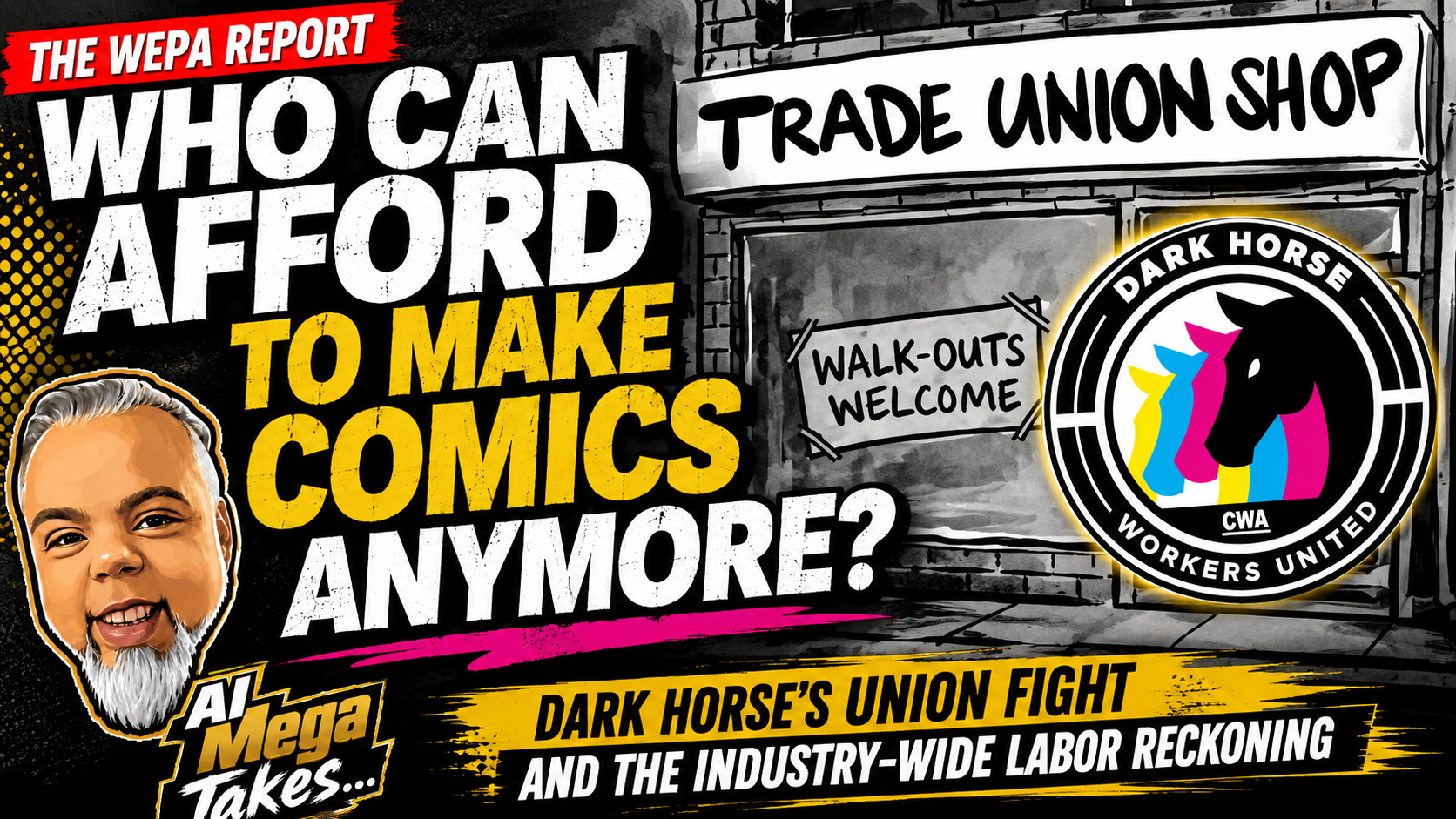
Dark Horse workers say senior editors are being pushed toward supervisory roles that could take them out of the bargaining unit. Management disputes the union’s framing and says it is following federal labor law. Behind all that corporate language sits a much bigger question for comics: what happens when the people making the books can no longer afford to stay in the business they love?
WEPA! Mi gente, we spend a ridiculous amount of time in comics arguing about reboots, deaths that last six months, variant covers, movie numbers and which superhero got a costume redesign nobody asked for. Meanwhile, behind the books, another fight has been getting louder, and this one ain’t got capes, cosmic cubes or a convenient reset button.
The people editing these books, marketing them, producing them, shipping them, selling them and keeping this beautiful little madhouse alive are asking a question that should make everybody in publishing uncomfortable: Can I actually build a life doing this? Right now, Dark Horse Comics is sitting smack in the middle of that conversation.
Dark Horse Workers United announced its organizing drive in May, saying employees wanted equitable pay, workplace democracy and continued support for creator-owned comics. In June, Dark Horse voluntarily recognized the union. The Communications Workers of America later said 78 Dark Horse employees had won voluntary recognition and were joining Image Comics and Seven Seas Entertainment workers in CWA Local 7901. CWA said Dark Horse workers pointed to layoffs, hiring freezes, artificial intelligence and return-to-office mandates as part of the pressure that pushed them to organize.
On paper, that sounded damn near refreshing. Interim CEO Jay Komas said the company intended to bargain in good faith and build a stronger workplace where employees felt heard and respected. Beautiful. Everybody hugs. Cue the inspirational music. Roll credits, right?
Nah, papi. The movie kept going, and the next scene got uncomfortable real quick.
Just over a week after recognition, Dark Horse Workers United and CWA sent management a cease-and-desist letter after nine employees in IT and operations were slated for termination, according to The Comics Journal. The outlet reported that three IT positions and six operations roles were affected. Dark Horse management said those decisions had been made before the union notice arrived and were tied to plans to outsource fulfillment and rely more heavily on centralized technology resources.
That timing matters, and we are not gonna play stupid with it. A layoff happening after union recognition does not automatically mean retaliation. If those plans were already in motion, that matters too. The union, however, argued that the scope and impact of those changes had not been made sufficiently clear during recognition discussions. So now you got two very different versions of events sitting across the same bargaining table, both insisting the other side is missing something important.
Then the whole thing got messier.
Dark Horse Workers United said senior editors were later given job “clarifications” that would qualify them as supervisors. Under the National Labor Relations Act, statutory supervisors generally fall outside a bargaining unit. According to the union, those editors had not previously exercised the kind of management authority now being attached to their jobs.
An organizing committee member told Publishers Weekly that senior editors who refused the newly defined supervisory role could be demoted and see their pay cut by roughly $10,000. Big red circle around this part, fam, because this is journalism, not Facebook Fight Club: that approximately $10,000 figure comes from the union side and has not been publicly confirmed by Dark Horse. We are not turning an allegation into a fact just because it makes the headline hotter.
Dark Horse responded to Publishers Weekly by saying its voluntary recognition agreement follows federal labor law and excludes statutory supervisors. The company said it remains committed to working together in good faith. In that response, Dark Horse did not directly address the union’s allegation that senior editors’ responsibilities had changed after recognition, and it did not confirm the reported pay-cut figure.
And papi, this is where the real story lives. If these senior editors were already functioning as statutory supervisors, Dark Horse has a legitimate legal argument that they should not be part of the bargaining unit. If those jobs were materially changed after union recognition in a way that suddenly kicked them outside the unit, then yeah, the situation deserves a whole lot more scrutiny.
Dark Horse Workers United clearly believes it is the latter. The union has publicly accused management of union busting and has demanded that senior editors retain their titles, salaries and union eligibility. Dark Horse has not accepted that characterization. So the responsible move here is not to sit in the cheap seats screaming “good guys” and “bad guys.” It is to ask for specifics and keep asking until the paper trail catches up with the rhetoric.
Were senior editors already exercising hiring, firing, discipline or meaningful supervisory authority before the union campaign? Did those responsibilities change afterward? If they did, when was that change planned? Were compensation changes attached to refusing those duties? Why could these employees apparently do the job before without this distinction becoming the center of the damn universe?
Those answers matter more than anybody’s slogan, press release or victory lap.
Now zoom the camera out, because Dark Horse ain’t standing in this mess by itself. Once you ask why comic-industry employees are organizing, the trail runs straight through the rest of publishing.
Image Comics workers became the first comic-book publishing staff in the United States to unionize and later ratified a first contract that included structured annual wages and formal workplace procedures. Seven Seas Entertainment workers also organized with CWA, becoming the first manga and light-novel workers in North America to form a union. Dark Horse is not some isolated weird little labor story. It is part of a current that has been getting stronger.
Step one foot outside comics and the ground is shaking even harder. In July, Hachette Book Group employees voted 388 to 130 to unionize, creating a bargaining unit of roughly 600 eligible workers and what Publishers Weekly described as the largest union in trade publishing history. University of Chicago Press employees also voted to organize, while HarperCollins has had union representation for decades.
This ain’t three disgruntled comic nerds complaining near the copier because somebody stole their lunch from the fridge. Something structural is happening in publishing, and pretending otherwise is just lazy.
Compensation keeps showing up in these fights. So do workloads, job security, remote-work policies and artificial intelligence. Publishers Weekly reported that workers across several organizing campaigns have raised those same concerns, while CWA specifically cited layoffs, hiring freezes, AI and return-to-office policies among the reasons Dark Horse employees organized.
Even companies outside these specific negotiations appear to understand the pressure around pay. Penguin Random House raised its entry-level salary from $51,000 to $55,000, effective in August 2026, and increased minimum salaries for other established bands by $4,000. That does not magically settle the argument over what publishing labor is worth, but come on, mi gente, nobody raises the floor because the conversation is imaginary.
Now we get to the part comics has been dancing around forever. This industry has survived on passion, and passion is beautiful right up until somebody starts using it like a coupon code for underpaying people.
People accept rough freelance rates because they love comics. They move to expensive cities because they love publishing. Editors carry ridiculous workloads because they love the books. Retailers work stupid hours because they love their customers. Journalists cover releases at midnight because apparently some of us looked at sleep and said, “Nah, I got solicitations.” Love keeps this industry alive, but love does not pay rent, groceries, health insurance or whatever fresh hell your utility bill decided to become this month.
Comic Crusaders has been covering this industry since 2011. We deal with editors, publicists, creators, publishers, retailers and freelancers constantly, and after enough years you start seeing the invisible labor behind every single book. The comic in your hand did not teleport onto a shelf because somebody yelled “FOC” three times into a mirror.
Somebody answered creator emails. Somebody checked files. Somebody coordinated corrections, fixed metadata, argued about deadlines, chased approvals, got previews to press and made sure the printer received the right damn PDF. Somebody caught the typo before you did. Somebody probably caught five more you never knew existed. Lose enough experienced people and readers will eventually notice, but here is the scary part: they usually do not notice on day one.
Institutional knowledge leaves quietly. Deadlines start slipping. Communication gets slower. Creators get frustrated. Mistakes survive longer. The people left behind inherit more work, burnout gets worse, turnover accelerates and then everybody acts shocked when the whole machine sounds like it got a loose belt. By the time readers see the damage, the folks who knew how to fix it may already be gone.
Now, before anybody starts polishing the torches, none of this means every union demand is automatically correct. Dark Horse has legitimate business concerns too. Publishers operate on budgets. Departments change. Positions evolve. Companies restructure. Management has to be able to manage, and federal labor law absolutely distinguishes supervisors from bargaining-unit employees.
There is also no publicly available evidence proving Dark Horse simply woke up one morning and decided, “How do we punish everybody for organizing?” Corporate restructuring was already underway before union recognition, including major leadership changes and plans affecting operations and technology. A serious investigation has to acknowledge that reality instead of stuffing every inconvenient fact into the union-busting box because it makes a sexier headline.
But management does not get a free pass either, mi gente. If you voluntarily recognize a union, layoffs follow, and then senior editors suddenly become the center of a fight over whether they count as supervisors, people are gonna ask questions. Hell, they should ask questions. Dark Horse can answer with dates, job descriptions, decision records and bargaining proposals. The union can support its own claims the same way. Bring receipts, not vibes.
And now we hit the biggest question: Why should readers care? Because sooner or later, every labor problem becomes a product problem. Readers want good comics. Creators want publishers capable of supporting them. Retailers need books delivered properly and promoted intelligently. Publishers need experienced staff who understand an industry that already has enough moving parts to make your head hurt.
Nobody wins if publishers become financially impossible to operate. Nobody wins if employees become financially unable to stay. And nobody wins if the industry burns through experienced people faster than it can replace them, then wonders why quality, communication and trust start wobbling.
Artificial intelligence adds another layer because publishing is not just logistics. The product is creative work. AI can be useful as hell in the right hands, but employees are clearly worried about what happens when companies start seeing automation as a substitute for experience instead of a tool used by experienced people. That conversation is not going away. If anything, it is about to get louder.
Dark Horse’s dispute may ultimately be resolved through bargaining. Senior editors may remain in the unit, become supervisors, reach a compromise or land somewhere nobody outside those negotiations can predict today. The responsible position right now is not to declare a villain. It is to keep asking questions, keep separating allegations from established facts, and keep watching what the company and the union actually do next.
Dark Horse told its workforce that it wanted good-faith bargaining and employees who felt heard and respected. That was a serious promise, papi. Now everybody gets to see what happens when those words leave the press release and walk into the bargaining room.
Because this stopped being only a Dark Horse story a while ago. Image workers organized. Seven Seas workers organized. Hundreds of Hachette employees organized. University press workers organized. Across publishing, people are asking the same basic questions about pay, workload, security and what AI means for their future.
Comics loves stories about regular people realizing they have power, standing up, finding their voice and refusing to stay quiet. Turns out some of the people making those stories have been paying attention.
The Crusade Never Ends.
Sources & Receipts
Publishers Weekly: Dark Horse Union Faces Roadblock to Contract Negotiations
The Comics Journal: Making Hay? Dark Horse Layoffs on the Heels of Union Recognition
Communications Workers of America: Video Game and Comic Book Workers Score Big Organizing Wins
Communications Workers of America: Image Comics Workers Ratify First Contract
Communications Workers of America: Seven Seas Entertainment Workers Win Voluntary Recognition
Publishers Weekly: Hachette Book Group Employees Win Union Election
Publishers Weekly: Publishing’s “Hot Labor Summer”
Publishers Weekly: Penguin Random House Raises Base Salary
Publishers Weekly: Leadership Shakeup at Dark Horse
Editorial Disclaimer
This article is an independent editorial and investigative analysis based on publicly available reporting, union statements, company statements and trade-industry sources available at the time of publication. Allegations made by Dark Horse Workers United, including claims involving job classifications, demotions and potential salary reductions, are identified as allegations and should not be interpreted as independently established facts unless otherwise stated. Dark Horse Comics has disputed elements of the union’s characterization and has said it remains committed to good-faith collective bargaining. Comic Crusaders has no role in the negotiations and presents the competing positions in the public interest. This article may be updated if additional documentation, statements or material facts become available.
Leave a Reply
You must be logged in to post a comment.