
He Who Fights With Monsters Review: Jason Asano Wakes Up Naked, Underpowered, and Still Somehow Ready to Talk Spicy to the Apocalypse
·Al Mega
Crusaders, gather close because this one does not walk into the room politely. Nah. He Who Fights With Monsters, Book 1, Outworlder kicks the door open, steals your pants, throws you into a hedge maze, drops a quest notification in your face, and then sends a monster hamster at your head like the universe got jokes and zero chill.
Written by Travis Deverell, writing as Shirtaloon, this is the kind of fantasy brick that looks at the reader and says, “You got snacks? Good. Sit down.” And honestly, fam, sit down you should. Because what we have here is a massive, loud, funny, brutal, game-system-powered fantasy ride that starts with pure absurdity and slowly reveals a whole meal underneath the madness. Not a snack. Not a light appetizer. A full arroz con gandules plate with the pernil stacked high and the hot sauce looking at you sideways.
The setup is beautiful in its insanity. Jason Asano, an office-supplies-store middle manager from our world, wakes up in a strange magical realm with no clothes, no hair, no clue, and no customer service number to call. The man opens his eyes and immediately enters the worst tutorial level in history. He gets quests. He gets inventory. He gets a character sheet. He gets monsters. He gets trauma. He gets magic. But first, as the synopsis says, he needs pants. And that right there tells you the flavor of this book. It is epic fantasy with a clown horn hidden in the dragon’s mouth.
But here is where Shirtaloon gets slick with it. The humor is not just decoration. It is survival gear. Jason uses sarcasm the way other heroes use enchanted swords. He is not the biggest guy in the room. He is not the chosen warrior with abs forged by prophecy. He is not walking around like some destiny-bro with a glowing jawline. He is scared, confused, undertrained, and absolutely allergic to shutting up when shutting up might save him. That makes him frustrating, hilarious, and deeply human. He talks too much, thinks too fast, and keeps poking powerful people in the ego because apparently common sense did not make the trip between dimensions. And yet, that mouth? That mouth saves him. Sometimes. Other times it nearly gets him cooked, chopped, and served by cannibal blood cultists. Balance, baby.
The first stretch of the book is a masterclass in controlled chaos. Jason’s discovery of the interface, quests, inventory, spirit coins, essences, awakening stones, monster cores, magical gear, and all the other LitRPG goodies could have turned into a dry instruction manual real quick. But Deverell keeps the system tied to Jason’s panic, confusion, comedy, and physical consequences. You learn because Jason is learning, usually while bleeding, falling, vomiting, arguing, or making a bad decision with the confidence of a man who has not yet accepted that today is not going to improve.
That is the secret sauce. The mechanics are crunchy, yes, but they have flavor. The book gives you stats, ranks, powers, cooldowns, ability descriptions, inventory rewards, and progression language, but it does not feel like somebody dumped a spreadsheet in your lap and called it worldbuilding. The system is part of the joke, part of the danger, and part of Jason’s identity crisis. When your personal growth comes with a user interface, things get philosophical real quick.
Speaking of identity, this book has more going on than “dude levels up and punches monsters.” That would have been fun enough, no doubt, but Shirtaloon keeps digging. Jason is an outworlder. He is no longer exactly what he was, but he also does not belong to the place he landed in. That loneliness sits underneath the jokes like a bassline. At first, he is surviving minute to minute. Later, as he gets pulled into the Adventure Society, the city of Greenstone, politics, gods, aristocrats, contracts, class divisions, and magical power structures, the book starts asking bigger questions. What does power do to a person? Who gets protected by institutions? Who gets used by them? What happens when being “good” requires getting blood on your hands? Yeah. It goes there.
Jason’s powers being “evil-looking” is one of the funniest and smartest angles in the whole thing. Dark essence. Blood essence. Sin. Doom. My guy walks into the heroic career path looking like the HR department would immediately schedule a meeting. But the book does not treat aesthetics as morality. That is important. Jason is not defined by how spooky his build looks. He is defined by his choices, his mouth, his guilt, his stubbornness, and his willingness to stand in front of something horrible even when he is wildly underqualified. That is heroism with dirt under the nails. Not shiny. Not clean. Real messy. Very Brooklyn, honestly. Sometimes you do not feel brave. Sometimes you just look around and realize everyone else is about to get hurt, so you step forward while your knees are filing a formal complaint.
The supporting cast brings the heat too. Rufus is the mentor figure with discipline, patience, and that calm “I know exactly how badly this can go” energy. Farrah is power, warmth, and lava-blasting magnificence wrapped in practical intelligence. Gary, the leonid, is an absolute treasure, a giant armored good-time beast who delivers some of the best team chemistry in the book. Anisa brings friction, prejudice, and ideological messiness that gives the early party dynamic sharper teeth. Later characters, including Clive, Sophie, and the broader Greenstone crowd, expand the world from survival fantasy into social fantasy, political fantasy, and adventurer-life fantasy all at once.
That is where the book shifts from “Jason has the worst first day ever” to “oh, this world is huge.” Greenstone is not just a place to buy potions and accept quests. It is a living city with class pressure, social circles, bureaucracy, guild-style institutions, magical commerce, street-level danger, and power games happening in the nice rooms where people smile before stabbing each other legally. You get monster contracts, training, magical theory, social climbing, gods getting involved, corruption, healing clinics, team politics, and enough world texture to make you believe this series can run for a long time without running out of gas.
Does the book take its time? Oh yeah. This is a big boy. At 768 pages, it is not pretending to be a quick subway read unless your commute is from Brooklyn to the moon. There are sections where the pace settles into training, explanation, city business, and character development. For some readers, especially those not already built for LitRPG or progression fantasy, the system talk and extended setup may feel like a lot. That is the one place where the book asks for commitment. It wants you to learn the rules, remember the players, and care about the ladder Jason is climbing.
But here is the thing: the patience pays off. The longer you stay, the more the slow-build pieces start connecting. What feels like banter becomes bonding. What feels like mechanics becomes identity. What feels like side business becomes social architecture. The book is building a whole machine, and by the time Jason starts finding his rhythm, you understand why the engine needed all those parts. And the comedy? Still nasty in the best way. Shirtaloon has a gift for undercutting high fantasy grandeur with a line that feels like your funniest cousin whispering nonsense during a funeral. The book will give you monsters, rituals, magic, and cosmic danger, then pivot to Jason being worried about his outfit, arguing about food, naming creepy things like they are pets, or saying the exact wrong thing to someone who could absolutely turn him into decorative paste. The jokes do not always whisper. Sometimes they walk in wearing Timbs.
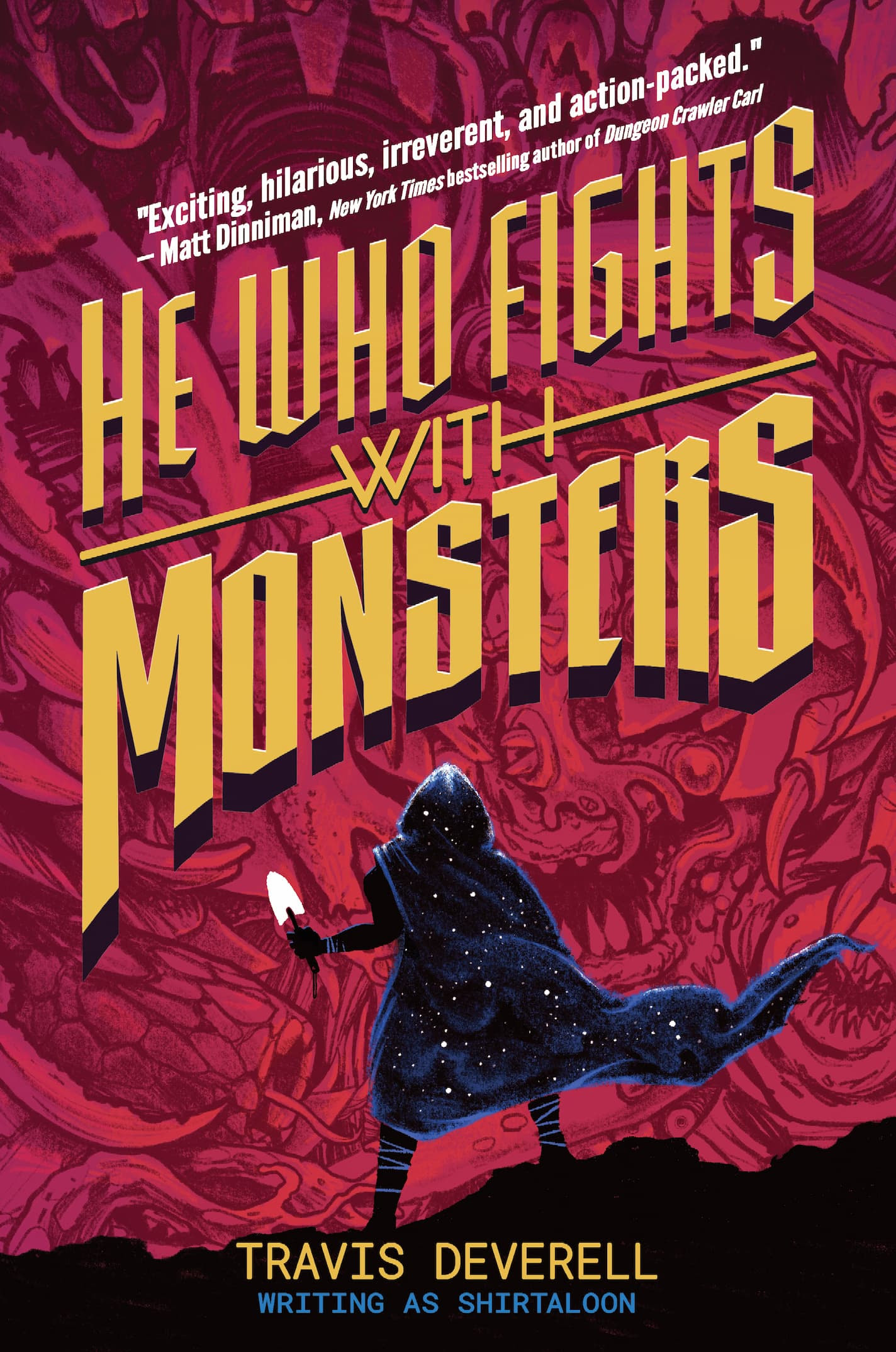
Adam Cahoon’s cover work and hardcover design deserve love too. The visual identity understands the assignment: scale, danger, discovery, and a little punk-rock absurdity. That bold title treatment, the red monster-loaded background, and the tiny cloaked Jason standing against something way bigger than him captures the whole vibe. One little dude, a small weapon, a giant wall of problems. That is the book. That is the hook. That is the sauce.
As a Comic Crusaders read, even though this is prose and not sequential art, it speaks directly to our people. Gamers, fantasy heads, anime fans, tabletop warriors, superhero readers, indie-comics explorers, and anybody who loves a loud underdog story with a brain and bite will find plenty to chew on. This thing has boss fights, builds, lore, moral damage, party dynamics, weird powers, and a lead character who would absolutely derail a villain monologue just to make a point about how corny their name is.
At its heart, He Who Fights With Monsters is about adaptation. Jason is dropped into a world that does not care if he understands the rules. So he learns. He fails. He bleeds. He talks trash. He gets stronger. He makes friends. He makes enemies. He makes choices that follow him. That is the part that makes the book stick. The monsters are wild, but the real fight is Jason figuring out who he becomes when survival starts changing him.
That is where the title hits different. He who fights with monsters better be careful. Not just because the monsters bite. Because the world itself will try to make you harder, meaner, colder, and more useful to people who see you as a tool. Jason fights that too. Not perfectly. Not politely. But he fights.
This is big, funny, violent, dense, clever, and ridiculously addictive fantasy with a hero who survives on nerve, wit, bad timing, and suspiciously evil magic. It is not flawless, because no 768-page beast walks without a little extra baggage in the saddle. But it is confident, memorable, and built with the kind of long-game ambition that makes readers say, “Fine, one more chapter,” until suddenly the sun is up and your coffee is judging you.
He Who Fights With Monsters, Book 1 is a big WEPA for LitRPG fans and a killer entry point for readers who like fantasy with game logic, actual consequences, and a protagonist who treats cosmic horror like a heckler at an open mic. Jason Asano may start with no pants, no plan, and no clue, but this book has plenty of all three where it counts: momentum, personality, and worldbuilding muscle. Highly recommended.
CRUSADERS SCORE:
4.5/5

Writer: Travis Deverell writing as Shirtaloon
Cover Art / Hardcover Design: Adam Cahoon
Print Formatting: Kevin G. Summers, Adam Cahoon, and Rikki Midnight
Bonus Story Included: When Farrah Met Gary
Publisher: AETHON: Vault
In Association With: Aethon Books
Distributed By: Simon & Schuster
On Sale: 7/8/2026
Leave a Reply
You must be logged in to post a comment.