

Samaritan Review: Mythos Comics Delivers Gritty Superhero Noir
·Al Mega
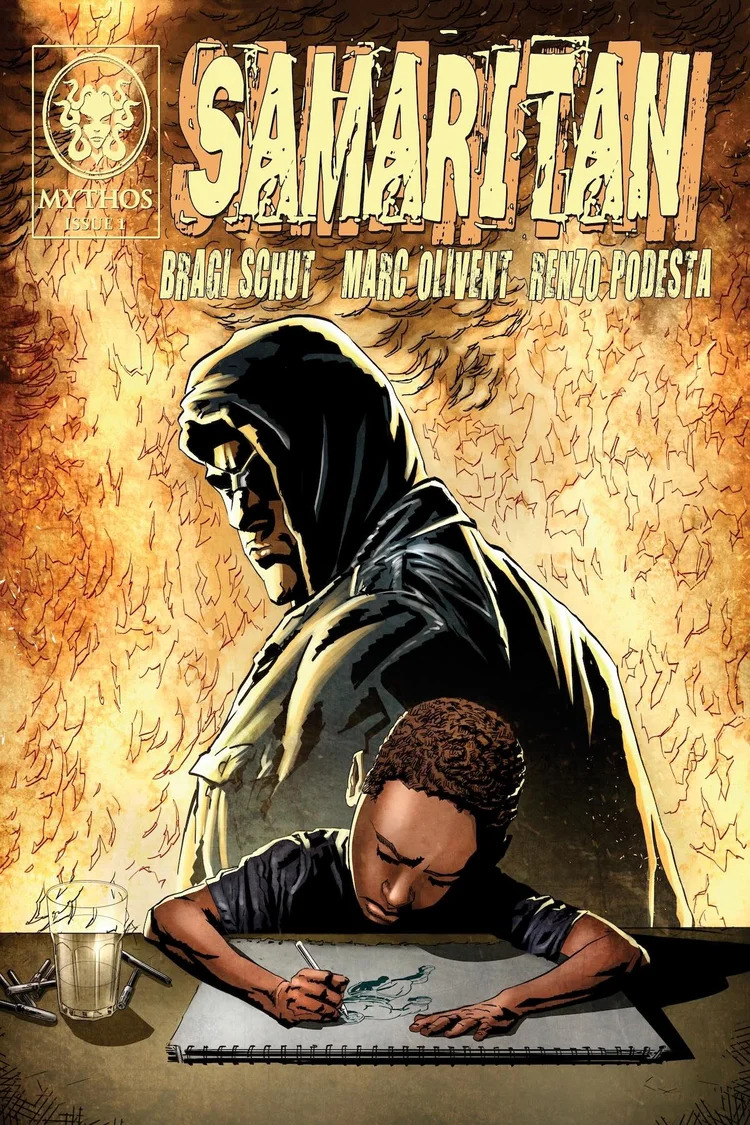
WEEEEPPPAAAA! Let’s get it, Crusaders! Samaritan from Mythos Comics comes through like a rain-soaked boom-bap beat echoing between cracked apartment towers, busted dreams, and one kid’s stubborn belief that heroes don’t always die… sometimes they just clock in, keep their head down, and take out the trash.
What hits first is the atmosphere. Acropolis is not some shiny superhero playground with clean skylines and hopeful orchestral music in the background. Nah, this city is grimy. It sweats. It limps. It looks like the kind of place where hope got mugged in an alley and nobody filed a police report. Bragi Schut does a slick job grounding the myth of Samaritan and Nemesis in a city that feels emotionally bankrupt but still alive with rumor, fear, and survival instinct. The legend of Samaritan is not treated like a clean golden-age bedtime story. It feels more like neighborhood folklore. Everybody heard something. Nobody knows everything. And that makes the mystery work.
Sam Cleary is the soul of this piece, and that is where the book finds its strongest heartbeat. He is not just “the kid who believes.” He is the kid who needs to believe because the world around him is giving him nothing but static. Bullies, gangs, money pressure, a strained home life, and a city that has normalized dysfunction all shape him into a young narrator who feels vulnerable without being weak. That is a tricky balance, and Schut lands it. Sam daydreams, sketches, watches, wonders, and connects dots the adults are too tired or too broken to see. That youthful imagination becomes his survival tool. In a city full of predators, his curiosity is his shield. That’s real.
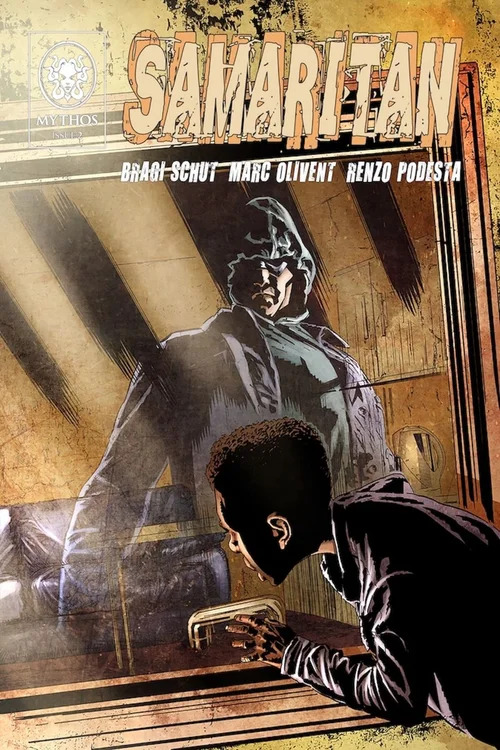
Then there is Joe, the grizzled sanitation worker neighbor who carries himself like a man trying to hide a thunderstorm under a hoodie. Marc Olivent’s art sells Joe beautifully. He is built like old trauma wrapped in muscle. Every shadow on him feels intentional. Every silent panel makes you lean in. The genius is that the book does not rush to give the reader fireworks. It lets Joe’s weight exist in small gestures: the way he moves, the way he watches, the way danger bends around him before anyone fully understands why. That’s good visual storytelling right there. No need to scream “legend” when the page can whisper it with menace.
Olivent’s linework has that rough, indie-noir bite that gives Samaritan its identity. The layouts often feel fragmented and claustrophobic, which fits Sam’s world. Panels stack like memories, fear, and rumors colliding. The action is not glossy superhero choreography; it is raw, blunt, sometimes ugly. When violence happens, it does not feel like spectacle for spectacle’s sake. It feels like consequence. Renzo Podestá’s colors lock into that mood with bruised palettes, dirty yellows, cold blues, rain-gray cityscapes, and sudden bursts of heat when the past or violence breaks through. The book has texture. It feels worn-in, like an old VHS tape you found in a basement labeled “DO NOT PLAY,” so of course you play it. We’re comic people. Bad decisions are part of the hobby.
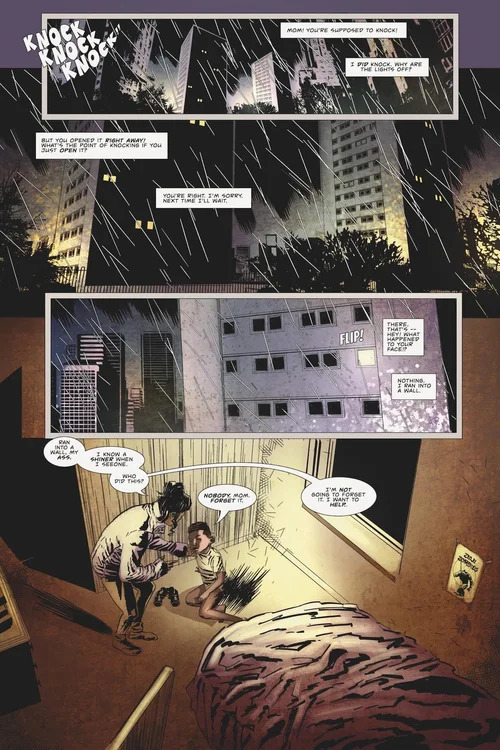
As a whole story across these two issues, Samaritan works best as a slow-burn urban myth rather than a straight-up punch-fest. The creative team is clearly more interested in asking what happens after the superhero story ends. Who pays the bill when gods disappear? What happens to the kids left behind in cities where legends failed? That angle gives the book real flavor. It has superhero DNA, but its pulse is street-level drama. It is about poverty, fear, belief, masculinity, abandonment, and the complicated hunger for someone strong enough to make the monsters back up. That is powerful material.
The pacing is mostly strong, especially in how issue #1 establishes Sam’s voice and the mythic shadow of Samaritan, while issue #2 tightens the danger around him and pushes the mystery into more personal territory. Still, if I’m keeping it a buck, there are moments where the supporting street-level players could use a little more definition. Some of the gang and neighborhood elements move fast, and while the mood is clear, a bit more character texture around those threats would make the danger hit even harder. Also, the handwritten caption style and gritty visual design are cool as hell, but in a few places the readability asks the reader to work. Not a dealbreaker, but a cleaner balance between grit and clarity would help the emotional beats breathe wider.
But make no mistake, this book has sauce. It understands that the best superhero stories are not always about capes flying over skyscrapers. Sometimes they are about a lonely kid staring out a window, wondering if the man across the way is more than he seems. Sometimes they are about the mythology we build because reality is too heavy to carry without it. Samaritan taps into that beautifully. It has echoes of classic urban vigilante fiction, old-school superhero tragedy, and that 90s street-cinema tension where every block feels like a battlefield and every grown man might be hiding a whole war behind his eyes.
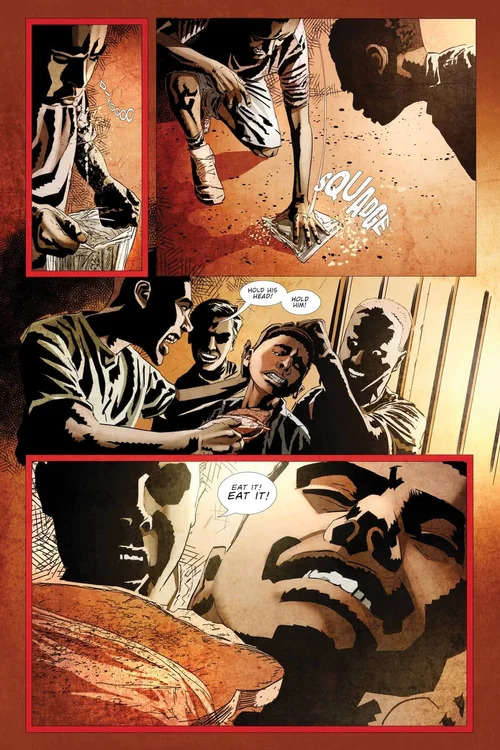
Bragi Schut gives the story emotional bones. Marc Olivent gives it scars. Renzo Podestá gives it weather. Together, they create a comic that feels cinematic without losing its sequential storytelling identity. This is not a book trying to dazzle you with empty noise. It wants to pull you into the rain, hand you a busted umbrella, and say, “Look closer, because the legend ain’t dead yet.”
Samaritan is gritty, heartfelt, moody, and loaded with mythic street-level energy. A few areas could be sharpened for clarity and supporting character depth, but the core is strong, the vibe is heavy, and the mystery has claws. Crusaders, put this one on your radar, tell your crew, and support Mythos Comics because sometimes the hero doesn’t arrive with a spotlight… sometimes he’s across the hall, carrying garbage bags, waiting for the city to remember his name. WEPA!
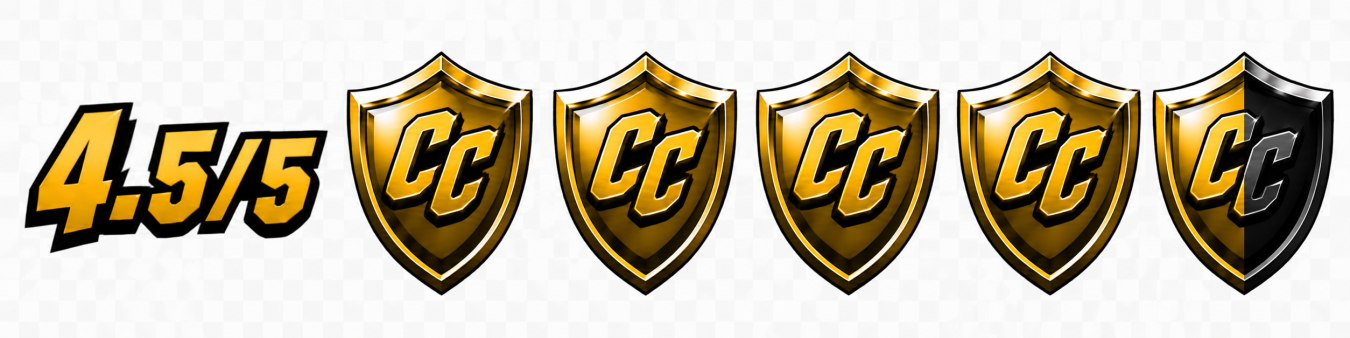
CRUSADERS SCORE:
4.5/5
Writer: Bragi Schut
Pencils and Inks: Marc Olivent
Colors: Renzo Podestá
Website: Mythos Comics
Copyright: Mythic Publications, LLC
*Disclosure: Comic Crusaders received a review copy for coverage consideration. This did not influence our opinion.
Leave a Reply
You must be logged in to post a comment.