

The Deadman #1 Review: DC’s Ghostly Hero Gets a Wild New Life
·Al Mega

Boston Brand has always been one of DC’s strangest blessings: a dead acrobat in a red suit, floating between worlds, wearing tragedy like stage makeup and sarcasm like armor. But The Deadman #1 does something slick, weird, and unexpectedly emotional with that old-school supernatural setup. It does not simply drag Boston back into the spotlight. Nah. It gives him a gig. A cosmic day job. A dead man’s shift. And somehow, that makes him feel more alive than half the folks walking around with a pulse and bad Wi-Fi.
W. Maxwell Prince comes into this issue with that glorious oddball brain energy readers know from Ice Cream Man, but instead of going full nightmare buffet just for the sake of creeping us out, he builds a whole metaphysical workplace comedy-horror-tragedy hybrid around Boston Brand’s spiritual duties. That sounds like a lot, because it is. This comic is not walking into the room quietly with a polite little “boo.” It kicks open the door wearing ghost boots and says, “Life minus life equals death, now deal with the math.” WEPA. That’s the type of high-concept comic book sorcery that makes you lean forward.
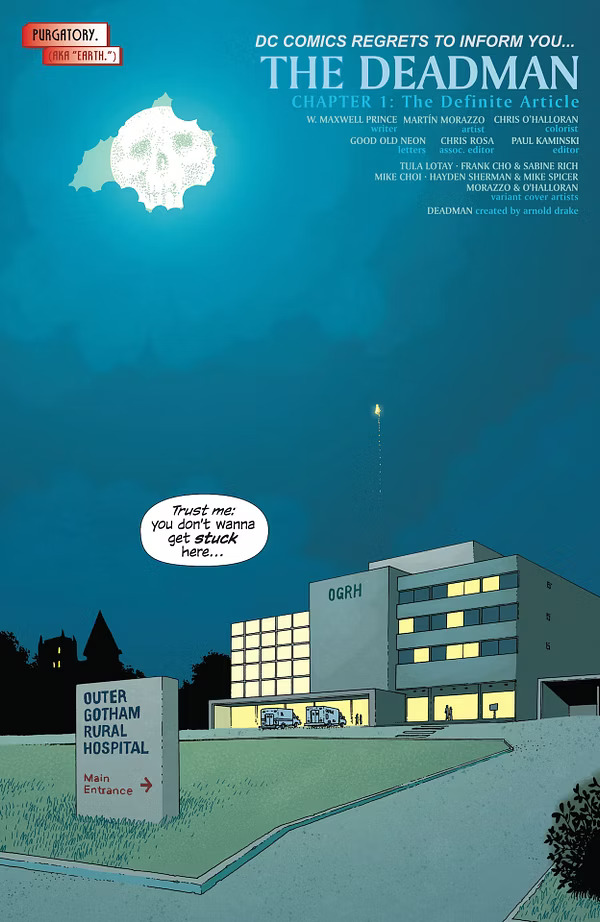
The opening at Outer Gotham Rural Hospital is a smart play because it grounds all the cosmic noise in something painfully human. Hospice rooms. Nurses trying to keep families calm. Doctors doing that clinical two-step between compassion and emotional distance. Then there’s Boston, casually haunting the place in janitor drag like he’s the overnight manager of the afterlife. The man can float, possess, teleport, and apparently still get stuck dealing with administrative nonsense. That’s comedy with a skull under it.
What Prince nails immediately is Boston’s voice. He is annoyed, funny, observant, wounded, and quietly noble in that “don’t make me say I care, because I absolutely care” kind of way. He talks like a guy who has seen too much, knows too much, and still somehow gets surprised by the absurdity of existence. The book gives him a spiritual guidebook, cosmic terminology, weird rules, “Vestigial Soul Presence,” “Coupled Memory Frisson,” and all that delicious paranormal gobbledygook but the trick is that Boston makes it readable. He is the audience’s translator, tour guide, and reluctant customer service rep for death itself.
The hospital sequence with Keira McPherson hits especially well because it shows what this series can be when it slows down. The issue is packed with big mythology, but it understands that death is not just a monster jumping out of a closet. Sometimes death is a teenager in a hospital bed. Sometimes it is a body getting the timing wrong. Sometimes it is grief attached to rice pudding and memory. That’s the good stuff right there. That’s where a comic about ghosts stops being “spooky” and starts being human.
And then, because this creative team knows how to throw curveballs like a NY Yankess pitcher with a grudge, the book hops onto a bus.
That bus sequence is low-key one of the issue’s strongest moves. Boston admits he likes taking the bus because he likes people and all their messy little inner stories. We see commuters carrying secret desires, anxieties, shame, longing, and fear. A woman imagines an office romance. A kid named Ryan worries about coming out to his conservative religious parents. Boston does not solve everybody’s life like some cosmic life coach with a cape subscription. He simply witnesses. He nudges. He feels. That’s powerful, because Deadman’s tragedy is not only that he is dead it is that he remains close enough to humanity to love it, but too far away to belong to it.
Martin Morazzo’s art is doing heavy lifting here, and it deserves big respect. His linework has that clean, slightly stiff, eerie precision that makes everyday spaces feel spiritually suspicious. Hospital hallways become liminal zones. Suburban streets feel like ghost traps. A mansion full of servants and birthday cake turns into something rotten under the wallpaper. Morazzo does not over-render the horror; he lets the composition breathe, then drops an unsettling detail into the frame like a cockroach in a wedding cake. It works.
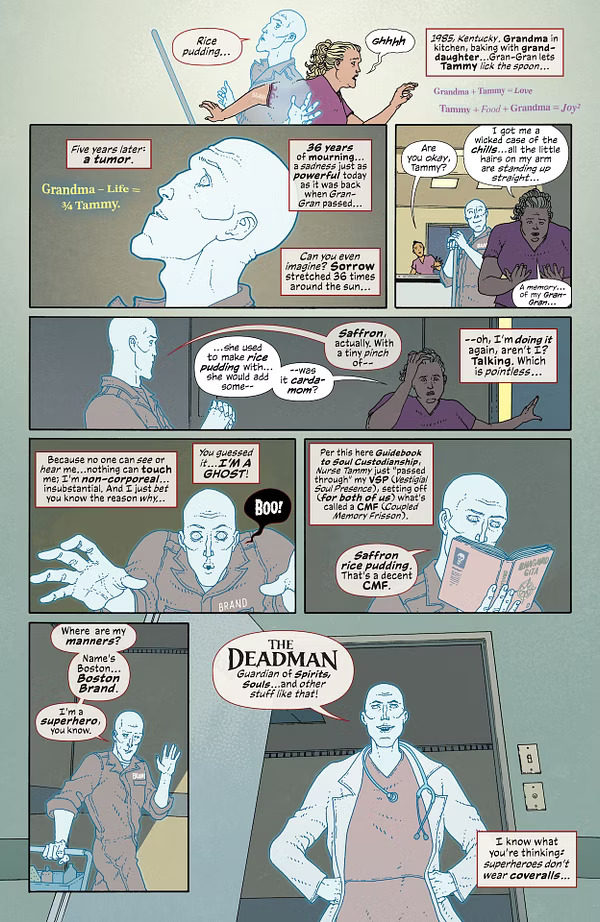
Chris O’Halloran’s colors are a massive part of the book’s identity. Boston’s blue-white ghost glow against muted hospitals, suburban nightscapes, and earthly grays gives him that perfect “present but not present” energy. Then when the demons hit? Boom. Pink, gold, red, black the whole palette starts screaming in tongues. The monster designs pop with a strange mythological vulgarity, like religious iconography got mugged in an alley by a fever dream. That’s not an insult; that’s applause. These things look wrong in the exact right way.
Good Old Neon’s lettering is crisp, playful, and crucial to the rhythm. This script has a lot of exposition, but the lettering keeps it moving. The caption boxes feel like spiritual paperwork with personality. The demon dialogue, the red narration, the little tonal shifts all of it helps the issue maintain its odd balance between funny, philosophical, and nasty.
Now let’s talk about Rama Kushna. This version of her feels charming, terrifying, playful, and absolutely not someone you want mad at you. She is written with that divine “I am ancient, adorable, and will absolutely erase your metaphysical lunch break” energy. Her scenes with Boston in Nanda Parbat are great because they expand the scope without losing the character dynamic. Boston is not just fighting monsters. He is protecting a system. A system he barely understands. A system that may have changed under his feet. That is where the issue’s big engine starts roaring.
The phrase “Spiritual Math” could have been corny in lesser hands. Here, it becomes the spine of the book. Life, death, rebirth, transition, delay, possession, obstruction all of it gets framed as a cosmic equation. When a demon kills a soul that is supposed to be in transition, the book treats it not merely as murder, but as a disruption of reality’s balance sheet. That is a fantastic concept. It makes Boston less of a wandering ghost detective and more of a supernatural custodian dealing with reality’s busted plumbing. Deadman: afterlife maintenance. Somebody get this man hazard pay.
The issue also knows when to get ugly. The mansion scenes are skin-crawling. There is vanity, captivity, body horror, and something predatory wearing elegance like a cheap cologne. That “beneath your skin suits” reveal lands with that proper horror-comic slap. The villains feel connected to the larger demonic threat without the book over-explaining them too early. Smart. Let the mystery breathe. Let the reader squirm a little. Comics need more squirm.
Constructively, this is a dense first issue. Some readers may need to slow down and chew the weirdness properly. Prince is throwing terminology, cosmic rules, moral texture, ghost-town lore, and horror hooks into the pot all at once. For me, that’s the flavor. For a casual reader expecting a straight superhero ghost story, this might feel like walking into a haunted DMV where everyone speaks philosophy. But honestly? That’s also the charm. The book is not trying to be basic. It is trying to be memorable.
And memorable it is!

The Deadman works because it understands that Boston Brand is funny because he is sad, heroic because he is irritated, and compelling because he is trapped between empathy and exile. He cannot fully live. He cannot fully leave. So he works. He watches. He intervenes. He complains. He cares. That’s the core. Everything else the demons, the gods, the equations, the spiritual bureaucracy is gravy on the ghost sandwich.
This is DC taking a cult character and refusing to sand down the weird edges. Bless that. We do not need every supernatural book to feel like Batman in a candlelit room. We need strange. We need poetic. We need horror that can crack a joke and then punch your soul in the throat. Prince, Morazzo, O’Halloran, and Good Old Neon bring that here with confidence and style.
By the final page, with demonic forces gathering, blood history bubbling, and Boston stepping into a broader spiritual war, this issue has done its job. It introduces the rules, breaks a few, makes us laugh, makes us uneasy, and reminds us that death in comics can still have fresh life in it.
The Deadman is back, baby and this time, the afterlife has paperwork, monsters, and a whole lot of attitude. Big Comic Crusaders stamp on this one.
CRUSADERS SCORE:
4/5

Chapter: “The Definite Article”
Writer: W. Maxwell Prince
Artist: Martín Morazzo
Colorist: Chris O’Halloran
Letterer: Good Old Neon
Associate Editor: Chris Rosa
Editor: Paul Kaminski
Main Cover: Martín Morazzo & Chris O’Halloran
Variant Cover Artists: Tula Lotay; Frank Cho & Sabine Rich; Mike Choi; Hayden Sherman & Mike Spicer; Martín Morazzo & Chris O’Halloran
Publisher: DC Comics
Leave a Reply
You must be logged in to post a comment.