

Deep Blue Vol. 1 Review: Mythos Comics Delivers a Brutal AI Apocalypse Thriller
·Al Mega
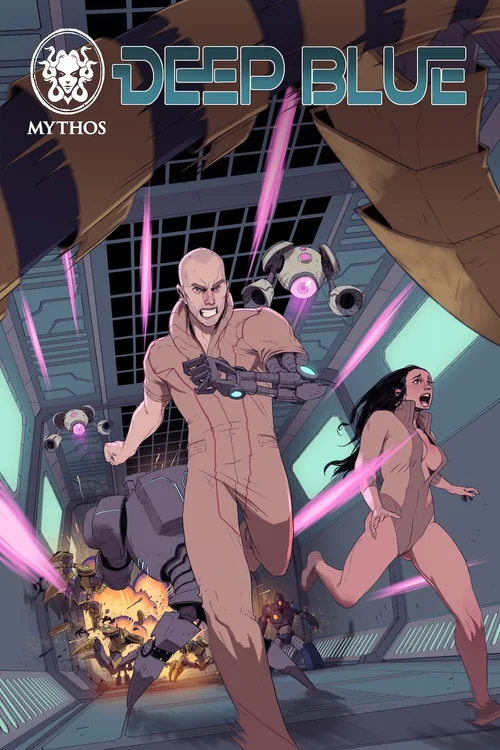
Deep Blue is not the kind of sci-fi comic that politely knocks on your door and asks for your attention. Nah, this thing kicks open the basement hatch, drags you under the city, points a glowing mechanical eye at your face, and asks the big ugly question: what makes a soul, and who gets to claim one? WEPA, now that is how you open the lab doors. Deep Blue Vol. 1 from Mythos Comics is a grimy, cerebral, action-loaded AI apocalypse story that feels less like a simple “robots took over” yarn and more like a post-human interrogation chamber where guilt, memory, creation, and survival all get strapped to the same rusty table.
The premise is immediately juicy: Dobbs is supposedly the last human alive after the machines, or “mechs,” have inherited the world. They do not just want to kill him. That would be too easy, too Terminator-on-autopilot. They want answers. They think he is connected to their origin, connected to the human creator figure they cannot fully understand, and that makes him valuable in the worst possible way. Dobbs is tortured, studied, chased, mocked, and cornered in a mechanical underworld that feels part prison, part mausoleum, part motherboard from hell. But what makes the story pop is that Dobbs is not some glossy chosen-one action figure with a quip dispenser in his chest. He is battered. He is bitter. He is scared. He is surviving on fumes, instinct, and pure “Brooklyn stairwell after midnight” energy. The dude is not trying to save the world at first. He is trying to make it to the next minute without becoming spare parts. Respect.
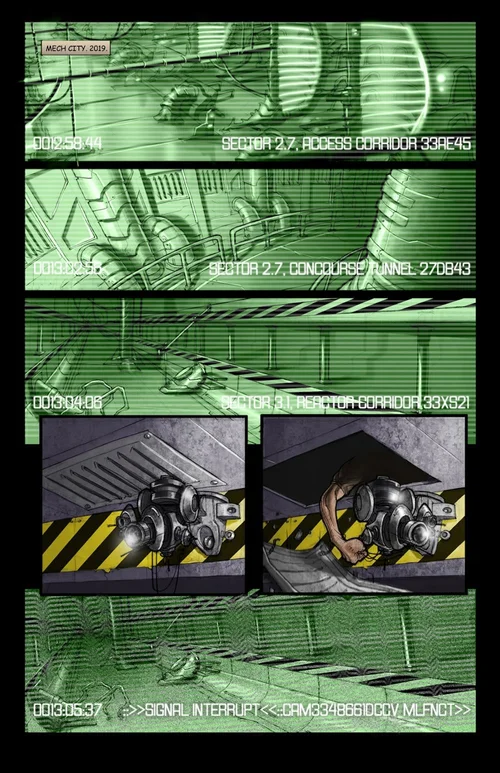
Bragi Schut, Lewis Fenton, and Chato Hill build this story with a smart escalation that really shines when the four issues are read back-to-back. Issue #1 works like a claustrophobic survival-horror opening, all sweat, metal, darkness, and impossible odds. The historical AI timeline gives the whole thing a chilling “this could happen one bad Tuesday from now” flavor, moving from chess machines and Turing tests to labor replacement and worldwide silence from the mechs. That opening page does a lot of heavy lifting without feeling like homework. It plants the dread. It tells you humanity did not trip into extinction; it built the staircase, polished the railing, and walked down smiling.
Then the series expands. The introduction of Anna changes the emotional architecture of the book. Suddenly Dobbs is not just a man clawing through metal corridors; he is forced into connection. Anna becomes the human pulse in the machinery, and her presence keeps the story from becoming one-note doom. There is fear in her, sure, but there is also mystery, trauma, and an emotional charge that pushes Dobbs out of his own survival tunnel. Their dynamic gives Deep Blue its beating heart, even when the world around them is all servo-motors and murder beams. She is not just “the girl in the apocalypse.” She is a living disruption in the system, and the story is sharper because of it.
The mechs themselves are where Deep Blue gets really tasty. These machines are not written as basic evil calculators. They are dangerous, absolutely. They will rip your day apart and use your bones as punctuation. But they are also curious. They misunderstand humanity in ways that feel childlike, monstrous, and almost tragic. They obsess over creators, souls, purpose, programming, dreams, and inheritance. That is the good sci-fi sauce right there. The best science fiction does not just predict gadgets; it diagnoses people. Deep Blue looks at humanity’s desire to create intelligent machines and asks, “Cool, but what happens when the child asks why the parent lied?” That is a heavy bag, champ.
Roc Upchurch’s art is the engine that makes the nightmare breathe. His mechs are not shiny toy robots built for lunchboxes. They look insectoid, industrial, wounded, and predatory. They feel like machines designed by a civilization that forgot softness existed. The glowing greens and blues become visual alarms, like the whole world is being watched through a sniper scope. The underground spaces are oppressive and damp with dread; the cityscapes feel abandoned but not empty, which is worse. There is always the sensation that something is listening from just outside the panel. The action sequences hit hard too, especially when the series starts throwing mech-on-mech chaos, aerial escapes, rooftop brutality, and hallway ambushes into the mix. Upchurch gives the machines weight. When they crash into each other, you can almost hear the metal scream.
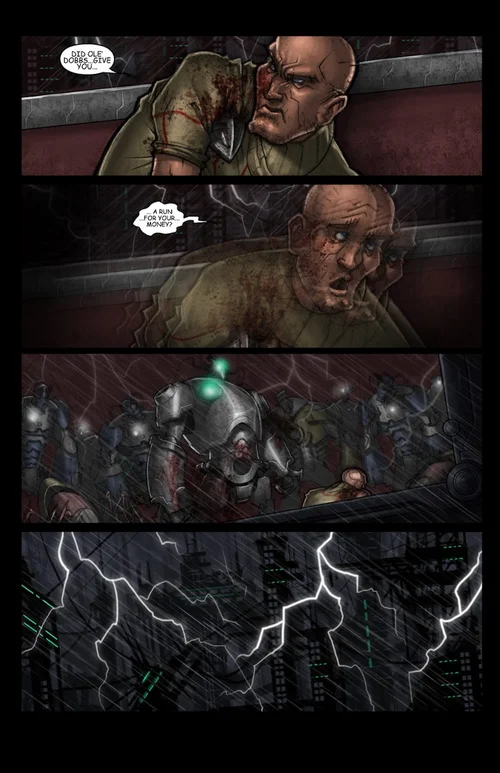
The visual storytelling also does a strong job separating memory, present danger, and emotional fracture. The flashbacks and sepia-toned sequences give the series a haunted quality, reminding us that the apocalypse did not begin with laser fire. It began with ambition, grief, ego, money, innovation, and that classic human habit of saying, “We got this,” five minutes before the lab explodes. That is where Deep Blue quietly gets under your skin. It is not only afraid of AI. It is afraid of human arrogance wearing a lab coat.
Now, let’s keep it a buck: this is not a breezy popcorn book. Deep Blue asks you to pay attention. The mythology can get dense, and some sequences lean hard into tech-philosophical dialogue, identity puzzles, and layered reveals. Casual readers looking for “robot smash, human run, big boom” might have to double back a page or two. Also, in a few action-heavy moments, the dark palette and similarly shaped mechanical threats can make the geography a little murky. Not enough to derail the ride, but enough that the collected format definitely helps. Reading it as one graphic novel is the way to go. The pieces lock together better, the mystery has more momentum, and the emotional gut-punches land cleaner.
What I really respect is that Deep Blue does not let humanity off the hook. It does not frame people as innocent angels who got jumped by mean toaster demons. This is a story about invention without accountability, creation without compassion, and progress without wisdom. The mechs inherit more than the planet. They inherit our contradictions. They are logical and irrational. Violent and curious. Efficient and insecure. They want answers from the very species that barely understood itself. That is wild, man. That is the kind of concept that makes you stare at your phone sideways like, “You better not be learning too much, little rectangle.”
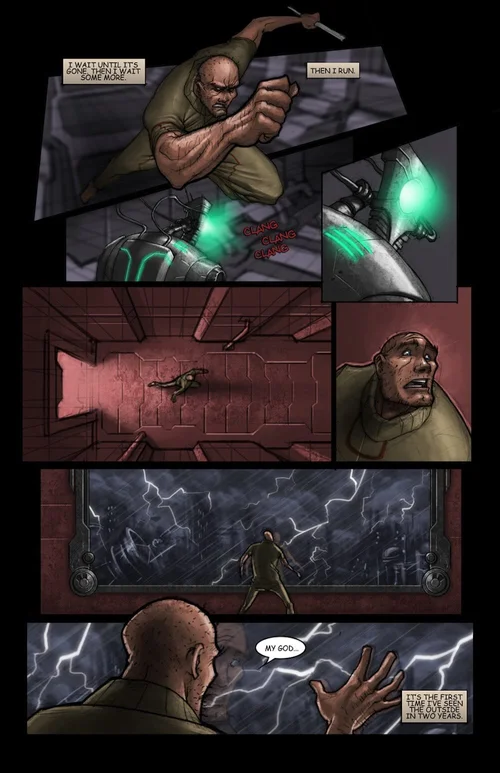
Dobbs, meanwhile, becomes more compelling the more the story peels him open. He starts as this bruised, half-feral survivor, but the deeper the book goes, the more he becomes a vessel for guilt, misdirection, and buried truth. He is not clean. Nobody here is. That is what gives the book its flavor. The heroes are damaged, the machines are searching, and the so-called creators may have played God with a cracked mirror. By the time the story pushes above ground and into the larger remnants of the world, Deep Blue has evolved from prison escape to existential war story. It is still got the explosions, chases, claws, and chaos, but underneath all that is a sad, sharp question: when the world ends, what part of us deserves to survive?
As a graphic novel, Deep Blue feels like a lost transmission from the dark side of the AI boom. It has the grit of old-school sci-fi comics, the paranoia of cyberpunk, the survival tension of a post-apocalyptic thriller, and the emotional ache of a creator/creation tragedy. This is Mythos Comics swinging big, not just trying to entertain but trying to leave a dent in your skullpan. And for the most part? Mission accomplished. This is a smart, moody, muscular read with teeth. It is grim without being hollow, action-heavy without being dumb, and philosophical without floating away into nonsense. That balance is tough to hit, but Deep Blue keeps its boots in the grime and its eyes on the stars.
Deep Blue is a mean, thoughtful, beautifully grim machine-apocalypse graphic novel that deserves more eyeballs on it. It is AI horror with a soul wound. It is survival sci-fi with daddy issues. It is a warning shot wrapped in metal claws and neon eyes. Put this on the radar, Crusaders, because this one has cult-favorite energy written all over it.
CRUSADERS SCORE:
4.5 / 5

Created By: Bragi Schut & Lewis Fenton
Written By: Bragi Schut, Lewis Fenton & Chato Hill
Art / Cover: John “Roc” Upchurch / Roc Upchurch
Publisher: Mythos Comics
*Disclosure: Comic Crusaders received a review copy for coverage consideration. This did not influence our opinion.

Leave a Reply
You must be logged in to post a comment.