
THE MASK/MARSHAL LAW Retro Review: Two Maniacs Enter Future San Francisco, Everybody Else Better Duck!
·Al Mega
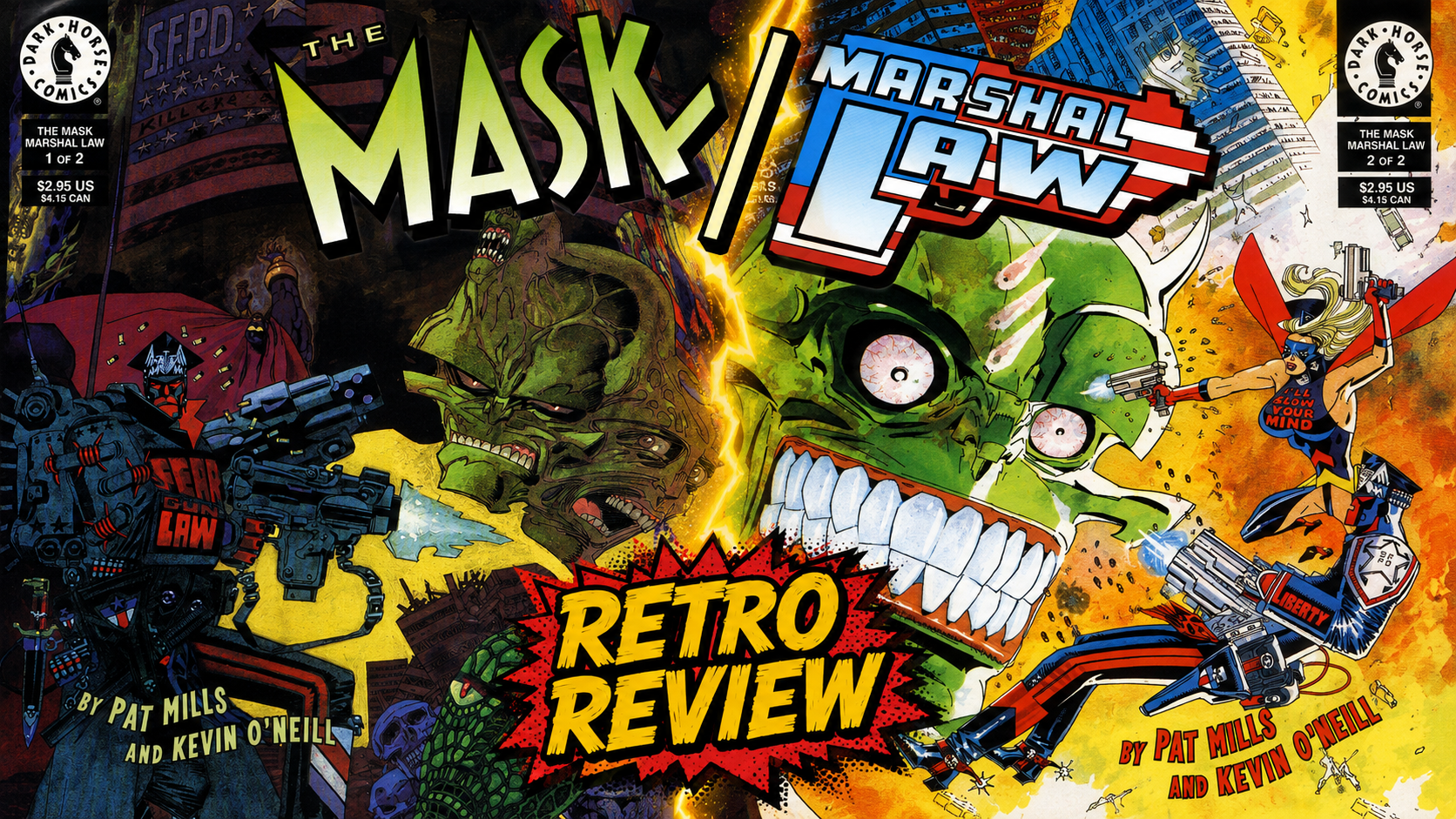
WEPA, mi gente! Somebody at Dark Horse Comics once looked at Marshal Law, looked at The Mask, ignored every responsible adult in the building, and said, “Yeah, put those lunatics together.” The resulting two-issue collision from 1998 feels like a stolen muscle car loaded with explosives, pointed downhill through future San Francisco while Pat Mills and Kevin O’Neill argue over who gets to stomp the accelerator. Subtle? Hell no. Tasteful? Not remotely. Entertaining? Buckle the hell up.
Marshal Law begins this madness ready to retire from hunting superheroes. Joe Gilmore has spent years tearing through fraudulent capes, government-manufactured icons, homicidal patriots, and every chemically enhanced creep hiding behind inspirational branding. The rage no longer hits the same. He wants out. He has even selected Gale Force as his replacement, partly because she possesses the firepower and hatred necessary for the job, partly because Joe’s emotional decision-making remains about as stable as a shopping cart flying down the BQE.
Retirement lasts roughly as long as anybody familiar with Marshal Law would expect. Joe’s old enemy Danny Mallon, better known as the Sleepman, has been secretly kept alive in a vegetative state after Marshal Law believed he killed him. Scientists trying to study the Mask place it onto Danny’s face, because comic-book laboratories apparently share one universal workplace policy: if an ancient reality-warping artifact looks dangerous, strap it onto the most psychologically damaged murderer available and start taking notes.

Mills ain’t just tossing two violent maniacs into a steel cage and ringing the bell, mi gente. The matchup hits because the Mask grabs whatever ugliness somebody has buried in the basement, drags it upstairs, and lets it run wild in the street. Marshal Law, meanwhile, has built his whole existence around ripping the capes off fake heroes and exposing the rot hiding underneath. One man turns his darkest impulses into flesh-and-blood insanity. The other looks at every superhero costume like evidence bagged at a Brooklyn crime scene. Slam these two combustible lunatics together and the brawl becomes something much nastier than your average crossover beatdown. We’re talking trauma, fantasy, self-hatred, identity, and all the lies people tell themselves just to make it through another day without cracking.
Danny might be the worst possible dude to wear the Mask, which naturally makes him the perfect host for this story. His guilt, bitterness, desperate hunger for approval, hatred of Marshal Law, and seriously warped relationship with his mother become high-octane fuel for the green-faced chaos. This ain’t goofy cartoon destruction just for cheap laughs. Danny’s transformation turns one man’s private nightmare into everybody else’s public emergency. His damaged mind spills across San Futuro through twisted bodies, grotesque punchlines, and reality-bending madness, but Mills never loses sight of the broken human being underneath all that green lunacy. Every mutation peels back another rotten layer. Every gag exposes another piece of Danny’s pain. The insanity has horsepower, familia, and the emotional engine underneath it is running hot.
Joe’s side of the ride carries more weight than you might expect too. He keeps claiming he’s finished with superheroes, but the Sleepman is old trauma Joe can’t bury alongside his guns, leather, and bad memories. Marshal Law’s anger has always come with a self-destruct button, and his finger stays dangerously close to it. Yeah, he hates manufactured heroes, phony symbols, and government-sponsored capes, but what really scares him is the possibility that he has no purpose without somebody left to punish. If the hunt ends, who the hell is Joe Gilmore? Mills lets that question ride shotgun while the mayhem blows through every red light in San Futuro. The dialogue stays sharp, vicious, darkly funny, and mean enough to draw blood, while the psychological shrapnel gives this showdown real impact beyond the wreckage and body count.

Gale Force brings another worthwhile dimension. She is not decorative backup or an expendable love interest. Her anger toward superheroes mirrors Joe’s, but her experience in psychiatric care gives her a different weapon against the Mask. Marshal Law’s instinct is confrontation. Gale understands suggestion, insecurity, and the diseased logic operating beneath Danny’s spectacle. Their approaches create a clever tactical rhythm as the second issue shifts from pursuit into psychological warfare. Punching the Mask harder is not necessarily the winning move when reality itself has stopped respecting the speed limit.
Kevin O’Neill’s artwork is gloriously unhinged. Future San Francisco looks assembled from urban decay, military hardware, pornographic advertising, fascist iconography, medical nightmares, and scrap metal somebody dragged through hell. Nothing feels clean. Nothing feels safe. Buildings bend into oppressive walls of visual noise while machinery appears ready to grow teeth and bite whoever operates it. O’Neill understood that Marshal Law’s world should never merely contain satire. The environment itself needs to sneer at you.
His version of the Mask becomes a walking mutation rather than the slick, rubber-faced prankster many casual readers associate with the movies. Limbs twist, faces split, bodies inflate, and identities mutate from panel to panel. O’Neill draws transformation as both comedy and violation. The laughter comes with tetanus. Action scenes remain readable despite the density because he controls silhouette, directional movement, and scale like a veteran stunt coordinator. When a splash page arrives, it lands like a truck punching through the wall of the barbershop.

Dave Stewart’s colors keep the visual insanity organized. Sick greens announce the Mask’s contamination, furnace reds intensify the violence, and grim industrial browns hold San Futuro together beneath the madness. Brighter heroic colors are repeatedly dragged through dirt, blood, smoke, and moral corrosion. The palette never tries to make O’Neill’s work pretty. It makes the grotesquerie legible, atmospheric, and aggressive. Ellie DeVille’s lettering also deserves respect because these pages contain narration, screaming, sound effects, competing voices, and sudden shifts in scale. The lettering guides the eye without sanding down the chaos, which is no small feat when practically every character speaks like they are trying to win an argument during an explosion.
The pacing across both issues is tight, but not rushed. Issue one establishes Joe’s retirement, Gale’s position, Danny’s history, and the experiment before detonating the premise. Issue two pays it off through escalating confrontations that mix horror, black comedy, superhero parody, and character reckoning. There is no empty middle lap. Mills keeps shifting the threat, while O’Neill finds fresh ways to visualize Danny’s deteriorating mind. Even the nastiest jokes feed the book’s central obsession with identity and repression.
Let’s keep it 100, familia, this book’s unapologetic vulgarity will send some readers running for the exit. Mills and O’Neill came here to roast the culture with brass knuckles on, and they damn sure weren’t asking anybody’s permission before throwing haymakers.. Sexual imagery, brutal violence, psychiatric horror, and offensive urban caricature are baked into its DNA. The material comes from a late-1990s comics climate willing to turn good taste into roadkill. Yet reducing it to empty shock would miss the machinery underneath. Mills attacks heroic mythology, institutional negligence, masculinity, authority, celebrity worship, and the comforting fiction that evil always looks abnormal. O’Neill translates those attacks into visual pandemonium with fingerprints nobody could mistake for another artist’s.

The Mask/Marshal Law ain’t some safe little crossover cooked up in a boardroom by suits moving characters around like action figures on a sales chart. Nah, familia, this savage joint has Pat Mills and Kevin O’Neill’s fingerprints, fury, and twisted sense of humor splattered across every page. These two maniacs didn’t link up for some corny handshake, quick cash grab, and matching variant covers. Their entire philosophies crash head-on. The Mask yanks every filthy urge, buried trauma, and forbidden fantasy out of the basement, while Marshal Law storms through the wreckage looking for the fraud responsible. What follows is grotesque, hilarious, psychologically rotten, and way smarter than a comic loaded with massive guns, mutated bodies, and exploding scenery has any right to be.
If your only experience with The Mask is Jim Carrey dancing in a yellow suit, mi gente, brace yourself, because this version will smack that nostalgic smile clean off your face. Marshal Law fans already know what kind of savage ride Pat Mills and Kevin O’Neill bring to the block: political mockery with brass knuckles, superhero mythology dragged through broken glass, and enough emotional damage to keep every therapist in San Futuro collecting overtime. Joe also gets forced to confront the ugly truth about his own addiction to violence, which gives the carnage some real weight beneath all the insanity. Nearly three decades later, this two-issue burner still feels fearless because it has absolutely no interest in acting respectable. It kicks down the garage door, steals the nastiest ride on the lot, floors it through every red light, and leaves flaming tire marks across the superhero genre.
The Mask/Marshal Law is a demented, intelligent, full-throttle crossover powered by Pat Mills’ acidic writing and Kevin O’Neill’s irreplaceable visual savagery. Dark Horse gave two radioactive properties enough road to collide properly, and nearly three decades later, the crash remains spectacular! Weepaaaaaaaaaaaaaaaa…
CRUSADERS SCORE:
4.5/5

Writer: Pat Mills
Artist and Cover Artist: Kevin O’Neill
Letterer: Ellie DeVille
Colorist: Dave Stewart
Publisher: Dark Horse Comics
Publication: February and March 1998


Leave a Reply
You must be logged in to post a comment.