
THE PLAGUE #1 Review: Lucky Devil Comics Revives Old-School Antihero Mayhem With a New Orleans Bite
·Al Mega
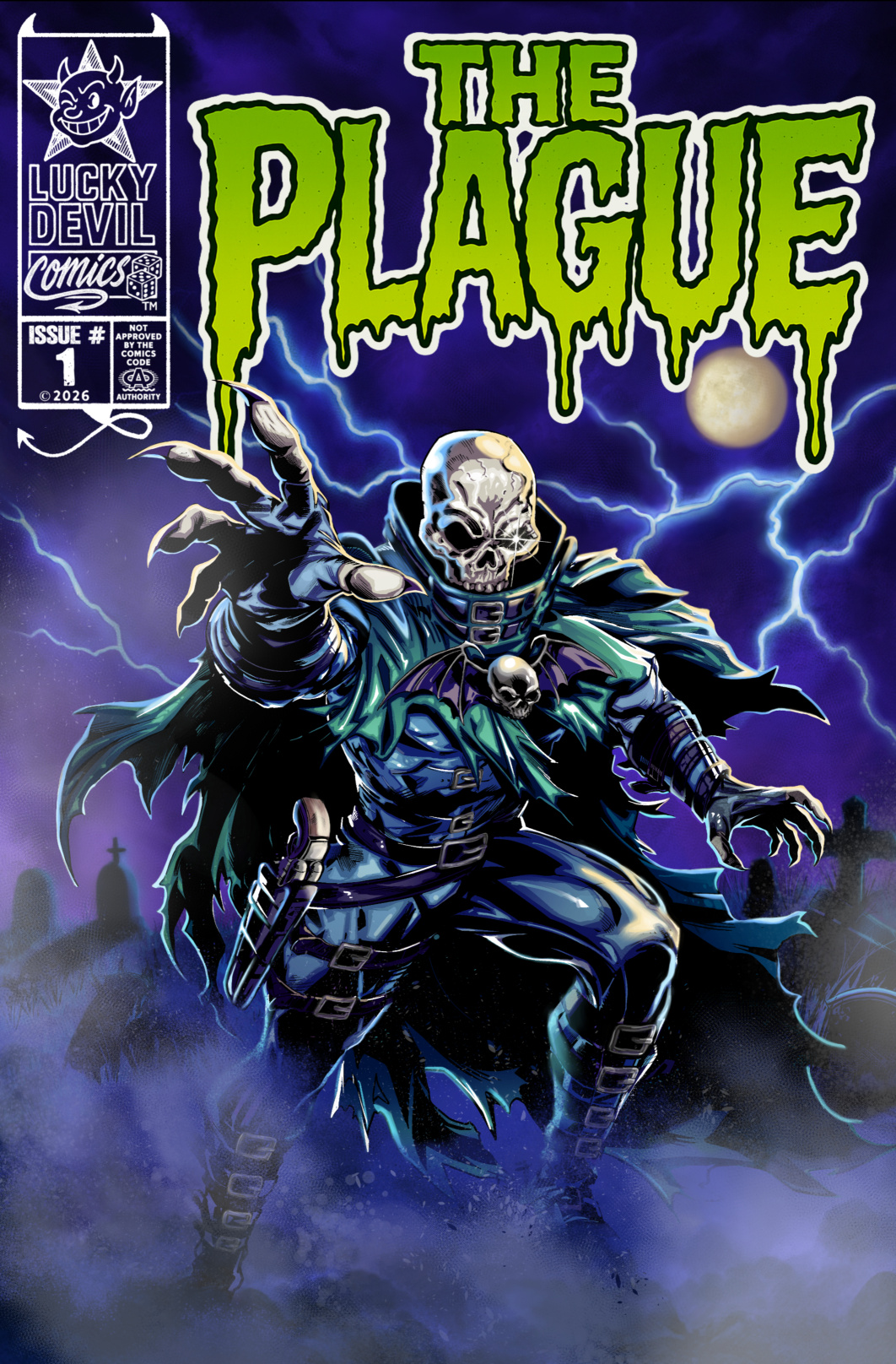
WEPA! THIS is the kind of indie comic I love finding in the wild, something with dirt under its fingernails, gasoline in the veins, and absolutely zero interest in showing up dressed like everybody else at the party. The Plague #1: Ill Fate from Lucky Devil Comics comes roaring out of the garage like somebody resurrected the attitude of late 80s and early 90s comics, dropped it into a dystopian New Orleans, stuffed corporate corruption, bio-horror, supernatural vengeance, and good old-fashioned skull-faced badassery into the trunk, then mashed the accelerator through the damn floor. Writers Styles Pacheco and Nicky C. introduce us to Diego Diaz, an everyday working stiff who discovers very quickly that punching the clock for the wrong people can become hazardous to your health. Extremely hazardous. Like, “your employer may have murder included in the benefits package” hazardous. From its killer opening image of Diego’s skeletal alter ego standing over New Orleans in the rain, The Plague announces what kind of ride we’re taking before throwing the transmission into reverse and showing us the human being underneath all that nightmare fuel.
New Orleans, 2030. A devastating virus has already torn across the world, governments have consolidated power under the United Council of Governments, and pharmaceutical giant Inqugenex has positioned itself as humanity’s supposed savior. Yeah, because giant corporations taking control during a crisis always ends beautifully, right? Diego works low-level security for Inqugenex, keeping his head down while the company enjoys its monopoly, protesters fill the streets, militarized security forces patrol the city, and the public starts realizing that maybe the people selling the cure have some explaining to do about the disease. Pacheco and company spend a healthy chunk of this opening issue building that machinery before letting it explode, and while some early pages carry a heavy load of exposition, the groundwork pays dividends because you understand the system Diego is trapped inside. Dr. William Zheng hands him information that could bring the whole house down, investigative journalist James Connolly gets pulled into the orbit, company president Nathaniel Bishop starts tightening the screws, and suddenly Diego’s quiet little security job is moving faster than a stolen ride down the FDR at three in the morning.

Diego is the reason all this corporate dirt, conspiracy, and straight-up shady business actually hits, because underneath the madness, you got a regular dude getting dragged into something way bigger than he ever signed up for. My guy is not introduced as some unstoppable tactical demigod who came out of the womb bench-pressing Buicks. He’s nervous. He loves Nina. He knows something stinks but understands there are consequences for digging around where powerful people told you not to dig. That vulnerability gives the later mythology some weight because The Plague actually lets us meet Diego before asking us to believe in the monster he eventually becomes. Nina also gives the book some emotional gasoline. Their relationship isn’t there just to fill pages between explosions. She represents Diego’s normal life, his humanity, and the possibility that there might still be something worth protecting inside a world already selling pieces of its soul wholesale. Meanwhile Bishop and his personal crew bring exactly the kind of unapologetic villain energy this style of comic needs. Nobody is hiding behind twelve pages of philosophical ambiguity before doing dirt. Sometimes you need a bad dude you can immediately look at and say, “Yeah, somebody needs to slap the Wi-Fi password outta this man’s mouth.” Old-school storytelling, baby.
Visually, Daniel José Ruiz Jimeno and Miguel Ayuso understand the assignment. The Plague needs atmosphere just as badly as it needs action, and these pages carry plenty of both. The opening sequence immediately sells Diego’s transformed silhouette, especially that slick half-skull, half-human composition that basically gives you the character’s entire internal conflict in one image. Corporate interiors are cold and geometric. The streets feel controlled and surveilled. The Louisiana bayou becomes muddy, sickly, claustrophobic territory where you can practically hear mosquitoes filing paperwork to drink your blood. Then the supernatural material arrives and the visual language starts getting meaner, stranger, greener, and more aggressive. There are occasional moments where anatomy, facial consistency, or environmental perspective could use another polishing pass, but the ambition of the artwork consistently outruns those imperfections. I’d rather see an indie team swing for Yankee Stadium and occasionally foul one into the cheap seats than bunt safely for thirty pages. These cats are SWINGING.

Josh Rodriguez, Miguel Ayuso, and Nicky C. deserve real love for the color work because color is doing serious narrative lifting here. The early corporate material leans into colder blues, muted grays, and institutional greens, while the swamp and supernatural sequences begin poisoning the palette with radioactive emeralds, acidic illumination, deep blacks, and burning oranges. When Diego’s world crosses from corporate thriller into something much darker, you can feel that transition before anyone needs to explain it. The pages become less comfortable. Shadows get nastier. Energy crackles. The supernatural greens around Fausta and the transformation imagery practically glow off the page, and the contrast between those scenes and the warmer moments involving Nina reinforces what Diego stands to lose. Lettering throughout is readable and intentionally old-school, with turquoise narration boxes, yellow location captions, conventional balloons, and visually distinct supernatural dialogue. Some pages get text-heavy, especially during the world-building stretches, and giving certain panels a little more oxygen would sharpen the pacing, but nothing becomes impossible to follow. One production note for the record: the digital edition we read does not separately identify a letterer in its credits box, so I’m not going to invent one just to make the credits look prettier.
What hit me right away is The Plague ain’t out here biting nobody else’s style. This book knows exactly what lane it’s in, stomps on the gas, and owns that joint from jump. This isn’t an indie comic desperately chasing whatever the larger publishers were doing six months ago. You can feel the creators’ love for 80s and 90s storytelling everywhere without the book becoming a cosplay convention for somebody else’s characters. There’s conspiracy thriller DNA, supernatural antihero swagger, corporate bio-horror, militarized dystopia, revenge fiction, gothic imagery, and enough pulpy attitude to make the spinner rack inside my brain start rotating. New Orleans helps tremendously because the city provides something visually and spiritually different from Generic Metropolis Number 47. Mardi Gras masks, neon nightlife, old streets, swamps, ravens, occult imagery, quarantine barricades, and modern corporate towers coexist naturally here. Even better, the book doesn’t spend thirty pages screaming its themes into your ear. Questions about fear, manufactured scarcity, corporate control, disease, government authority, truth, and what desperate people will surrender for security are baked into the engine, but The Plague remembers the prime directive: this is still supposed to be a COMIC BOOK. Give me monsters. Give me betrayal. Give me dudes getting launched into terrible life decisions. Gracias.

By the time Ill Fate rolls into its final stretch, Diego Diaz has gone through enough hell to make the skull face feel earned, and the book leaves him pointed directly toward the people responsible without blowing every secret in its first issue. Smart move. Lucky Devil Comics isn’t handing us a trailer pretending to be Issue #1. There’s meat here. We get a world, a protagonist, relationships, villains, conspiracy, tragedy, supernatural mythology, transformation, and a clean runway into the ongoing series. Could portions of the setup move quicker? Absolutely. Could some dialogue be trimmed so the artwork gets more room to breathe? Yup. But none of that killed the momentum for me because the creators clearly have a story they are hungry to tell, and hunger counts for a LOT in indie comics. The Plague #1 feels raw in the right ways, ambitious in the important ones, and proudly uninterested in sanding off its personality for mass consumption. If you miss comics that looked you dead in the eye, revved the engine, threw a skull mask on the hero, and said, “Get in, we’re going to Hell,” Lucky Devil Comics may have just built your next ride. The Crusade approves. 💀🔥 WEPA!
CRUSADERS SCORE:
4/5

Written & Created By: Styles Pacheco
Cover Art: Daniel José Ruiz Jimeno & Nicky C.
Pencils: Daniel José Ruiz Jimeno & Miguel Ayuso
Colors: Josh Rodriguez, Miguel Ayuso & Nicky C.
Publisher: Lucky Devil Comics
Leave a Reply
You must be logged in to post a comment.