
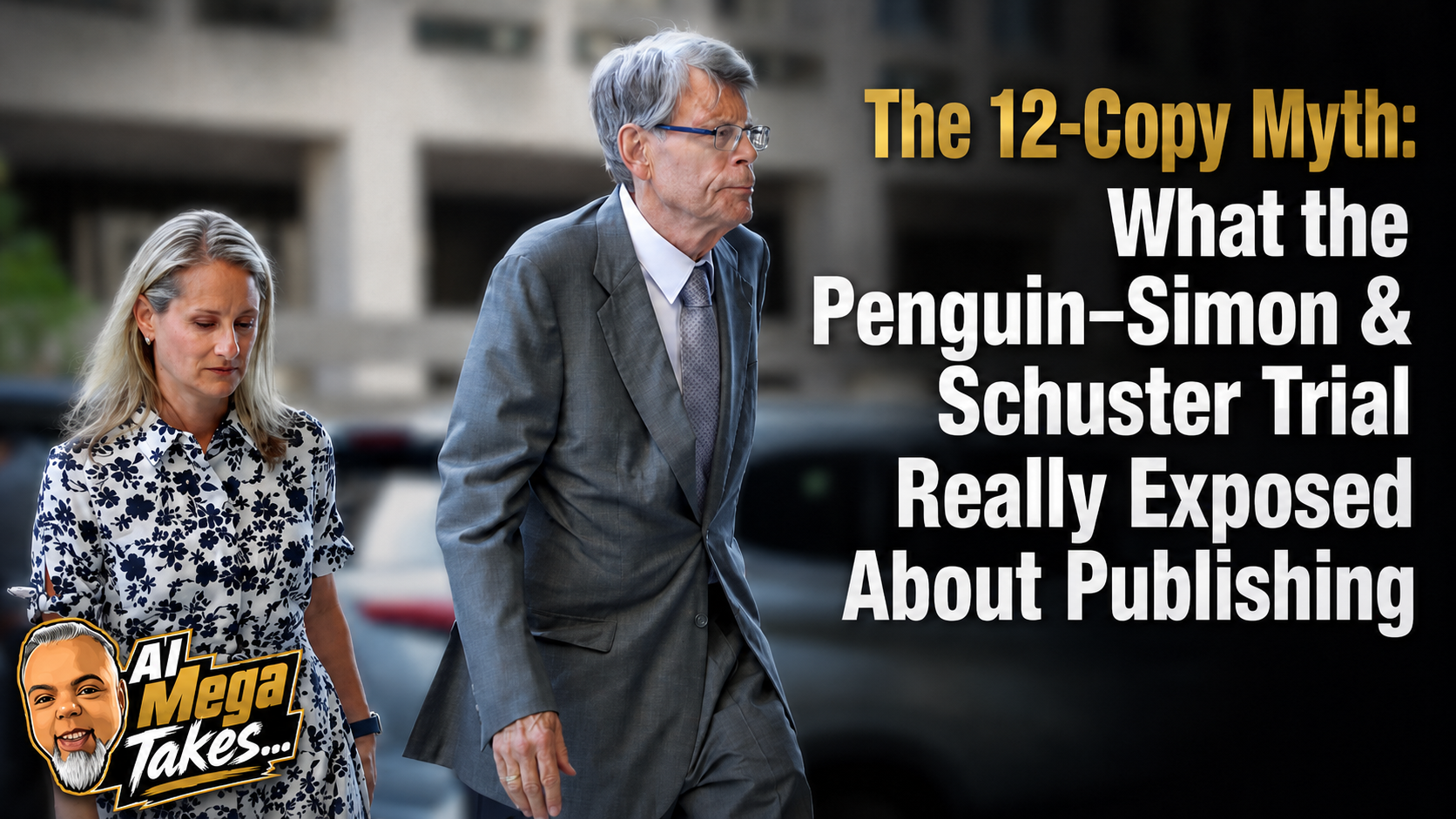
The 12-Copy Myth: What the Penguin–Simon & Schuster Trial Really Exposed About Publishing
·Al Mega
A viral claim says half of all Big Five novels sell fewer than 12 copies. That is not what the evidence shows. The real numbers, however, reveal an industry where most books receive modest sales while money, marketing and negotiating power gather around a tiny circle of expected winners.
Ay yo, creators, gather around, because we need to have one of those uncomfortable conversations where the internet hands us a juicy statistic, everybody reposts it, and then somebody finally checks whether the math is wearing pants.
Writer K.G. Russell recently posted that 50% of all Big Five-published novels sell fewer than 12 copies, 66% sell fewer than 1,000 and 98% sell fewer than 5,000. The conclusion was motivational: sell 13 copies and you have supposedly outsold half the novels released by publishing’s biggest houses.
Indie authors and publishers, here’s some raw stats from the Simon & Schuster / Penguin anti-trust hearings, just in case you thought your books aren’t selling well. According to publisher testimony:
50% of all Big-5 published novels sell less than 12 copies
66% sell less than a…KG Russell (@KGRussellwrites) July 15, 2026
That message hits hard because indie creators know what it feels like to fight for every single sale. You finish the book, pay the artist, chase the printer, beg the algorithm for mercy and celebrate when somebody who is not related to you buys a copy. Hearing that major publishers may not perform much better feels validating.
There is only one problem: those three numbers do not belong together!
The post combines different datasets, different time periods and different groups of books, then presents them as if they describe the same population of Big Five novels. They do not. That does not mean the publishing business is healthy. It means we need to expose the real problem without building our case on bad math. Because mi gente, when the truth is already ugly, there is no reason to put a fake mustache on it.
The numbers trace back to the Justice Department’s successful attempt to block Penguin Random House from purchasing Simon & Schuster for approximately $2.2 billion. The case focused mainly on competition for anticipated top-selling books, particularly projects commanding advances of $250,000 or more. The government argued that combining two major bidders would give authors fewer places to take valuable projects, reducing advances and weakening contract terms.
After a 13-day courtroom battle, the judge slammed the brakes on the deal, ruling that combining Penguin Random House and Simon & Schuster could hurt competition for those big-money, headline-grabbing book deals. And that right there is the part people need to understand.
This wasn’t about saying every book sitting on a shelf was suddenly in danger. Nobody was crying because Aunt Linda’s mystery novel or somebody’s romance paperback wasn’t going to get its fair shot. Nah, this was about the heavyweight fight at the top — the massive deals where publishers throw down serious money to land the next bestseller.
The court basically asked one simple question: if two of the biggest players in the game become one giant machine, who loses when creators are sitting across the negotiating table?
Let’s keep it real, when competition disappears, creators usually feel it first. Less competition means fewer doors to knock on, fewer people fighting for your work, and potentially less power when it’s time to talk contracts. And for writers, artists, and every creator trying to make a living from their craft, that power balance matters.
The Justice Department supplied examples showing how direct competition affected real money. In one auction, Penguin Random House and Simon & Schuster continued bidding after other publishers dropped out, pushing the advance from roughly $650,000 to $825,000. Another contest for a debut novel climbed from offers around $510,000 and $525,000 to a winning $700,000 bid.
One smaller example may be even more important. According to the government’s complaint, competition between the companies helped a freelance science writer secure an additional $15,000 money the author said would help pay her son’s college tuition. That is the human reality hiding beneath all this corporate legal language. An extra bidder is not just another logo at an auction. It can mean rent, medical bills, childcare, research time or one less shift at the day job.
During the trial, a government attorney asked a defense economist whether he would be surprised to learn that half of approximately 58,000 new trade titles sold fewer than a dozen copies and that 90% sold fewer than 2,000. The witness did not verify the figures. He also noted that the group contained many different publishers.
Most importantly, no clear source for the 12-copy figure was supplied during that exchange. The approximately 58,000 titles were not described as Big Five novels. They covered trade books from large and small publishers, potentially across multiple categories.
Publishing analyst Jane Friedman reported the figure after the trial and has since described doing so without sufficient sourcing as a consequential reporting mistake. After the claim spread online, BookScan analyst Kristen McLean attempted to reconstruct what the underlying data might actually show.
McLean examined 45,571 new ISBNs from ten large publishers over a 52-week period. Her reconstruction found that:
- 14.7% sold fewer than 12 print copies.
- Roughly 66% sold fewer than 1,000 print copies.
- About 88% sold fewer than 5,000 print copies.
- Less than 2% sold 50,000 copies or more.
Fourteen-point-seven percent of books selling fewer than 12 copies is still a wild number. Let that sink in for a second. That means thousands of professionally published books — books that had editors, designers, marketing teams and a major publisher’s name behind them — barely moved off the shelf. But hold up… before everybody starts screaming “the whole system is broken!” and running around with pitchforks, we gotta keep the facts straight!
That number is shocking, but it is not 50%. The data did not prove that half of all Big Five books are selling twelve copies or less. The information came from a much broader group of ten large publishers, not just the Big Five. And that famous “98% sell under 5,000 copies” statistic? That came from a completely different snapshot of BookScan data from 2020. In other words, we cannot take three different numbers from three different places, throw them in a blender, hit puree and call it the truth. That’s not research, that’s making statistical Frankenstein with a publishing contract.
Now here’s where things get even more interesting, fam. BookScan is valuable, but it is not the entire scoreboard. It tracks U.S. print sales through participating retailers like Amazon, Barnes & Noble, independent bookstores and other outlets. That gives us a real look at the market — but it does not show every single way a book can make money.
A book might sell through ebooks. Audiobooks. Libraries. Direct sales from the creator. International markets. Special events. Subscription programs. All those copies and dollars might exist outside what BookScan sees. So when somebody says, “This book only sold 500 copies,” the next question should always be:
“500 copies where? In what format? During what time period? Through what sales channels?”
Because without that information, we are looking at one piece of the puzzle and pretending we have the whole picture. And here’s another thing creators need to understand: books are not always counted as simply “one book equals one number.” A hardcover edition might have its own ISBN. The paperback gets another. A special edition, collector’s version, large-print edition or updated release can all create separate records. A book that launched at the end of a reporting period might only have weeks to build sales numbers, while another title had an entire year to rack them up.
That’s why saying “copies sold” without explaining the format, location, sales channel and timeframe is like telling somebody, “My car is slow,” but refusing to say if you’re driving a Honda Civic or pushing a shopping cart uphill. The number matters. But context is king. Because in this creator economy, bad statistics can hurt just as much as bad contracts. And creators don’t need more noise they need the truth so they can make smarter moves.
Once the misinformation is stripped away, the publishing system still looks brutally uneven. Why do so many traditionally published books produce modest retail sales? Because publishers release more books than the market can give equal attention. Why release so many? Because publishing operates partly as a portfolio business. A company does not know with certainty which titles will break out, so it acquires many projects while hoping a smaller number of hits and dependable backlist books carry the load.
Why do only certain books receive major campaigns? Because marketing money follows expectations. Publishers place larger bets on celebrity authors, established sellers, major acquisitions and books they believe can become cultural events. Everybody else may receive competent editing, distribution and basic publicity but not the full marching band.
Why does that leave authors exposed? Because many writers understandably hear “major publishing deal” and imagine national promotion, bookstore tables and readers arriving like the Avengers through portals. In reality, plenty of authors are expected to help create the demand themselves.
Why does consolidation matter? Because when fewer companies control access to editing, production, distribution, publicity and retailer relationships, creators have fewer serious buyers competing for their work. The Justice Department argued that competition between Penguin Random House and Simon & Schuster produced higher advances, better services and more favorable contract terms. Remove a bidder and the creator’s leverage can shrink with it.
That is the real story not that every Big Five novel is selling twelve copies, but that getting through the gate does not guarantee the gatekeeper will carry you across the finish line. The antitrust case did not examine Marvel, DC or comic-book work-for-hire agreements. We should not pretend a book-publishing trial proved something it never studied. But the broader lesson absolutely applies to comics and graphic novels.
A publisher’s logo can provide editing, production, retailer access, distribution and legitimacy. It cannot guarantee that your book becomes a priority. It cannot guarantee a sustainable career. And it certainly cannot replace an audience that knows your name and follows your work.
Before signing, creators should know:
- Who owns the characters and underlying intellectual property?
- What formats, territories and adaptation rights are included?
- Is there a rights-reversion clause?
- Can the creator inspect or audit sales records?
- What marketing has the publisher actually committed to doing?
- Is the advance guaranteed, recoverable or tied to milestones?
- Can the publisher hold the project indefinitely without releasing it?
- Does an option clause restrict the creator’s next project?
Get those answers in writing. Then get a lawyer who understands publishing and intellectual property to read the agreement. Your cousin who watches courtroom dramas does not count.
The counterargument deserves respect. Traditional publishers assume financial risk. They pay advances, hire editors, design books, manufacture copies, pitch retailers, handle returns and maintain relationships that an individual creator may need years to build. A good publishing partnership can transform a career.
Indie publishing also carries risks. Control sounds beautiful until you realize you are the publisher, marketing department, warehouse manager, customer-service representative and poor soul answering an email asking where somebody’s package went because they entered the wrong address.
Being pro-indie does not mean walking around telling everybody that independence is some magical shortcut where success just falls out of the sky. Nah, fam. That’s not how this game works. Indie means ownership, control and freedom but it also means you are the CEO of the whole operation. You are the writer, artist, editor, marketer, salesperson, customer service department, accountant, and sometimes the person sitting there at midnight packing orders while wondering why you thought this was a good idea. The trade-off is real.
You might keep more rights. You might earn better margins. You might build a direct relationship with your audience instead of being another name on somebody’s spreadsheet. But you also carry more responsibility. The printer bill is yours. The marketing is yours. The mistakes are yours. The victories? Those are yours too. And let’s pump the brakes on that “I sold 13 copies, so I beat half the Big Five” mentality. Come on now. That’s not empowerment that’s a participation trophy built out of broken math and internet hype. Nobody wins by lying to themselves. The real question is not “Did I outsell someone else?”
The real questions are:
- Did this project make sense financially?
- Did it pay the creative team fairly?
- Did it build an audience that will come back?
- Did it grow your email list, your community, your brand?
- Did you protect your characters and your intellectual property?
- Did you create opportunities beyond that first sale?
Because one comic, one graphic novel, one book that’s not just a product. That’s a seed. The creators who survive are not always the ones who sell the most copies on day one. They are the ones who understand the business, protect what they build, connect with their audience, and keep planting. That’s the indie hustle. Not pretending the mountain isn’t there. Learning how to climb it.
Those questions matter more than an internet statistic designed to make everybody feel like a bestseller before lunch. The Penguin Random House–Simon & Schuster trial did expose something important. It showed that fewer bidders can mean less money and weaker negotiating power for creators. It revealed how intensely major publishers compete for the books they believe will win. And the sales data surrounding the case suggests that most titles will never receive blockbuster numbers, regardless of the logo printed on the spine.
So build independently where it makes sense. Partner with publishers where the deal adds genuine value. Protect your rights either way. Just do not base your business plan on the idea that selling thirteen books makes you Stephen King. Come on, fam.
We can be motivational without being mathematically delusional!
Disclaimer
This article is an editorial analysis based on publicly available court filings, government records, industry reporting and social-media commentary. It reflects the author’s interpretation of the evidence and is intended to encourage informed discussion about publishing consolidation, creator compensation, book sales and independent publishing.
The sales figures discussed in this article should not be interpreted as complete lifetime sales totals for every book or publisher. BookScan and similar datasets may exclude or incompletely measure ebooks, audiobooks, direct sales, library purchases, subscription reading, international sales and other distribution channels.
References to the Penguin Random House–Simon & Schuster litigation describe allegations presented by the U.S. Department of Justice and findings made during the federal antitrust case. The article does not allege criminal conduct or misconduct beyond what is documented in the cited public records.
Comic Crusaders supports creator ownership, informed contract negotiation and independent publishing while recognizing that traditional publishing can offer valuable editorial, production and distribution support. Creators should evaluate every agreement individually and consult a qualified publishing or intellectual-property attorney before signing a contract.
Any factual correction supported by credible documentation may be submitted to Comic Crusaders for review.
Receipts/Primary Sources
- K.G. Russell’s X thread discussing the publishing-sales statistics
- U.S. Department of Justice Complaint: United States v. Bertelsmann SE & Co. KGaA, et al.
- U.S. Department of Justice announcement confirming the Penguin Random House–Simon & Schuster merger was blocked
- U.S. Department of Justice proposed findings and evidence from the antitrust case
Supporting Research and Analysis
- Jane Friedman: Why Book Sales Figures Are So Hard to Interpret
- Jane Friedman: BookScan Clarifies the “One Dozen Copies” Statistic
- Jane Friedman: Why the DOJ v. Penguin Random House Trial Does Not Change Publishing
- California Lawyers Association: DOJ Blocks the Penguin Random House–Simon & Schuster Deal
Main Image:
Photographer: Tom Brenner
Credit: REUTERS/Tom Brenner
*Ai Disclosure: The main image includes AI-assisted artwork reviewed by Comic Crusaders before publication.
Leave a Reply
You must be logged in to post a comment.