
DIAMOND IS GONE, SO WHY ARE PUBLISHERS STILL FIGHTING TO GET THEIR COMICS BACK?
·Al Mega
Wepaaaa, fam. Remember when the Diamond bankruptcy was supposed to be the ugly ending to one chapter of the comic-book business? Yeah, apparently somebody forgot to tell the comics still sitting in a warehouse.
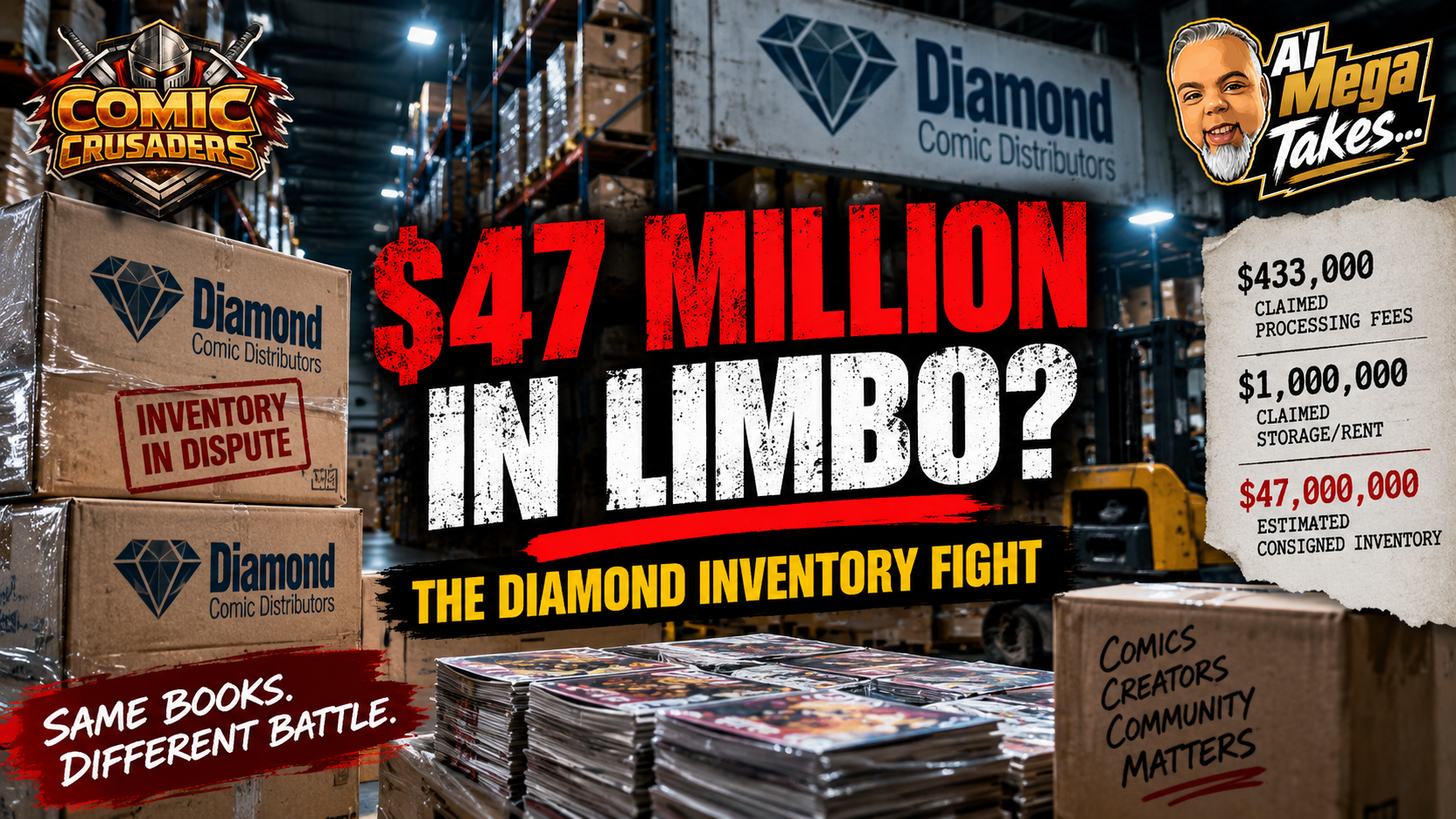
More than a year after Diamond Comic Distributors filed for bankruptcy in January 2025, publishers are still fighting over consigned inventory that never simply became Diamond’s property. According to reporting from ICv2 and The Beat, 15 publishers reached a proposed settlement with the Diamond estate intended to help them reclaim inventory held at the former Diamond facility in Olive Branch, Mississippi. Then Sparkle Pop, the Ad Populum entity operating the warehouse, objected. Now the books are caught in another legal and financial tug-of-war while everybody argues over who owes whom for processing, storage and removal.
Mi gente, this is where the story stops being bankruptcy paperwork and starts becoming a real comic-industry accountability problem. These are physical books publishers produced, printed and expected to sell. When inventory sits trapped instead of moving through stores, that is money sitting on concrete instead of coming back into a publisher’s business.
ICv2 reported that Sparkle Pop is seeking $433,270 in processing fees tied to consignment inventory it sold, along with roughly $1 million in rent for storing the remaining inventory, with rent allegedly accruing at $125,000 per month. The proposed settlement involved $892,913 being held in escrow from sales after Sparkle Pop’s acquisition of Diamond assets.
Then another player entered the room. The Beat reported that Pop King, run by Pacific Comics co-founder Steve Schanes, approached roughly 140 publishers with an offer to purchase consigned inventory and manage its removal, assuming the transaction can legally happen. The Beat put the estimated value of the consignment inventory still involved at approximately $47 million.
Forty-seven million dollars worth of comics is not some forgotten pallet behind the mop bucket. Even if that figure represents inventory value rather than cash publishers would immediately realize from selling every copy, the scale tells you why nobody involved is shrugging and walking away.
Here is the part readers should understand without needing a bankruptcy attorney sitting beside them. Consignment generally means a supplier places goods with a distributor or seller while retaining an ownership interest until those goods are sold under the terms of the agreement. The precise legal rights here are being fought through the bankruptcy process, which is exactly why Comic Crusaders is not going to pretend a complicated ownership dispute has a simple winner.
What we can say is that publishers have been trying to recover inventory they contend belongs to them, while Sparkle Pop argues that releasing that inventory without addressing its claimed expenses would leave it holding the bag for storage and processing. That is the fight. Everything else is noise unless the court, the parties or documented agreements establish otherwise.
For Marvel or DC, a delayed pallet is irritating. For a smaller publisher, trapped backlist can hit differently. Inventory is working capital. It can fulfill retailer orders, conventions, direct-to-consumer sales, bundles and reorders. When books cannot move, the publisher cannot turn those books back into cash.
That pressure lands downstream too. Retailers cannot order inventory that is inaccessible. Readers cannot buy books stores cannot obtain. Creators whose work depends on long-tail sales may watch a title disappear from circulation for reasons that have nothing to do with demand. The Diamond collapse already forced publishers and retailers to rebuild distribution relationships. Having inventory still tangled in the wreckage extends the consequences long after the distributor itself stopped being the center of the market.
Ask the first why: why are publishers still fighting for inventory? Because the bankruptcy did not magically resolve competing claims over goods, proceeds and expenses. Why does that matter? Because possession of the books, legal ownership and the costs of handling them are now intertwined. Why are the costs significant? Because warehousing and processing inventory at this scale keeps generating expenses. Why does that become dangerous for publishers? Because every additional month can make recovering inventory more complicated or more expensive. And why should readers care? Because those costs eventually land somewhere in an industry already operating on tight margins.
The uncomfortable lesson is that distribution is not merely trucks and boxes. Distribution determines who controls access to inventory, who gets paid first, how quickly publishers can convert products into revenue and what happens when the machine breaks.
The Pop King proposal is intriguing because it potentially creates another route for inventory to leave the warehouse. But an offer is not a court order, and it does not erase the competing claims. The Beat specifically noted that the purchase would depend on whether the transaction is legally feasible.
That distinction matters. There is a temptation in comics media to see a new buyer enter a messy story and yell, “Problem solved!” Nah. Not yet. The important questions are what publishers would receive, what rights they would surrender, who pays warehouse-related charges, how inventory would be valued and whether the bankruptcy court permits the arrangement.
The next phase of this story needs voices from the publishers whose books are actually involved, retailers who lost access to inventory and the parties controlling the warehouse. How much sellable inventory remains? How many publishers can realistically afford the process of recovering it? What happens to inventory belonging to companies that cannot? How much has already been sold? Who ultimately absorbs the storage and processing costs?
Those are not sexy solicitation-season questions, but they matter more than another variant-cover announcement. Diamond dominated comic distribution for decades. Its collapse was always going to leave wreckage. The part the industry cannot normalize is publishers spending year two of that collapse still asking when they can get their own books back.
Sources / Receipts
ICv2: Sparkle Pop Objects to Consignment Settlement
The Beat: Pop King Offers to Buy Diamond Consignment Inventory
The Beat: Diamond Again — What About Sparkle Pop?
Editorial disclaimer: This report summarizes publicly available reporting and legal claims concerning the Diamond bankruptcy and related consignment dispute. Allegations, claims and objections described here remain subject to court proceedings and should not be interpreted as findings of wrongdoing by any party.
Leave a Reply
You must be logged in to post a comment.