
The Presses Stopped, but the Questions Didn’t: What Happened at Comix Wellspring?
·Al Mega
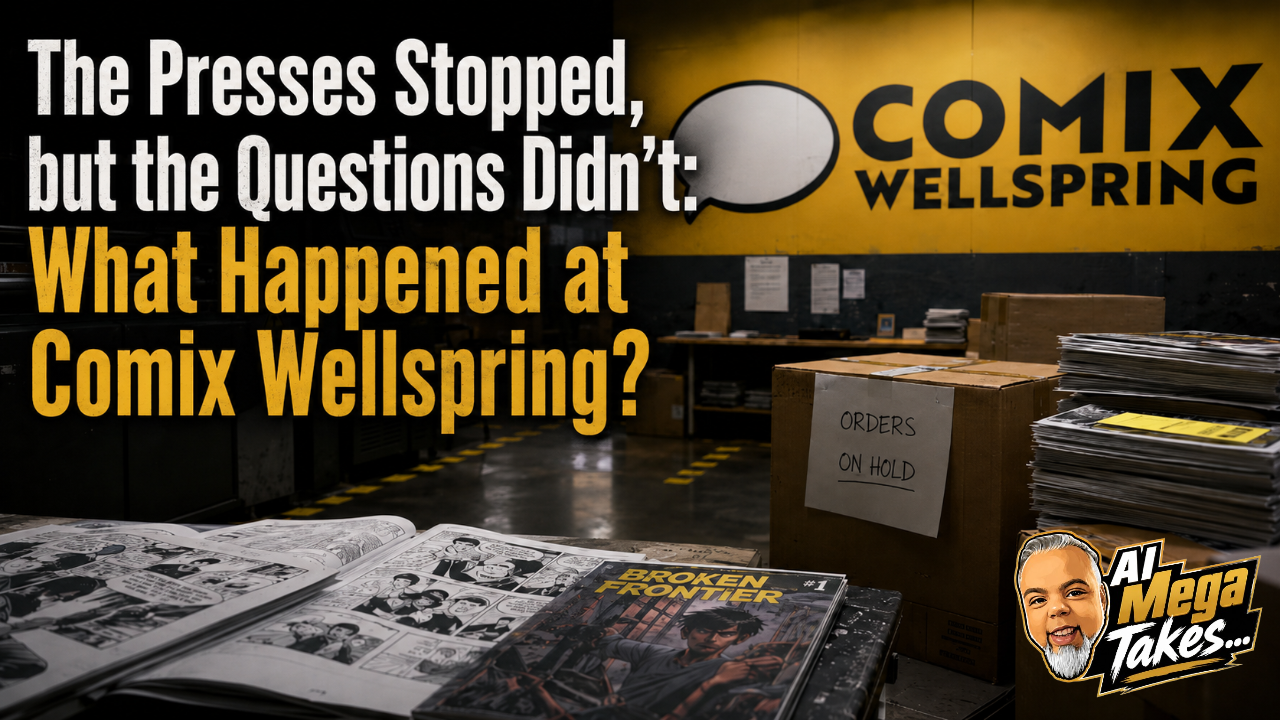
A trusted indie-comics printer halted production, promised refunds and pointed customers back to its original founders. The official explanation is four vague words: “unforeseen operational challenges.” Creators deserve more than that.
Ay yo, imagine spending months or years writing, drawing, coloring, lettering and crowdfunding your comic, only to reach the final stretch and discover that the printer holding your order has stopped production. No books. No convention inventory. No rewards for backers. No clear refund date. Just a carefully worded announcement and a whole lot of creators staring at calendars that do not care about corporate problems. That is the situation surrounding Comix Wellspring, a company that spent more than a decade building a reputation as one of the independent comic community’s most familiar printing partners.
On July 10, 2026, Comix Wellspring announced that it had suspended new orders and halted production because of “unforeseen operational challenges.” The statement identified Carta Finishing as the company’s owner and operator, promised full refunds for unfinished orders and said affected customers would receive additional information “in the near future.” No production restart date, refund schedule or detailed explanation was provided.
Comic Crusaders sent detailed questions seeking comment from the companies and organizations connected to this situation. As of publication, no substantive response had been received! That silence does not prove fraud, insolvency or deliberate wrongdoing. Let us make that crystal clear before the internet puts on its detective hat sideways. But silence does create an accountability problem when creators have money, deadlines and reputations sitting in somebody else’s production queue.
Comix Wellspring says every unfinished order will be refunded. It also says it worked with Greko Printing the original operation behind Comix Wellspring to remove a non-compete restriction that had prevented Greko from printing comic books. Comix Wellspring is now directly recommending that displaced customers contact Greko for future work. That is not a minor detail. Companies expecting a brief equipment repair or a two-week production pause do not ordinarily remove contractual restrictions on a direct alternative and then send their customer base there. It does not prove Comix Wellspring will never return, but it strongly suggests management expects the interruption to be significant.
The refund promise is positive, but “we will refund you” is not the same thing as money returning to a creator’s account before the next convention, shipping deadline or Kickstarter update. The public statement does not say how many orders are affected, how much customer money is involved or when refunds will arrive. That gap matters because comic printing is not just another online purchase. For an independent creator, the books are the business. Danny J. Quick of 4th Wall Productions told The Beat that the timing could set creators back for months during convention season. His blunt summary was dead-on: no books means no sales.
The shutdown did not follow months of public retreat. Comix Wellspring’s corporate messaging described a company moving in the opposite direction. Its LinkedIn page said the operation had served more than 8,000 creators, produced millions of books and was transforming itself from a traditional printer into a global “print-tech platform” offering automation, fulfillment, book-of-one printing and creator dashboards.
Only weeks before the suspension, the company was promoting new pricing, one-copy physical proofs, spot-foil products, ordering tools and free art boards tied to purchases of at least $100. Those promotions remained part of an active sales campaign shortly before production stopped. Here is the uncomfortable question: When did management know there was a serious problem?
We currently have no evidence showing that Comix Wellspring accepted money while already knowing it could not complete orders. Operational failures can happen suddenly. Equipment can fail. Financing can disappear. Key employees can leave. A parent company can change direction faster than a New York driver when somebody leaves half a parking space open. But active expansion followed by an abrupt shutdown deserves examination. The company should explain whether the failure came from machinery, staffing, cash flow, ownership decisions, technology, order volume or something else entirely. “Operational challenges” is corporate oatmeal. It fills the bowl but tells you nothing.
In July 2025, GlobalComix and Comix Wellspring announced a creator-first print-on-demand program. The plan called for a limited U.S. launch in August 2025 and a wider rollout during the fourth quarter of that year. Creators were told they could sell physical books without holding inventory or paying for large minimum runs. Months later, public comments on the announcement were still asking when the feature would become broadly available. A separate discussion in the GlobalComix community similarly reflected uncertainty, with users saying they had not seen a full rollout and an account representative saying there were no updates to share at that time.
Comix Wellspring also entered a separate print-on-demand arrangement with Comix.One. That beta reportedly became active in early 2026. After the suspension, Comix.One told users it had secured another printing partner and planned to expand formats and geographic availability. That quick pivot suggests Comix.One had some contingency protection that direct Comix Wellspring customers did not. Do not mix up GlobalComix and Comix.One. They are separate platforms with separate arrangements. The similarity in their names is already enough to make a copy editor reach for the good rum.
The larger point is this: Comix Wellspring was trying to become more than a printer. It was positioning itself as infrastructure a bridge connecting digital publishing, physical manufacturing, fulfillment and worldwide sales. That vision was not foolish. Indie creators desperately need those tools. The problem is that infrastructure must be boringly dependable. When a company becomes the bridge between creators and customers, failure does not remain inside the factory. It travels outward into crowdfunding campaigns, convention appearances, online stores and reader trust.
Comix Wellspring began in 2011 as a comic-focused division connected to Greko Printing. The current Comix Wellspring statement now identifies Greko as the original founder and confirms that a non-compete had prevented Greko from printing comic books until the present crisis. Carta Finishing describes itself as a merger of two Michigan bindery companies focused on binding, die-cutting, mailing and other post-press services. Comix Wellspring’s public statement says Carta owns and operates the comic-printing business, but neither company has publicly explained the complete transaction history, what assets changed hands or what responsibilities remained with each organization.
Industry writer Sean Kleefeld has raised the possibility that leadership or parent-company changes contributed to the shutdown, noting that a public professional profile appeared to mark June 2026 as the end of former CEO Dan Hills’ tenure. Kleefeld clearly labeled his broader theory as speculation, and Comic Crusaders found no evidence establishing that Hills’ departure caused the production halt. Still, the sequence deserves answers:
Comix Wellspring pursued new technology, new partnerships, new pricing and expanded production. A senior leadership change apparently occurred. Production then stopped. Greko’s non-compete was removed, and customers were directed back to the original printing company. That is a timeline not proof of a motive!
Why are creators angry?
Because orders were interrupted, refund timing remains unclear and deadlines do not pause when a printer does.
Why were creators so exposed?
Because many relied on one specialized vendor for printing, proofing and sometimes fulfillment.
Why did they rely on one vendor?
Because Comix Wellspring had earned years of trust and marketed itself as a creator-focused specialist capable of supporting projects from a first issue to global distribution.
Why was there apparently no smooth backup for direct customers?
Because independent creators rarely have the money or staff to qualify multiple printers, maintain alternate templates, order duplicate proofs and reserve capacity at several factories.
Why do we still not know the root cause?
Because the company gave customers a category instead of an explanation and has not publicly answered the basic questions surrounding the suspension. That last “why” belongs entirely to management! Comix Wellspring served creators successfully for years. Public posts include longtime customers who praised its work and communication before more recent problems. One creator describing an earlier factory move reported a delay but said customer service remained responsive and the final books were satisfactory.
The company also appears to be taking two responsible steps: promising refunds and releasing Greko from the non-compete. Those actions could help reduce the damage. It is also possible that the shutdown truly was unforeseen. The sales promotions immediately before the suspension might show that management expected operations to continue not that it intended to trap customers.
We should not label this a scam without evidence. We should not claim money was misused without financial records. We should not turn every delayed order or dark proof into evidence of a corporate conspiracy. Social-media complaints are leads. Invoices, emails, refund records, dated production promises and photographs are evidence. Know the difference, mi gente. But fairness works both ways. The absence of proven misconduct does not erase the responsibility to explain what happened.
Comic Crusaders is not endorsing any printer blindly. Order samples, request a physical proof and get delivery commitments in writing before trusting a major campaign to anyone.
Greko Printing: The original operation behind Comix Wellspring is now permitted to print comics again and is the alternative recommended in Comix Wellspring’s own statement. Its current website accepts custom book-printing inquiries and says customers can request quotes and timelines directly.
Ready Comics: A comic-focused Arizona printer offering standard comics, manga, graphic novels and specialty products including foil, acetate, metal and glow-in-the-dark books. Its FAQ says standard paper products generally have a minimum of 10 copies.
Mixam: Offers comic-book printing and allows very small quantities, including single-copy orders for some products. That makes it worth considering for proofs, short convention runs or creators unwilling to commit to hundreds of books.
Ka-Blam: A specialist that says it has printed comics, manga and graphic novels since 2005 and shipped more than three million comics. Its comic-specific experience may appeal to serialized creators and very small publishers.
PrintingCenterUSA: Offers domestic comic and book printing, with its dedicated comic service listing a 200-copy minimum. Some book products advertise production within several business days after proof approval, but creators should obtain a project-specific schedule.
PrintNinja: Better suited to larger offset runs. Its comic-printing service lists a 500-copy minimum and offers fulfillment, freight and warehousing options for crowdfunding projects. That may work for established campaigns, but it is not the move for somebody who needs 25 copies next Friday.
Save every invoice, proof approval, promised completion date, email and screenshot. Request the refund in writing, even if the company says refunds will be automatic. Ask for the amount, payment method and expected processing date. Do not let uncertainty burn through your payment-dispute window. The Consumer Financial Protection Bureau says a charge for goods that were never delivered can qualify as a billing error and advises consumers to contact their card issuer promptly. Federal guidance commonly references a 60-day written-notice period from the statement containing the charge, although issuers may provide additional protections. Before transferring the project to another printer, confirm trim size, bleed, color profile, paper stock, binding and page-count requirements. Do not assume one company’s template will slide perfectly into another company’s workflow. That is how you end up with important dialogue sitting inside the staple, and nobody wants Batman whispering into the gutter.
For future campaigns, build at least one backup printer into the schedule. Obtain a second quote before launching crowdfunding. Add time for a physical proof. Avoid promising delivery dates based entirely on a printer’s best-case estimate. Comix Wellspring was not some random website selling bootleg convention banners from a basement. It was a known part of the independent-comics production chain. That is exactly why the explanation matters.
When a company asks creators to trust it with campaign money, production deadlines and reader relationships, “operational challenges” cannot be the final chapter. Carta Finishing and Comix Wellspring should disclose what failed, how many customers were affected, when refunds will be completed and whether the business realistically intends to return. They may have a reasonable explanation. They may even have a painful one. But creators should not have to solve a corporate mystery while simultaneously finding a new printer, calming their backers and figuring out whether they can afford their next convention. Independent creators already write the books, finance the books, market the books and sell the books. They should not also have to become forensic accountants just to find out where the books went.
Editorial disclosure: This report relies on public company statements, archived promotional material, public creator comments, industry reporting and unanswered requests for comment. Comic Crusaders has found no verified evidence of fraud, bankruptcy or intentional misuse of customer funds. The article will be updated if Comix Wellspring, Carta Finishing, Greko Printing, GlobalComix or other relevant parties provide substantive information based on our questions.
Receipts/Sources:
- facebook.com – Comix Wellspring, the comic book printer that has become …
- comicsbeat.com – Comix Wellspring suspends operations, Refunds Orders
- facebook.com – Comix Wellspring decided to quit on us, so I’m looking for …
- firstcomicsnews.com – comix wellspring statement
- facebook.com – A message from Comix Well Spring
- kleefeldoncomics.com – What’s Up with Comix Wellsping?
*Ai Disclosure: The main image includes AI-assisted artwork reviewed by Comic Crusaders before publication.

Leave a Reply
You must be logged in to post a comment.