
Image Comics Said Warren Ellis Had to Make Amends. Five Years Later, He’s Back. So What Changed?
·Al Mega
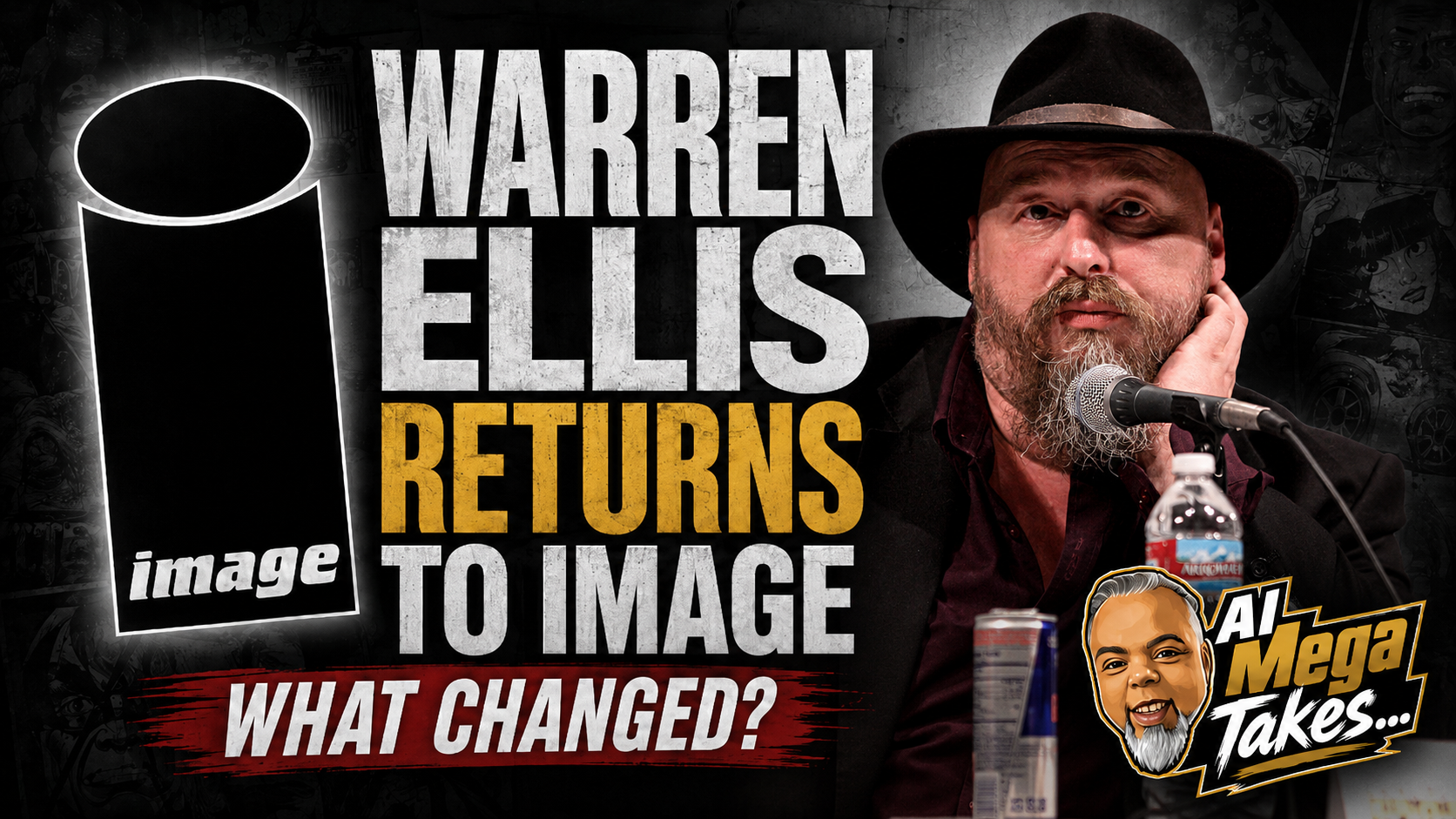
Image Comics drew a very public line around Warren Ellis in 2021. Five years later, he is publishing new work with the company again. People can change, second chances can be earned, and careers do not necessarily have to end forever. But when a publisher publicly establishes a standard for somebody’s return, then crosses that line without explaining how or why, asking “What changed?” is not outrage. It is journalism.
Comics loves a comeback story. Fam, we kill superheroes on Wednesday and start taking bets on the resurrection before folks even finish bagging and boarding the issue, so disappearing for a while and eventually walking back through the door is practically baked into the DNA of this business. Real life does not work that cleanly, though, and when Image Comics announced that Warren Ellis would write the new graphic novella Ghost Drive Station with artist and designer Lordess Foudre, it reopened a story the comics industry never really finished.
Before the internet gets its boxing gloves on, let me make something clear. This is not me arguing that Warren Ellis should never work again, and it is not me pretending five years passing automatically wipes the board clean either. People can change. People can screw up, sometimes badly, recognize what they did, get help, apologize, learn, and try to become better than the person they were when the damage happened. If accountability offers absolutely no road back no matter what somebody does afterward, then we are not really talking about accountability anymore. We are talking about permanent exile with a prettier name.
My issue is somewhere else entirely, and this is where Image Comics enters the spotlight. In 2021, Image publicly established a condition for working with Ellis again. Now the company is working with him again, including publishing newly created material, but it has not publicly explained whether that earlier condition was met, changed, abandoned, or simply allowed to disappear once enough time passed. When Popverse asked Image what had changed, the publisher reportedly declined to comment. Silence does not prove somebody did something wrong, but after making such a strong public declaration five years ago, you cannot act shocked when people remember what you said.
We also need to be exact about what Warren Ellis was accused of because this is journalism, not one of those internet telephone games where every retelling somehow gets five degrees worse. Beginning in 2020, numerous women and nonbinary people publicly described experiences with Ellis that they characterized as manipulation, grooming, deception, coercion, gaslighting, and abuse of professional or social power in relationships that were sexual or eventually became sexual. These were not primarily allegations of criminal sexual assault, and calling them that would inflate the reporting beyond what the people involved actually alleged.
The collective So Many of Us eventually brought together accounts from people who said Ellis had targeted them over roughly two decades. Their concern was not simply that a famous comic-book writer had multiple relationships with multiple people. The allegations centered on patterns in which friendship, professional encouragement, mentorship, emotional intimacy, and sexual relationships allegedly overlapped while some participants remained unaware that Ellis was maintaining numerous similar relationships at the same time. When one person has fame, professional connections, the ability to boost a career, and tremendous stature inside the industry, questions about power become a hell of a lot more complicated than simply asking whether two adults said yes.
Reporting from The Guardian added another layer to the story. The newspaper reported that dozens of women had prepared accounts and that reporters reviewed emails and text messages connected to some of those claims. Several women described a similar progression in which communication that began as friendship or professional encouragement became increasingly personal or sexual. That consistency was part of what transformed the controversy from individual accusations bouncing around social media into a legitimate industry story that publishers could no longer ignore.
Ellis responded publicly in June 2020 and denied consciously coercing, manipulating, or abusing anyone. He also denied assaulting anyone. At the same time, he acknowledged that he had failed to understand how his fame and professional position affected relationships around him, apologized for hurting people, and accepted responsibility for not recognizing the power imbalance his status created. That nuance belongs in this story because Ellis did not confess to everything alleged against him, but he also did not simply wave his hand and say everybody accusing him was lying.
That leaves us with an uncomfortable reality that requires grown-folk thinking instead of internet tribalism. Serious allegations were made by numerous people, some supported by communications reviewed by journalists, while Ellis challenged portions of how his conduct had been characterized and acknowledged other failures in his behavior. Both facts can exist in the same damn paragraph. We do not need to manufacture certainty that does not exist, nor do we need to minimize what was alleged because acknowledging complexity somehow feels less satisfying than choosing a team.
The Image Comics portion of this story really kicked into gear in 2021 when artist Ben Templesmith announced plans to revive Fell, the cult series he had created with Ellis years earlier. Image initially appeared prepared to publish the project, but the announcement triggered immediate criticism from readers and creators asking how Ellis could return to a major publisher while the accountability process surrounding him remained unresolved. Image eventually reversed course and placed the return on hold.
Now this is where you pull the receipts out and put ’em right on the damn table. Contemporary reporting from outlets including Comics Beat documented Image saying it would not work with Ellis further until he had “made amends to the satisfaction of all involved.” Image also directed readers toward So Many of Us. Those were not words forced into the company’s mouth by critics or journalists. Image chose the language, Image established the condition, and Image put that condition into the public record.
Yo, read those words again and think about what they actually demand. “The satisfaction of all involved” sounds powerful when you need a decisive statement during a controversy, but who exactly qualifies as all involved? Every single person who came forward? The collective representing many of them? Individual creators? Image management? A mediator? Ellis himself? What happens when ten people believe meaningful amends have been made and somebody else does not? Image created a standard that sounded crystal clear in a press statement but becomes almost impossible to administer once you introduce actual human beings into the equation.
Ellis did not simply disappear after that. He later issued another public statement acknowledging that trying to revive Fell before addressing the controversy had been poor judgment. He said he had entered therapy, increased charitable donations to organizations supporting women, asked his supporters not to attack or harass the people criticizing him, and approached So Many of Us about entering a mediated accountability process. Whether somebody believes those steps were enough is another question, but leaving them out would create a misleading picture of what happened after 2020.
According to So Many of Us, mediated conversations formally began in August 2021 with the assistance of a facilitator. The collective approached the process cautiously and repeatedly stressed that genuine accountability was not something that could be packaged into a quick apology, a checklist, and a triumphant return announcement. It would require communication, reflection, concrete action, and time. Up to this point, you can see something resembling the type of process people often claim they want when these scandals happen.
Then So Many of Us said something that completely changes how Image’s 2021 promise should be viewed. The collective made clear that it did not want to become the authority determining when Warren Ellis was sufficiently rehabilitated to work again. It said it would not “sign off” on his moral progress and rejected the notion that its members should decide which publishers or creators could work with him in the future. They wanted accountability without becoming somebody’s permanent career parole board.
And fam, this matters because one of the easiest arguments available today falls apart right there. We cannot honestly say, “So Many of Us never approved Warren Ellis returning, therefore Image broke its promise,” because the collective specifically rejected the idea that its approval should govern his career. Nobody who says they were harmed should also inherit a lifelong unpaid job deciding when the person they accused deserves employment again. That puts another emotional burden on people who never asked for it and keeps their lives permanently connected to the person they were trying to hold accountable.
The mediation itself eventually fell apart. In January 2023, So Many of Us announced that the process had ended and said months of communication had failed to establish the conditions necessary for accountability work to continue. According to the collective, the facilitator ultimately concluded that the process could not proceed under the circumstances, and So Many of Us said that, to the best of its knowledge, Ellis had not taken the steps it had requested in order for the process to move forward.
Now look at where this leaves Image. Their own 2021 statement tied any future relationship with Ellis to making amends, yet the most visible accountability process on the table ended without the resolution So Many of Us said it was looking for. Yet even after that breakdown, the collective did not call for Ellis to be permanently banned from publishing. Instead, it expressed hope that he would continue pursuing personal change independently and argued that publishers and other industry institutions needed to create their own systems for dealing with accountability. There is the basketball bouncing straight back into Image Comics’ court.
Jump ahead to August 2026 and Image announces a new edition of Ocean, the science-fiction story Ellis created with artist Chris Sprouse and originally published through WildStorm. A reprint by itself would have created an interesting but somewhat different debate. Existing material involves other collaborators, contractual rights, royalties, creator ownership, and the separate question of whether previously published work should remain available regardless of later controversy surrounding one of its creators.
Then came Ghost Drive Station. This was not Image simply putting an older Warren Ellis book back onto shelves. The graphic novella is new material written by Ellis with art by Lordess Foudre and announced for publication by Image Comics. Whatever ambiguity might have existed around the Ocean announcement disappeared immediately. Image had resumed publishing newly created Warren Ellis work.
Popverse subsequently asked the logical question: What changed? According to its reporting, Image declined to comment. Again, declining comment is not proof that some sinister conversation occurred in a dark office somewhere. Publishers decline comment all the time for perfectly ordinary reasons. The problem here is that Image previously made its position part of a very public accountability conversation, so changing course without explaining the reasoning naturally creates questions.
There could be good answers. Ellis may have done meaningful work privately that Image knows about and the public does not. Conversations might have taken place that cannot ethically be disclosed because they involve therapy, private relationships, or confidential mediation. Image might have reconsidered its 2021 language and concluded that “the satisfaction of all involved” was an impossible and unfair standard, especially after So Many of Us explicitly said it did not want responsibility for determining whether Ellis could work again. Hell, Image might simply believe five years, therapy, professional consequences, personal reflection, and Ellis’ other actions constitute enough evidence to justify another opportunity.
Any one of those explanations could be perfectly defensible. I might agree with some of them myself. The problem is that we currently do not know which explanation, if any, guided Image’s decision because the company has not publicly explained the shift.
And yes, there is a strong argument for giving Warren Ellis another professional opportunity. We cannot spend years telling people to acknowledge harmful behavior, go to therapy, reflect on themselves, accept consequences, change, and become better human beings, then turn around and tell them nothing they ever do matters because forgiveness is permanently unavailable. That is not rehabilitation. That is a life sentence administered by public opinion.
Five years is not five minutes. Time alone does not prove somebody changed, but time combined with action absolutely can matter. Ellis apologized for causing harm, acknowledged that his status affected relationships, said he entered therapy, contributed to charitable causes, asked supporters not to harass his critics, participated for a period in a mediated process, and spent years largely removed from his previous position in mainstream comics. Anyone arguing this story fairly has to acknowledge those facts rather than pretending he vanished into a bunker and waited for Twitter to get bored.
So Many of Us itself has left room for Ellis to continue working. The collective has repeatedly said it does not exist to cancel him and does not believe it should decide who is permitted to collaborate with him. Warren Ellis has the right to write. Lordess Foudre has the right to work with him. Image Comics has the right to publish him. Readers have the right to buy Ghost Drive Station, refuse to buy it, review it, criticize it, celebrate it, debate it, or walk past it at the comic shop and spend their five bucks on something else.
Image having the right to make that decision does not mean journalists suddenly lose the right to ask how the decision was made. Those are two completely different things. A publisher can be completely justified in giving someone a second chance while still owing reasonable questions about how its current position aligns with a standard it loudly established during the original controversy.
Looking back, I think Image’s biggest mistake may have happened in 2021 before this comeback was even imaginable. “Made amends to the satisfaction of all involved” was probably an impossible promise from the beginning. It sounds fantastic in a statement when the public wants certainty, but human beings do not operate on unanimous consent. Different people experience harm differently, heal differently, forgive differently, and some may never forgive at all. Those choices belong to them.
No company should place somebody’s future employment entirely in the hands of people who say they were harmed by that person. That forces those individuals into a relationship they may be desperately trying to leave behind. So Many of Us seemed to understand this when it refused the responsibility of determining whether Ellis could ever work again, and if Image eventually reached the same conclusion, say it. There is no shame in admitting your original policy did not survive contact with reality.
Companies should be allowed to grow too. If Image now believes its original statement was poorly worded, explain that. If the company created a new accountability standard, tell readers what the general standard is. Nobody is asking Image to publish Ellis’ therapy records, reveal private conversations, betray somebody’s confidence, or expose personal information belonging to the people who came forward. There is a giant difference between revealing confidential details and explaining the philosophy behind a major corporate decision.
This entire situation also reaches way beyond Warren Ellis because comics publishers spent much of the last decade learning how to speak fluent accountability whenever controversy exploded. Statements went out. Relationships were severed. Companies declared that behavior mattered and that certain lines could not be crossed. Fine. I actually think companies should have standards, but those standards have to mean something after the social-media fire burns out too.
You cannot treat accountability like the emergency lights at a club. Flip them on when everybody is screaming, make a big announcement so people know management is handling the situation, then quietly turn everything back off once the room settles down. If a company establishes a moral or professional standard in public, there should be enough institutional memory to explain when that standard evolves later.
Maybe Warren Ellis genuinely earned another chance. I am completely open to that possibility, and anybody pretending the concept itself is outrageous is avoiding the harder conversation. Human beings are capable of ugly behavior, complicated behavior, remorse, growth, relapse, change, selfishness, generosity, and contradictions that do not fit inside neat little hashtags. If Ellis spent the past five years doing meaningful personal work, I hope that work mattered. I hope anybody trying to become better succeeds.
The people who came forward do not owe him forgiveness, though. Their experiences do not become less real because a new graphic novel is hitting shelves, and they should never be pressured to participate in somebody else’s redemption narrative simply because readers want the story tied up with a bow. Ellis can move forward with his life while someone else continues believing he never adequately addressed what happened between them. Both realities can exist without one invalidating the other.
I also do not believe Comic Crusaders should sit here handing out certificates of redemption like we are the Vatican of comic books. Whether Warren Ellis has done enough to deserve your support is something every reader gets to decide for themselves based on the available information. Some people will buy his work again. Some never will. Some will separate the art from the artist. Some believe doing that is impossible. Welcome to human beings, mi gente. We rarely fit neatly into the boxes the internet builds for us.
Image Comics sits in a different position because Image made a public promise. The company told readers in 2021 where its line stood, and now that line has clearly moved. Moving it may be entirely reasonable. Maybe it should have moved. Maybe the original line never made sense in the first place. But when you draw that line publicly, changing its location becomes a legitimate subject for public discussion.
The receipts we have right now tell a complicated story instead of a convenient one. Serious allegations were made against Warren Ellis. Ellis denied intentionally coercive or abusive behavior while acknowledging that he hurt people and failed to understand the power his position carried. Image Comics halted its relationship with him and said further work depended upon amends. Ellis entered therapy and a mediated accountability process. That process ultimately ended without the resolution So Many of Us sought, while the collective simultaneously rejected the idea that it should control Ellis’ career. Five years after Image drew its line, Ellis is again publishing new work through the company.
Now, none of this proves Image is being hypocritical, and it sure as hell does not prove Ellis has somehow completed some clean redemption arc either. It proves there is a legitimate unanswered question sitting in the middle of one of the comics industry’s most difficult accountability stories, and ignoring that question because the answer might be uncomfortable serves nobody.
If Image Comics believes Warren Ellis earned another opportunity, tell us why the company reached that conclusion. If the original 2021 standard turned out to be unrealistic, acknowledge it. If Image developed a smarter system after learning from the failures of that moment, good, let the rest of the comics industry learn something from it too. A meaningful explanation could actually transform this story from another angry culture-war argument into something useful about redemption, institutional responsibility, and what happens after accountability begins.
Because that is the part nobody seems to have figured out yet. We know how to expose allegations. We know how to issue statements. We know how to cancel projects, distance companies from creators, write apologies, and fight about everything online until half the room blocks the other half. What comics still has not figured out is what comes afterward. What does somebody actually have to do to return? How much time matters? Who evaluates change? What role should the people who were harmed play, and how do we avoid forcing them to carry that burden forever?
Those questions are bigger than Warren Ellis, bigger than Image Comics, and frankly bigger than comics. They are questions every industry invoking the language of accountability eventually has to answer, because unless the only available consequences are “nothing happens” or “you disappear forever,” there has to be some road between them.
Maybe Warren Ellis has traveled enough of that road for Image Comics. Maybe he has not. From outside the company, we cannot responsibly pretend to know. What we can say is that Image Comics told the public there was a line in 2021, and five years later Warren Ellis is once again standing beside the company with new work headed toward comic shops.
So, Image, nobody is asking for gossip. Nobody is asking you to expose private trauma or confidential conversations. We are asking you to explain your own decision.
What changed?
SOURCES & FURTHER READING
The following sources were reviewed in preparing this editorial. Readers are encouraged to examine the original reporting, statements, and primary-source material directly.
- So Many of Us: Recognizing Abuses of Power
https://somanyofus.com/ - So Many of Us: Updates on the Warren Ellis Accountability Process
https://somanyofus.com/updates - So Many of Us: Frequently Asked Questions
https://somanyofus.com/faq - The Guardian: Women Speak Out About Warren Ellis
https://www.theguardian.com/books/2020/jul/13/women-speak-out-about-warren-ellis-transmetropolitan - The Verge: Warren Ellis Abused Star Power in Fan Relationships, Say Dozens of Women
https://www.theverge.com/2020/7/13/21322558/warren-ellis-allegations-forums-emotional-abuse-open-letter - Comics Beat: Warren Ellis Releases Statement Addressing Sexual Misconduct Accusations
https://www.comicsbeat.com/warren-ellis-releases-statement-addressing-sexual-misconduct-accusations/ - Warren Ellis: June 2020 Public Statement
https://createsend.com/t/d-258E4AB2CFB38E022540EF23F30FEDED - Warren Ellis: June 2021 Statement Regarding Therapy, Accountability and Mediation
https://orbitaloperations.cmail19.com/t/ViewEmail/d/6042F037FEAD877C2540EF23F30FEDED/C91D09C2D826AFC344D0DD5392A9C75A - Comics Beat: Image Comics Releases Statement, Fell Return Put on Hold
https://www.comicsbeat.com/image-comics-releases-statement-fell-return-on-hold/ - ScreenRant: Image Comics Officially Responds to Warren Ellis Controversy
https://screenrant.com/warren-ellis-sexual-misconduct-image-comics-response/ - Comic Book Club: Warren Ellis Back With New Comic at Image Five Years After Publisher Cut Ties
https://comicbookclublive.com/2026/08/11/warren-ellis-back-new-comic-at-image-five-years-after-publisher-cut-ties-accusations-sexual-coercion/ - Popverse: What Changed? Image Comics Is Working With Warren Ellis Again
https://www.thepopverse.com/comics-warren-ellis-image-comics-return-august-2026 - Image Comics: Warren Ellis Creator Page
https://imagecomics.com/creators/warren-ellis - Image Comics: Ghost Drive Station Official Announcement
https://imagecomics.com/press-releases/noir-mystery-collides-with-cosmic-horror-in-warren-ellis-lordess-foudres-upcoming-graphic-novella-ghost-drive-station-this-november - Image Comics: Ocean Returns to Print
https://imagecomics.com/press-releases/cult-classic-sci-fi-horror-thriller-ocean-by-warren-ellis-chris-sprouse-will-be-brought-back-to-print-this-fall-by-image-comics - Warren Ellis: Official Website
https://warrenellis.ltd/ - Warren Ellis: Official Contact Information
https://warrenellis.ltd/contact/
EDITORIAL DISCLAIMER
This article is an editorial and investigative analysis based on publicly available reporting, statements, primary-source materials, and accounts from individuals and organizations directly connected to the controversy surrounding Warren Ellis.
Allegations described in this article are presented as allegations and should not be interpreted as findings of criminal or civil liability. Warren Ellis has denied knowingly coercing, manipulating, abusing, or assaulting anyone while also publicly acknowledging that his professional stature created power imbalances, apologizing for causing harm, and discussing efforts toward therapy and accountability.
Comic Crusaders has attempted to distinguish documented facts from allegations, opinion, interpretation, and unanswered questions throughout this piece. Inclusion of a source does not constitute endorsement of every statement, interpretation, or conclusion published by that source.
This editorial is not intended to determine whether Warren Ellis has been sufficiently rehabilitated, whether any individual should forgive him, or whether readers, creators, retailers, or publishers should support his work. Those judgments belong to the individuals making them. Our purpose is to examine the public record, Image Comics’ previously stated position, the subsequent accountability process, and the questions raised by the publisher’s decision to work with Ellis again.
Comic Crusaders has contacted Image Comics for comment regarding the issues raised in this article and has extended an opportunity for relevant parties to provide additional context. If a substantive response is received after publication, this article will be updated and the update will be clearly identified.
The goal of this editorial is discussion, transparency, and accountability, not harassment. Comic Crusaders does not encourage readers to contact, threaten, intimidate, or harass Warren Ellis, members of So Many of Us, Image Comics employees, collaborators, accusers, or any other individuals connected to this story.
Leave a Reply
You must be logged in to post a comment.