
Enrique Corominas Opens the Attic Door on Dorian Gray in This Haunting Interview
·Al Mega
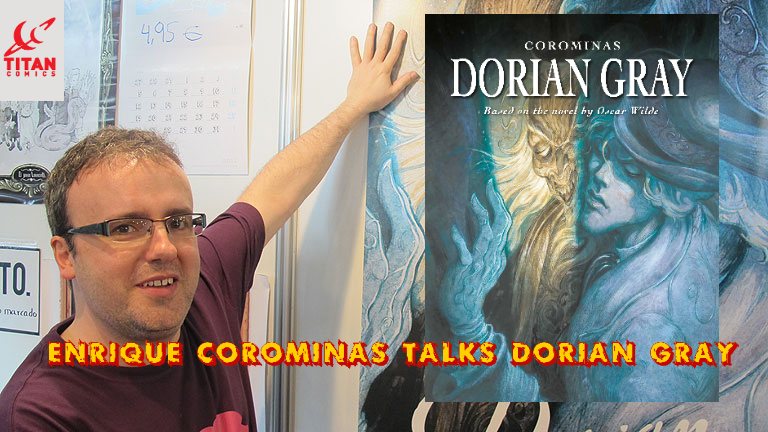
WEPA! Comic Crusaders family, this one has that gothic electricity humming under the floorboards. Enrique Corominas steps into Oscar Wilde’s immortal tale with Dorian Gray, a lush, decadent, razor-edged graphic adaptation that does not simply retell the classic it lets the portrait breathe, rot, seduce, and accuse from the page. This is beauty with teeth, elegance with a shadow, and the kind of literary darkness that walks into the room dressed better than everybody else.
Published by Titan Comics and arriving September 22, 2026, Dorian Gray invites readers back into Wilde’s world of vanity, temptation, influence, art, desire, and consequence but with Corominas’ visual language transforming the story into something operatic, sensual, and hauntingly modern. In this written interview, we dig into the creative choices, the Victorian art influences, the color psychology, the moral decay, and why Dorian’s hidden portrait still feels painfully relevant in the age of filters, followers, and perfectly curated masks.
Q1. Dorian Gray is one of those stories everybody thinks they know, but your version feels like it drips its own poison. What was the first image, emotion, or idea that made you say, “I need to adapt this my way”?
ENRIQUE COROMINAS: The Picture of Dorian Gray is my favourite novel. I have seen all its film adaptations but, although Albert Lewin’s 1941 movie is fantastic, none of them manages to convey the decadent and symbolic atmosphere of the original text. They are either horror movies for very bored teenagers or alleged homoerotic dramas for older ladies. So, I have tried to be completely faithful to Wilde’s spirit. But, in order to see what he wrote, I had to make some changes. I had to draw the influence of art on Dorian, the liberation of his ego, and his descent into hell… and leave the witty lines for the speech bubbles.
Q2. You describe the book as being shaped like a five-act opera with a monologue from Dorian himself. What did that structure give you that a more traditional chapter-by-chapter adaptation could not?
ENRIQUE COROMINAS: The last thing I wanted was for my comic was for it to read like a summary of the novel. I wanted to achieve the greatest possible synthesis and a huge emotional impact, one comic to have a narrative value of its own. So, I thought of the great operas, where the less relevant events of the story are left in ellipsis between acts. The more descriptive and theatrical chapters of Wilde’s novel are contained within those five acts… or so I hope!

Q3. Oscar Wilde’s original story is famous for wit, temptation, vanity, and moral rot hiding behind beautiful language. As both writer and artist, how did you decide what should remain in words and what needed to become purely visual?
ENRIQUE COROMINAS: I have tried to make my drawing style hedonistic and sensual, as attractive as possible. “Nothing can cure the soul but the senses, just as nothing can cure the senses but the soul.” is the mantra Dorian learns from Lord Henry. The text abounds with descriptions of precious stones, oriental fabrics, and luxury items that provide whoever owns them with a sensation as intoxicating as opium, and I hope that feeling is present in my drawings. In the dialogues, there is another kind of seduction and influence: ideas that stimulate the ego and debauchery.
Q4. The portrait is the soul of the story, literally and symbolically. In your version, how did you approach making the portrait feel present and dangerous without simply turning it into a horror prop?
ENRIQUE COROMINAS: We see the degree of corruption of the portrait at the beginning of each act, but in the panels, we only see the consequences of that degradation through the characters’ horrified stares. I felt I shouldn’t draw it in a small size or integrate it into the narrative as just another element.
It is the monolith from 2001, the elephant in the room, the cross, and, at the same time, the liberation of Dorian’s spirit. Something that doesn’t fit into a comic — all Victorian repression and its consequences condensed into a single idea.
Q5. Lord Henry’s influence over Dorian hits like a velvet-covered knockout punch. How did you visually separate his charm from the damage he causes?
ENRIQUE COROMINAS: Lord Henry explains to Dorian that “there is no such thing as a good influence. All influence is immoral,” since we should all have the right to be free and express ourselves individually, without being the echo of other people’s voices. Is Lord Henry merely encouraging Dorian to be himself and Dorian just turns out to be an abuser and a murderer? Or is Lord Henry the Mephistopheles pushing Dorian into sin? I believe both characters are victims of the repression of their era, although Henry is integrated into society and Dorian is a blank canvas. But, by not knowing how to live with their shadow, they both become Mr. Hyde.

Q6. Your Dorian is beautiful, disturbing, fragile, arrogant, and lost all at once. How difficult was it to draw a character whose greatest weapon is beauty, but whose real story is decay?
ENRIQUE COROMINAS: Everything was so difficult in this comic! At first, Dorian is pure as the driven snow, but he also feels the need to fit in and become someone. Lord Henry encourages him to use his beauty to manipulate people before they manipulate him, while Basil adores him just as he is: beautiful and pure. I have tried to draw a Dorian who feels an emptiness inside, fragile, who refuses to grow old and let his beauty disappear because he believes he has no other remarkable quality.
Q7. The book pulls from Victorian art, Symbolism, Pre-Raphaelite energy, and literary decadence. You even note inspirations such as Lord Leighton, Whistler, Sickert, Beardsley, and others. How deep did that research rabbit hole go?
ENRIQUE COROMINAS: I don’t know of any other book that opens as many doors to philosophical and artistic currents of thought as this one. It is incredible that back in 1890, Oscar Wilde discovered and reflected upon so many themes that would come to define the 20th century. He was trained in Aestheticism — ‘Art for art’s sake’ — but in The Picture of Dorian Gray, Hedonism, Symbolism, and, above all, French Decadentism win the day.
Wilde’s vast culture and sense of humor allow him to combine Oxford academicism and reverence for Walter Pater with an interest in the androgyny of a character as extravagant as Joséphin Péladan, or to adopt Dandyism by imitating Whistler. That way of gracefully appropriating everything around him to shine as a unique creator is also easy to connect with Pop culture; his influence is evident in Bowie, Morrissey, or Pet Shop Boys.
The subversion of gender norms, and the use of irony and aphorisms as tools for social critique are found in many contemporary queer and fantasy novels… and Oscar already did it in the heart of the Victorian era!
Q8. You mention using colour to track Dorian’s moral transformation, from more naturalistic early tones to emotional and expressionist colours later. Can you break down how colour became part of the storytelling, not just the mood?
ENRIQUE COROMINAS: Yes, I managed to make the use of color emotional and psychological to emphasize the change that takes place in Dorian. At first, before Basil finishes painting the portrait, the color is more impressionistic and naturalistic. The sunlight and the flowers shine in all their splendor.
But, as the painting transforms, darkness and more artificial, expressionistic tones take over, culminating in the combination of yellow and black (as if it were a Beardsley drawing on the cover of The Yellow Book) of Dorian’s descent into hell, and the gray of the subsequent scene.
Turquoise blue and purple are historically associated with royalty, power, and loneliness, so I was interested in associating them with Lord Henry and Dorian. Poor Basil always dresses in shades of brown.

Q9. Sibyl Vane has often been treated as a tragic symbol in adaptations, but here she carries a haunting theatrical energy. What did you want modern readers to feel from her role in Dorian’s fall?
ENRIQUE COROMINAS: Wilde was no stranger to the misogyny and classism of his era. Sibyl Vane symbolizes the virginal, romantic heroine, the helpless girl in the face of Dorian’s manipulation.
In my version, I have tried to transform her into an artist who puts on a performance more akin to a French cabaret than a small Victorian theatre — someone who wants to have her own voice.
We still see her through Dorian’s eyes, of course, but I think Dorian would be more disgusted by her having her own personality than no personality behind the masks of the characters she plays in the theater.
Q10. You chose to focus on the 1890 version of Wilde’s story and step away from some of the later added material. What did that earlier structure reveal to you about the core of Dorian Gray?
ENRIQUE COROMINAS: The original version published in Lippincott’s Monthly Magazine is shorter and more direct; the later additions focus on the supporting characters and introduce a certain self-censorship that I tried to avoid.
Q11. The book is elegant, but it is also nasty in the best gothic way: beauty, corruption, desire, ego, consequence, the whole haunted buffet. What was the hardest scene to adapt emotionally or visually?
ENRIQUE COROMINAS: The most complicated part was preserving the ‘fantastic drama’ tone of the original and not falling into a Gothic novel or horror story in any scene. Therefore, the most violent moments were the most difficult to draw. Fantastic drama is a genre with a very delicate balance, and my reference film is Portrait of Jennie (William Dieterle, 1948). Kafka’s The Metamorphosis or Balzac’s La Peau de chagrin (a novel Oscar knew very well) are other literary references.

Q12. At its heart, Dorian Gray asks what happens when beauty gets worshipped, but accountability gets buried. In today’s world of filters, fame, vanity, and curated identities, why does this story still hit like a brick through a stained-glass window?
ENRIQUE COROMINAS: You are absolutely right! We live in an era where we all sell an idealized image of ourselves, and technology is at the service of our narcissism.
Nowadays, Dorian would be just another instagrammer, just another influencer. His narcissism would be applauded by society rather than censored, so… would he be someone happier and freer? I’m afraid not.
Victorian society repressed and punished individuals who dared to be free (as in the case of Oscar Wilde himself), but today, we ourselves repress and hide our true selves to sell a false image to others, just like psychopaths or egomaniacs do. Dorian’s portrait remains hidden in our attic, along with all our fears and insecurities.
By the end of this conversation, one thing is clear: Corominas is not treating Dorian Gray like dusty required reading. He is treating it like a living curse wrapped in velvet — a story about art, ego, repression, freedom, and the dangerous lies we tell ourselves when beauty becomes a weapon.
For Comic Crusaders readers who love graphic novels that challenge the eye and the mind, this is one to keep on the radar. Dorian Gray looks ready to bring gothic literature, visual decadence, and emotional rot together in one unforgettable package. The portrait may be hidden away, but this book deserves to be seen. Big time.
On Sale:
September 22, 2026
Pre-order it from:
Amazon | Barnes & Noble, and Forbidden Planet for the UK & Europe
Leave a Reply
You must be logged in to post a comment.