
Dark Horse, Dark Times? The Comic Industry’s Creator-Owned Giant Faces a Worker Reckoning
·Al Mega
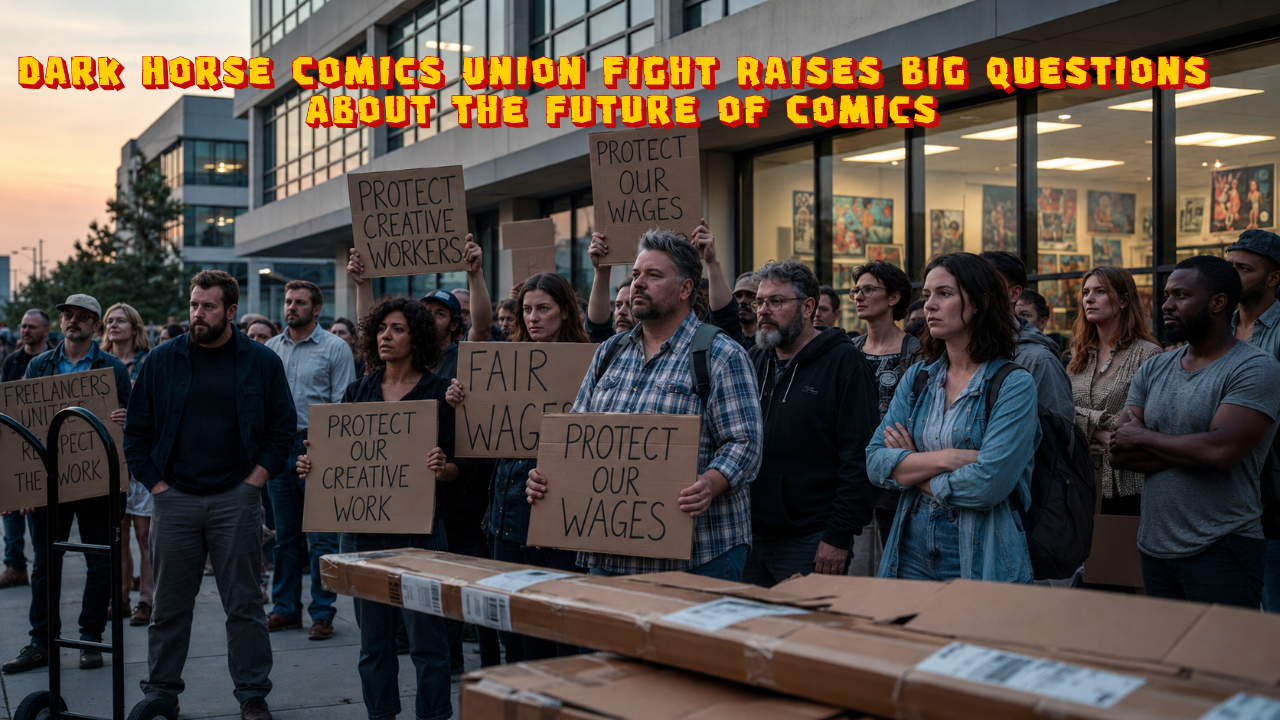
Wepaaaa… let’s talk about the horse in the room. Dark Horse Comics, one of the most important creator-owned publishers in modern comic book history, is now standing at the center of a labor fight that feels bigger than one company, one union, or one round of layoffs. This is about the future of the comics business. This is about the people who make the machine run. This is about whether “creator-owned” still means something when the industry around it keeps getting reshaped by corporate restructuring, media consolidation, AI anxiety, retail closures, and the same old sentence workers hear right before their lives get flipped upside down: “We’re modernizing.”
Now listen, nobody with sense should pretend running a comic book publisher in 2026 is easy. It is not. Paper costs are ugly. Distribution has been unstable. Retailers are exhausted. Readers are selective. Streaming money is not the magic fountain people thought it was. Corporate owners want efficiency. Investors want growth. Fans want quality. Creators want fair deals. Workers want to pay rent without needing a side hustle, a roommate, and a miracle from Doctor Strange. That is the whole tension right there. Everybody wants comics to survive. The fight is over who pays the price.
Dark Horse Workers United announced its union push at the end of May, organized with the Communications Workers of America. The workers cited concerns that should sound familiar to anyone paying attention to the wider creative economy: layoffs, wage and hiring freezes, leadership changes, return-to-office pressures, the rise of artificial intelligence, and uncertainty about the company’s long-standing commitment to creator-owned comics. That last part matters. This was not just a “give us more money” campaign. It was also a philosophical alarm bell. And that is where this gets deep, real deep!
Dark Horse was not built as just another corporate content farm. Its identity was tied to the idea that creators deserved more control, more ownership, and more respect. Hellboy. Sin City. The Umbrella Academy. Concrete. Dark Horse became a home for work that did not always fit inside the superhero factory. It gave readers something different. It gave creators another lane. It gave the industry proof that there was life outside the Big Two if you had the guts, the taste, and the hustle.
So when workers at that same company start asking whether the company will remain committed to creator owned comics, that is not background noise. That is the smoke alarm going off while everybody is still trying to enjoy the party.
To Dark Horse’s credit, the company voluntarily recognized the union. That is not nothing. In an industry where labor organizing can get treated like someone brought a skunk to Thanksgiving dinner, voluntary recognition matters. It can be read as a mature move, a practical move, or maybe a little of both. Management said, in effect, that it was willing to move forward and bargain. That is the right door to open. But then came the harder part.
Reports followed that Dark Horse planned layoffs in IT and operations shortly after recognition. The company’s position, according to reporting, is that these moves are part of a long-planned strategic transformation meant to modernize operations, improve stability, and position the company for the future. That may be true. Businesses do plan restructuring before unions arrive. A union does not magically turn every business decision into retaliation.
But timing matters. Optics matter. Trust matters. And when workers organize because they already feel unstable, then layoffs arrive days later, nobody should act shocked when the room gets tense. That is not “drama.” That is cause and effect.
The company also announced it would close all three Things From Another World retail stores, with Oregon locations closing June 30 and the California Universal City Walk location closing September 30. For newer fans, maybe that sounds like a normal retail decision. Stores close all the time. Welcome to 2026, where “brick-and-mortar” often gets treated like it has cooties.
But Things From Another World was not just some random storefront selling Funko Pops and nostalgia. It was part of Dark Horse’s origin story. It was part of the culture. These shops were physical spaces where readers discovered books, staff built relationships, and comics felt like something you could walk into. Losing that matters. Not because every store can or should stay open forever, but because every closure chips away at the public square of comic fandom. And let’s be real: the industry keeps asking local comic shops to be missionaries for the medium while the economics keep treating them like disposable furniture.
This is where the larger industry should be paying attention. Dark Horse is not an isolated case. Comics has been living through a pressure cooker. Distribution changed. Retail changed. Crowdfunding changed. Variant culture changed. Media licensing changed. AI entered the chat like it kicked the door off the hinges. Parent companies look at comic publishers and see IP libraries, not always communities. That is the dangerous part. Comics are art, yes. Comics are business, yes. But comics are also labor. Actual people. Editors, designers, sales teams, warehouse workers, production staff, marketers, retailers, freelancers, creators, letterers, colorists, assistants, publicists, and everybody else whose name does not always make the cover.
The romance of comics has always depended on invisible labor. The deadline gets met. The book ships. The booth is staffed. The files are fixed. The retailer gets answers. The creator gets handled. The fan gets the product. And behind all that? People doing the work while being told passion is part of the compensation package. Nah. Passion is beautiful. Passion is not a dental plan.
That is the conversation comics hates having. We love the myth of the scrappy creator, the midnight deadline, the basement studio, the fan who becomes the pro, the small publisher fighting giants. That mythology built the culture. But mythology can also become a trap. It can convince people to accept less because the job is “cool.” It can turn love into leverage. It can make workers feel guilty for asking basic questions: Can I afford to live near this job? Will I be replaced by software? Will my department exist next year? Does the company’s mission still match its decisions? Those questions are not anti-comics. They are pro-comics.
Now, let’s not get corny and pretend management is always the villain wearing a cape made out of spreadsheets. Companies face real pressure. If operations are inefficient, leadership has to address it. If retail is losing money, pretending otherwise does not save anyone. If a company has to move offices, shift fulfillment, or rethink business lines, that can be legitimate. A business that refuses to adapt becomes a museum exhibit with unpaid invoices. But here is the line: modernization should not become a magic word that explains away human damage.
Modernization should mean better systems, clearer strategy, stronger publishing, healthier creator relationships, and workers who can see a future inside the company. If modernization only means fewer jobs, more outsourcing, more IP extraction, more distance between leadership and labor, then call it what it is. That is not modernization. That is shrink-wrapping the soul and selling it as efficiency.
The union cannot stop every layoff. That is not how reality works. But a union can force a conversation. It can demand transparency. It can make management explain the math. It can negotiate severance, timelines, conditions, job classifications, outsourcing concerns, and workplace policies. It can stop workers from being treated like loose change found under the corporate couch cushion. That is why this moment matters.
For fans, the instinct may be to say, “I just want good comics.” Fair. We all do. But good comics do not fall from the sky like radioactive spiders. They are made inside ecosystems. If those ecosystems are stressed, unstable, underpaid, and afraid, the books eventually feel it. Maybe not today. Maybe not next Wednesday. But eventually, culture absorbs the conditions that produce it.
Dark Horse now has a chance to prove something important. It can show that voluntary recognition was not just good PR. It can bargain in good faith. It can be transparent about restructuring. It can protect the creator-owned identity that made the company matter. It can treat departing workers with dignity. It can show the industry that a legacy publisher does not have to choose between survival and humanity.
The workers also have a chance to prove something. They can show that labor organizing is not about burning the house down. It is about making sure the house still has people living in it when the renovation is done. That is the thoughtful middle. Not weak. Not soft. Just honest.
Because this is bigger than Dark Horse. This is the comic industry looking in the mirror and realizing the reflection is tired. The old model cannot keep running on passion, prestige, and panic. The new model cannot be only IP farms, layoffs, AI shortcuts, and corporate language polished so shiny you can’t see the people behind it. Comics deserves better than that.
Readers deserve better. Creators deserve better. Workers deserve better. Retailers deserve better. Even publishers deserve better than being trapped in a system where every hard decision looks like betrayal because nobody trusts the process.
So here is the question we should all be asking: when a company built on creator freedom enters a new corporate era, who gets protected first the mission, the margins, or the people?
Because if the answer is not “all three,” then the future of comics may be profitable, but it will not be healthy.
And fam, a sick industry can still sell books for a little while.
But it cannot build legends forever!
Leave a Reply
You must be logged in to post a comment.