

Marvel Is Leaving New York. Good. Somebody Else Better Claim the Block.
·Al Mega
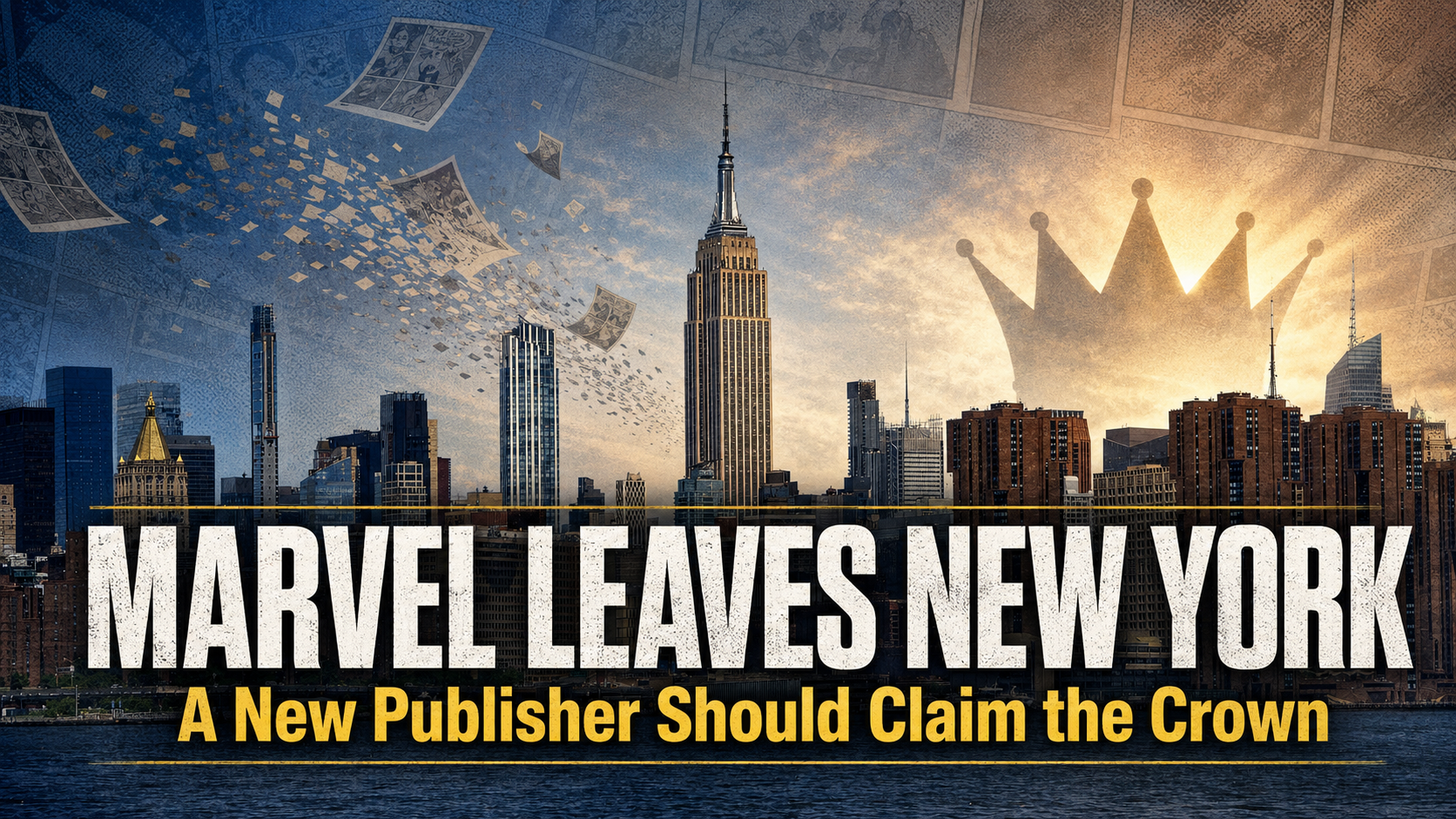
After nearly 90 years, Marvel Comics is packing up its New York operation and heading to Burbank. That hurts, no doubt. But while everybody is busy crying over the old House of Ideas, a massive opportunity is sitting right there for the publisher bold enough to rebuild New York comics culture.
Marvel Comics is leaving New York City. Read that again… Marvel Comics Is leaving New York. The company whose characters swing between Manhattan skyscrapers, fight aliens over Queens, wreck half of Midtown every other Tuesday and somehow still complain about rent is moving the people who make the comics roughly 2,500 miles away from the city printed all over its DNA. That is not a small office shuffle. That is history walking out the door carrying a Disney ID badge and a Burbank relocation packet.
More than 100 New York employees are reportedly being asked to relocate to California by July 2027. That means real people now have to decide whether to move their families, leave their homes, abandon their routines and cross the country to keep working for a company that spent decades selling New York as part of its soul. This is not only about nostalgia, though. Nostalgia will have you crying over the old building while somebody smarter buys the whole block. The real story is the opening Marvel is leaving behind.
For the first time in generations, New York City has no dominant comic-book publisher carrying its flag. DC left years ago. Marvel is next. The so-called mecca of American comics is being reduced to a setting, a convention destination and a memory. That should not be allowed to happen quietly. This is the moment for a new publisher to step up, plant its flag and say, “New York comics are not dead. We are just getting started.”
Marvel didn’t wake up one morning, look at the Empire State Building and say, “You know what? We hate pizza now.” This is corporate consolidation. Marvel’s New York lease is reportedly expiring. Disney already has a giant entertainment operation in Burbank. Marvel Studios, television, animation and the people making franchise decisions are already sitting over there. From the corporate point of view, moving comics closer to the movie and television machines probably looks efficient.
One campus. One leadership structure. Fewer expensive New York offices. More meetings about which comic-book character can become a streaming series, video game, collectible cup, theme-park attraction and limited-edition toaster. I understand the math. I do not have to like what the math means. Marvel says the move will create better collaboration between comics, film, television, animation and the rest of the franchise operation. That sounds reasonable until you remember that comics are supposed to be more than a laboratory for future intellectual property. A comic should be a comic first. It should not feel like a 22-page audition tape for a Disney+ show.
Marvel recently reorganized its publishing leadership under executives whose responsibilities stretch into television, animation, digital growth and franchise development. That tells us exactly where the company is going. Comics remain important, but they are increasingly being positioned as one engine inside a much larger entertainment factory. That may be good business for Disney. It does not automatically mean it is good for comics.
The danger is obvious. When comic publishing sits too close to the people making billion-dollar movies, stories can start serving the brand instead of the reader. Characters get adjusted to match screen versions. New heroes feel designed for casting announcements. Events become launchpads. Number-one issues multiply like roaches when somebody turns on the kitchen light. Fam, readers are not stupid. They know when a story has heart, and they know when somebody is handing them a movie treatment with speech balloons.
Marvel leaving is symbolic, but symbols matter. Marvel was born here. Its rhythm came from here. The city’s noise, neighborhoods, attitude, tension and ridiculous energy shaped the way those stories felt. Spider-Man worked because Peter Parker was not living in some perfect fantasy kingdom. He was trying to save the city while worrying about money, school, family and whether his boss would fire him before lunch. The Fantastic Four lived in Manhattan like celebrity scientists who could save reality and still argue at the dinner table. Daredevil belonged to Hell’s Kitchen. Luke Cage belonged to Harlem. The X-Men carried the pain of outsiders trying to survive inside a society that feared them.
New York gave Marvel pressure. Pressure creates diamonds, villains and unpaid parking tickets. Once Marvel and DC are both operating from Burbank, something changes. The two largest superhero publishers will still tell New York stories, but they will be telling them from California offices under giant entertainment corporations. Can writers and editors create authentic New York stories remotely? Of course. Talent is talent. But geography still shapes culture. Being surrounded by a city affects what you hear, who you meet, what you notice and which stories feel urgent. There is a difference between studying New York and having the city slap you in the face before your first cup of coffee.
Marvel can leave the city and continue publishing comics set here. What it cannot take with it is ownership of New York’s comics identity. That belongs to the people willing to build here next. Let me kill one bad idea before it grows legs. A new publisher should not try to become “the next Marvel” by launching 45 superhero books, printing 900 variant covers and acting like every new character is already worth a billion dollars. Stop it. That is not a publishing strategy. That is expensive cosplay.
Nobody is replacing Spider-Man, Batman, the Avengers or the X-Men overnight. Those brands have decades of history, billions of dollars behind them and armies of fans who will argue about costume colors until the sun burns out. The opportunity is not to copy Marvel. The opportunity is to become the company Marvel can no longer be. A hungry publisher based in New York could build a line that feels local, creator-driven and connected to the people actually reading the books. It could move faster than the corporate giants, take creative risks they cannot take and treat comics as the main course instead of the free bread before the movie deal. That is the lane.
A new flagship New York publisher could become the home for creators who want serious editorial support without surrendering everything they invent. It could attract industry veterans tired of corporate musical chairs, younger creators locked outside the gate and independent talent with audiences but no sustainable infrastructure. The company would not need to own half of pop culture. It would need to earn trust. That is harder than printing a shiny logo, but it is worth a lot more.
The first rule should be simple. Make great comics. Not fake movie pitches. Not 24-page character catalogues. Not stories built around press releases and adaptation potential. Comics! Strong writing. Strong art. Editors who actually edit. Lettering people can read. Colors that serve the page. Deadlines that do not destroy the creative team. Books that have beginnings, middles and endings instead of dragging one mystery through three relaunches and two crossover events. Yes, film and television rights matter. Games matter. Merchandise matters. Nobody is telling investors to light their money on fire for the love of panel borders. But adaptation should be the reward for a strong story, not the reason the story exists. Readers can feel the difference.
New York has a chance to build something better than the system it is losing. That starts with contracts. A serious new publisher should offer clear royalty structures, transparent accounting, audit rights, understandable ownership terms and fair participation when a creation moves into film, television, games or merchandise. No mystery math. No contract language that needs a wizard, three attorneys and Doctor Strange to explain it. No smiling at creators during the launch and suddenly forgetting their phone numbers when the adaptation money arrives.
Creators should know what the publisher owns, what they own, how long the company controls the rights and what happens if the book stops being published. That does not mean creators get everything and the publisher takes all the risk. Business does not work that way. It means everybody understands the deal before the champagne pictures hit Instagram. A publisher known for fairness would immediately stand out in this industry. Word travels fast among creators, especially when somebody gets treated badly. Word also travels when somebody gets treated right.
New York comic storytelling cannot remain trapped in Midtown, one Brooklyn rooftop and the same alley behind a fictional nightclub. New York is five boroughs, hundreds of neighborhoods and millions of stories walking past each other every day. A real New York publisher should recruit creators from the Bronx, Queens, Brooklyn, Manhattan and Staten Island. It should publish Black voices, Latino voices, Asian voices, immigrant voices, LGBTQ+ voices, working-class voices and people whose neighborhoods usually appear in comics only when a villain needs somewhere to hide. And please, no diversity-by-checklist nonsense.
Do not bring somebody in, ask them to sprinkle culture on a generic superhero story and then pat the company on the back for being progressive. Let creators tell stories with specificity. Let the dialogue sound like the people who live here. Let neighborhoods have personality. Let characters worry about rent, family, pride, immigration, class, identity, ambition, love and whether the train is ever coming. That is New York. The fantasy can be huge, but the people have to feel real. Marvel understood that once. Somebody else can understand it now.
A new publisher does not need a giant glass headquarters in Midtown with a receptionist sitting behind a statue of its first superhero. Relax, Tony Stark. New York real estate can eat a young company alive before issue number two ships. Build lean. Create a small editorial and production hub with room for meetings, creator workshops, signings, public events and retailer gatherings. Let writers and artists work from anywhere. Bring teams together when it matters. Use the city as a creative home, not an expensive vanity project. A headquarters should serve the books. The books should not exist to pay for the headquarters.
Comic shops matter. Let me say that clearly before somebody starts throwing long boxes at me. The direct market remains essential. Retailers are often the first people convincing readers to try something new. A smart publisher needs honest communication with stores, sensible ordering expectations and returnable programs where possible. But the company cannot live on Wednesday customers alone.
It needs bookstores, libraries, schools, subscriptions, crowdfunding, digital editions, foreign licensing, conventions and direct-to-reader sales. It needs collections that stay available after the monthly issue disappears. It needs marketing aimed beyond people who already know which Batman issue introduced some villain’s third cousin. There are potential comics readers everywhere. The industry just keeps talking to the same crowd and wondering why the room is not getting bigger.
The idea that New York no longer has the creative muscle to support a major comics publisher is nonsense. The city remains one of the largest publishing centers on the planet. Writers, artists, designers, agents, editors, publicists, journalists, filmmakers, game developers and media professionals are all here. New York Comic Con brings the entire industry into the city every year.
Comic shops continue doing the daily work. Libraries maintain huge graphic-novel collections. Schools teach storytelling, art, animation and design. Independent creators are building projects from apartments, studios, coffee shops and whatever table they can borrow without somebody asking them to order another drink. The talent is not gone. The infrastructure is scattered. That is the opportunity.
A publisher that connects those pieces could become more than another company printing monthly comics. It could become the center of a new creative ecosystem. Apprenticeships. Editorial training. Creator workshops. Partnerships with schools and libraries. Retailer summits. Public events. Affordable studio access. A real path for local creators to move from “I have an idea” to “My book is on shelves.” That is how you rebuild comics culture. Not with a slogan. With structure.
Now let us respect the argument from the other side. Some people will say location does not matter anymore. Comics are made remotely. Files move online. Meetings happen on video calls. A writer in Queens can work with an artist in Brazil and an editor in California without anybody sharing an office. True. Others will say New York is too expensive, publishing margins are tight and launching a new company in this market is financial madness. Also true. Some will point out that readers buy characters, not zip codes. Putting “Made in New York” on the cover will not save a weak book. Absolutely true.
This idea only works if the books are good, the money is disciplined and leadership understands the difference between passion and reckless spending. New York pride is not a business plan. But it can become an advantage when paired with strong editorial direction, patient investors and creators who believe in the mission. Nobody should build this company because they are angry at Marvel. Build it because Marvel’s departure exposes a gap nobody has filled.
City officials love talking about film, television, theater, music and fashion. Comics usually get remembered when somebody wants a colorful convention photo. That needs to change. Comics generate intellectual property, publishing jobs, licensing opportunities, tourism, education programs and stories that move into every form of media. New York should treat graphic publishing like the creative industry it is. The city could support a comics incubator, small-publisher grants, apprenticeships, affordable workspaces and partnerships between publishers, schools, libraries and local retailers. No, taxpayers should not hand some random dude ten million dollars because he drew a cape on a napkin. There should be standards, accountability and measurable results. But if New York can offer incentives to attract film productions and technology companies, it can help support an industry that was born in its neighborhoods and helped export the city’s image around the world.
Marvel made the decision it believes is right for Marvel. Now New York needs to make a decision that is right for New York. This city does not need to beg Marvel to stay. That decision appears to be made. The better move is to create what comes next. A publisher with vision, capital, patience and respect for creators can turn this loss into the beginning of something powerful. It will not happen overnight. It will take years of strong books, smart deals and keeping promises when nobody is watching. But the lane is open.
Marvel and DC are in Burbank. New York is wide open. The crown is sitting on the sidewalk, mi gente. Somebody better pick it up before the city that built American comics becomes nothing more than a background drawn by people who left. Marvel may be leaving New York. New York comics do not have to leave with it!
WEPA.
Receipts/Sources:
- The Hollywood Reporter: Marvel Comics to Leave New York and Move Staffers to L.A.
- Marvelous News: Marvel Comics Moving Publishing Operations From New York
- Kotaku: Marvel’s Move to L.A. Means the End of the New York City Comics Industry
- New York Post: Mass Shakeup for Marvel After Nearly 100 Years in NYC
- Instagram: Marvel Comics Announces Its New York-to-Burbank Move
- Facebook: Marvel Publishing Division Moving to Burbank
Main Image: Personal Photo from Al Mega collection.
*Ai Disclosure: The main image includes AI-assisted artwork reviewed by Comic Crusaders before publication.
Leave a Reply
You must be logged in to post a comment.